Quick answer: refractors are the easiest telescope type to start with, reflectors and Dobsonians give the most aperture per dollar, and catadioptrics are the most compact all-rounders. The right choice depends on what you want to observe, how much setup you will tolerate, and whether portability matters.
Which telescope type should you buy?
For visual astronomy, aperture beats advertised magnification.
When comparing scopes at the same price, the design that gathers more light usually shows more night-sky detail.
Match the telescope type to what you actually want to see. This is the short version before the full comparison table.
Best for the Moon, planets, kids, and grab-and-go viewing with almost no maintenance.
Best if you want brighter galaxies, nebulae, and clusters without paying for electronics.
Best when you want planets, GoTo tracking, and portability in one versatile setup.
Best if you want phone-controlled deep-sky images more than traditional eyepiece observing.
Rule of thumb: aperture beats advertised magnification. Bigger lenses or mirrors show more, as long as the scope still fits your budget and storage space.
The Main Types of Telescopes (Quick Answer)
There are three main types of telescopes used in amateur astronomy: refractor telescopes (which use glass lenses to bend and focus light), reflector telescopes (which use curved mirrors to gather and focus light), and catadioptric telescopes (also called compound telescopes, which combine lenses and mirrors). Every consumer telescope on the market — from a $100 beginner scope to a $5,000 astrophotography rig — falls into one of these three optical categories.
Beyond these core three, amateur astronomers also use Dobsonian telescopes (a reflector on a simplified alt-azimuth mount, treated as a distinct category because of their unique design philosophy), smart telescopes (all-in-one digital systems with built-in cameras), and solar telescopes (filtered instruments designed exclusively for safe Sun observation). Professional observatories extend the list further with radio, infrared, X-ray, and gamma-ray telescopes that detect wavelengths of light invisible to the human eye.
For most beginners, the choice comes down to three questions: what do you want to observe, how much do you want to spend, and how much setup and maintenance are you willing to handle? The comparison table below lays out the trade-offs at a glance, and the sections that follow go deep on each type.
Telescope Types Comparison Table
| Type | How It Works | Best For | Budget Range | Maintenance | Portability |
|---|---|---|---|---|---|
| Refractor | Light passes through glass lenses | Moon, planets, double stars | $100–$3,000+ | Very low (sealed tube) | High |
| Reflector (Newtonian) | Light bounces off a curved mirror | Deep-sky on a budget | $150–$1,500 | Moderate (collimation) | Moderate |
| Dobsonian | Newtonian reflector on a rocker-box mount | Visual deep-sky, star parties | $250–$2,500 | Moderate (collimation) | Low to moderate |
| Catadioptric (SCT/Mak) | Lenses + mirrors fold the light path | All-purpose, astrophotography | $300–$5,000+ | Low (sealed tube) | High |
| Smart telescope | Built-in camera + live stacking on a screen | Effortless deep-sky imaging | $400–$4,000+ | Very low | Very high |
| Solar telescope | Specialized filters (H-alpha, white light) | Sun: sunspots, flares, prominences | $50–$4,000+ | Low | High |
| Radio / professional | Dishes or detectors for non-visible wavelengths | Research, radio sources, space missions | Mostly institutional | High | Low |
Rule of thumb
Aperture is the single most important spec. A larger aperture gathers more light, which means brighter images and more detail on faint objects. When you compare telescopes in the same price range, prioritize aperture over magnification every time.
Refractor Telescopes
Refractor telescopes are the original telescope design — and the one most people picture when they think of a telescope. Light enters through a glass objective lens at the front of a long tube, bends (refracts) as it passes through the lens elements, and converges at a focal point where the eyepiece magnifies the image.

Because the optical tube is fully sealed, dust and air currents stay out. That means virtually zero maintenance: no mirrors to realign, no open tube to clean. You set up, point, and observe. This simplicity makes refractors the default recommendation for first-time telescope buyers who plan to observe the Moon, planets, and double stars.
Types of Refractors
Achromatic refractors use a two-element lens that reduces but does not fully eliminate chromatic aberration (color fringing around bright objects). These are the affordable workhorses of the refractor world. A 70mm to 90mm achromat in the entry-level price range is how many people start.
Apochromatic refractors (APOs) use three or more lens elements made from specialized glass (often ED or fluorite) to bring red, green, and blue light to essentially the same focal point. The result is razor-sharp, color-free images. APOs are the gold standard for deep-sky astrophotography but cost significantly more — a quality 80mm triplet APO usually costs far more than a beginner achromat, often before you add a mount.
Pros
- Sealed tube = zero maintenance and fast cool-down
- High-contrast, sharp images of the Moon and planets
- Durable and simple to use — ideal for beginners and kids
- Works for terrestrial viewing (birdwatching, nature, travel)
Cons
- Most expensive type per inch of aperture
- Budget achromats show color fringing at high magnification
- Limited aperture keeps faint deep-sky objects out of reach
- Long tube length can be awkward to store and mount
When to Choose a Refractor
Choose a refractor if your primary targets are the Moon, planets, and double stars, if you value grab-and-go simplicity over raw aperture, or if you plan to use the scope for daytime terrestrial viewing as well. Avoid a refractor if your main goal is hunting faint galaxies and nebulae from dark skies — a reflector or Dobsonian will give you far more aperture per dollar.
Best Refractor Models (2026)
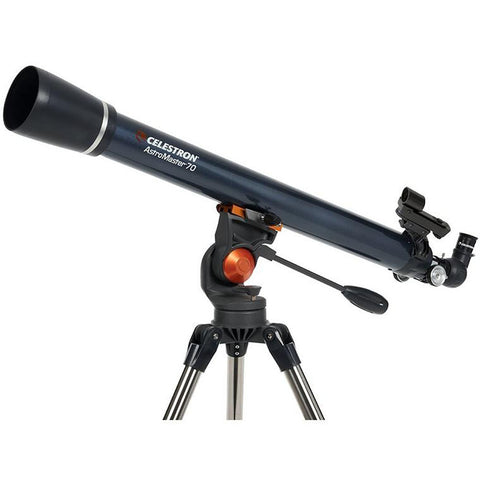
Celestron AstroMaster 70AZ
Simple refractor setup for Moon, planets, and first-time observing.
Check Price on Amazon →- Celestron AstroMaster 70AZ — The go-to starter refractor. Sharp lunar and planetary views, lightweight, easy to assemble. Typical budget: entry-level. Check current price
- Sky-Watcher Evostar 72ED — APO-quality doublet with near-zero chromatic aberration. Excellent for both visual and astrophotography. Typical budget: mid-range. See related refractor guides
- Sky-Watcher EvoStar ProED 120mm — Premium doublet APO for serious astrophotography and high-resolution visual work. Typical budget: premium. See related refractor guides
Related: Best Refractor Telescopes (Ranked) | Reflector vs Refractor: Which Do You Need?
Reflector Telescopes (Newtonians)
Reflector telescopes use a curved primary mirror at the bottom of an open tube to gather light. The mirror reflects incoming light up the tube to a smaller, flat secondary mirror angled at 45°, which diverts the focused beam out the side of the tube to the eyepiece. This design was invented by Isaac Newton in 1668, and the most common form — the Newtonian reflector — still bears his name.

The key advantage of reflectors is aperture per dollar. Mirrors are far cheaper to manufacture than large glass lenses, so a 6-inch reflector costs a fraction of what a 6-inch refractor costs while gathering exactly the same amount of light. This makes Newtonian reflectors the best-value option for deep-sky observers who want to see galaxies, nebulae, and star clusters.
The trade-off is maintenance. The open tube collects dust over time, and the mirrors periodically fall out of precise alignment. Re-aligning them — a process called collimation — takes about five minutes once you learn it, but it is an extra step that refractors and sealed compound scopes do not require.
Pros
- Best aperture-per-dollar ratio of any telescope type
- No chromatic aberration — mirrors do not split light into colors
- Excellent for galaxies, nebulae, and star clusters
- Shorter tube than a refractor of the same focal length
Cons
- Open tube collects dust; mirrors need occasional cleaning
- Requires periodic collimation (mirror alignment)
- Eyepiece at the top/side of the tube can be awkward for some targets
- Larger models need sturdy (and often expensive) mounts
When to Choose a Reflector
Choose a Newtonian reflector if you want the most aperture you can get for your budget, you observe from reasonably dark skies where that extra light-gathering power matters, and you are comfortable spending a few minutes on collimation before each session. Avoid a Newtonian if you want zero-maintenance grab-and-go convenience — a refractor or compound scope suits that need better.
Best Reflector Models (2026)
- Celestron AstroMaster 130EQ — Affordable 130mm Newtonian on an equatorial mount. A solid first reflector. Typical budget: entry-level reflector. See gear picks
- Sky-Watcher Quattro 200P — 8-inch f/4 imaging Newtonian designed for deep-sky astrophotography. Fast focal ratio, parabolic mirror. Typical budget: mid-range OTA. Check current availability before buying.
- Sky-Watcher Virtuoso GTi 150P — 150mm reflector with Wi-Fi GoTo mount. Best smart reflector value in 2026. Typical budget: mid-range tabletop/GoTo reflector. Check current availability before buying.
Related: Reflector vs Refractor: Which Do You Need? | Schmidt-Cassegrain vs Newtonian
Dobsonian Telescopes
A Dobsonian is a Newtonian reflector mounted on a simple, low-friction alt-azimuth rocker-box base instead of a conventional tripod. Invented by amateur astronomer John Dobson in the 1960s, the design philosophy is maximum aperture at minimum cost. By eliminating the expensive equatorial mount and using a streamlined wooden or metal rocker box, Dobsonians deliver more light-gathering power per dollar than any other telescope type.

An 8-inch Dobsonian — the most popular size — costs roughly $400–$500 and shows hundreds of galaxies, the dust lanes of the Andromeda Galaxy, the Veil Nebula with a filter, and globular clusters resolved into individual stars. Nothing else in that price range comes close.
The trade-off is bulk. A 10-inch or 12-inch Dob is a large piece of equipment, and the lack of a tracking motor means objects drift out of the eyepiece as the Earth rotates — you nudge the scope to follow. Some models, like the Celestron StarSense Explorer Dob, solve the "finding objects" problem with a smartphone app that tells you exactly where to point.
Pros
- Maximum aperture for the money — unmatched by any other design
- Intuitive alt-azimuth base: push, point, observe
- Extremely rewarding for visual deep-sky observing and star parties
- No polar alignment needed; set up in under five minutes
Cons
- Large and heavy — not ideal for apartment balconies or travel
- No tracking motor; objects drift and need manual nudging
- Requires collimation like any Newtonian
- Poor platform for long-exposure astrophotography (no tracking)
When to Choose a Dobsonian
Choose a Dobsonian if visual deep-sky observing is your priority, you have space to store and transport it, and you want the most telescope for your budget. A Dob is also the top recommendation for kids aged 10 and up who are serious about astronomy — the setup is dead simple and the views are spectacular enough to sustain interest. Avoid a Dob if you plan to do long-exposure astrophotography or if portability is a hard requirement.
Best Dobsonian Models (2026)

Celestron StarSense Explorer 8" Dobsonian
8 inches of aperture for visual deep-sky observing and beginner-friendly push-to navigation.
Check Price on Amazon →Also consider: Apertura AD8 at High Point →- Sky-Watcher Virtuoso GTi 150P — 6 inches of light-gathering power in a collapsible tabletop tube with motorized WiFi GoTo and tracking. Typical budget: mid-range tabletop GoTo Dobsonian. Check current availability before buying.
- Celestron StarSense Explorer 8" Dob — The most-recommended beginner Dob in amateur astronomy. 8 inches of aperture, smooth base, included accessories. Typical budget: classic 8-inch Dobsonian. Read the XT8 review
- Celestron StarSense Explorer Dob 8" — Same 8-inch optics with a phone-guided pointing system that tells you exactly where to push. Typical budget: higher than a manual 8-inch Dobsonian. Check current availability before buying.
Related: Celestron StarSense Explorer 8" Dob Review (#1 Beginner Telescope)
Catadioptric Telescopes (Compound)
Catadioptric telescopes — also called compound telescopes — combine lenses and mirrors in a single optical system. Light enters through a corrector plate (lens) at the front, reflects off a curved primary mirror at the back, bounces forward to a smaller secondary mirror, and then passes through a hole in the primary mirror to the eyepiece at the rear. This folded light path produces a long focal length inside a short, sealed tube.

The two most common designs are the Schmidt-Cassegrain Telescope (SCT) and the Maksutov-Cassegrain (Mak). SCTs use a thin Schmidt corrector plate and are the more versatile of the two, handling everything from planets to deep-sky objects to astrophotography. Maks use a thicker meniscus corrector and typically have higher focal ratios, making them specialists for planetary observation.
Catadioptric scopes are the most versatile telescope type available. An 8-inch SCT with a 2,000mm focal length fits in a tube just 18 inches long — you can carry it in a backpack. Pair it with a computerized GoTo mount (like the Celestron NexStar series) and you have a portable observatory that finds and tracks any of 40,000+ objects automatically.
Pros
- Compact and portable despite large apertures
- Sealed tube keeps optics clean; low maintenance
- Versatile: planets, deep-sky, double stars, and astrophotography
- Pairs naturally with GoTo computerized mounts
- Long focal length delivers excellent planetary detail
Cons
- More expensive than reflectors of equal aperture
- Slow focal ratio (f/10–f/15) limits wide-field views
- Requires longer exposure times for deep-sky imaging
- Corrector plate needs time to cool down to ambient temperature
SCT vs Maksutov-Cassegrain: Which Compound Design?
Schmidt-Cassegrains are the all-rounders. Their moderate focal ratio (typically f/10) works for a broad range of targets, and they accept focal reducers for wider-field imaging. SCTs are the better choice if you want one telescope that does everything reasonably well.
Maksutov-Cassegrains are planetary specialists. Their higher focal ratios (f/12–f/15) and smaller secondary mirrors produce exceptionally high-contrast images of the Moon, planets, and double stars. Choose a Mak if planets are your main interest and you want the sharpest possible views in a compact package.
Related: Schmidt-Cassegrain vs Maksutov-Cassegrain (Read This First!)
Best Catadioptric Models (2026)
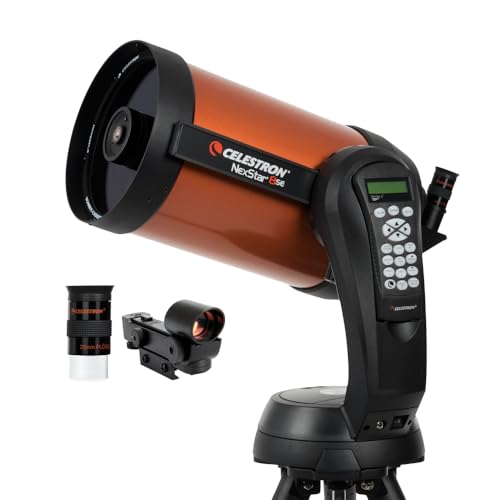
Celestron NexStar 6SE
Compact 6-inch SCT with computerized GoTo tracking for planets and all-purpose observing.
Check Price on Amazon →- Celestron NexStar 6SE — 6-inch SCT with a fully computerized GoTo mount. The top all-rounder recommendation for intermediate astronomers. Typical budget: mid/high all-rounder. See gear picks
- Celestron NexStar 8SE — 8-inch SCT with 2,032mm focal length. Outstanding for planets and serious deep-sky work. Typical budget: premium portable SCT. Read the 8SE review
- Sky-Watcher Skymax-127 SynScan AZ GoTo — 127mm Maksutov with GoTo. Compact, sharp, and excellent for planets. Typical budget: compact GoTo planetary setup. Check current availability before buying.
Related: Celestron NexStar 4SE Review | Celestron NexStar 8SE Review
Smart Telescopes
Smart telescopes are the newest and fastest-growing category in amateur astronomy. These all-in-one systems combine an optical tube, camera sensor, computerized mount, and companion app into a single device. You set it up, tap a target on your phone or tablet, and the telescope slews, focuses, and begins stacking exposures automatically. Instead of looking through an eyepiece, you watch a live-stacked image build on your screen — the longer you observe, the more detail and color the software extracts from faint objects.

Smart scopes make deep-sky targets like the Orion Nebula, Andromeda Galaxy, and even faint planetary nebulae accessible to complete beginners on their very first night out. They are also excellent for group observing and outreach events, since everyone can see the same image on a shared screen.
The main trade-off is that you lose the traditional "eye to the eyepiece" experience that many astronomers find deeply satisfying. Smart scopes also underperform on planets and the Moon compared to a good visual telescope, because their small sensors and stacking algorithms are optimized for faint, extended objects rather than bright, high-contrast targets.
Popular Smart Telescope Models (2026)
- ZWO SeeStar S50 — The entry-level benchmark. ~$500, lightweight, excellent app. Great first smart scope.
- Unistellar Odyssey — Mid-range with strong community features. Excellent for outreach and star parties.
- Vaonis Vespera II — Premium build quality with mosaic imaging for ultra-wide field views.
- Celestron Origin — Larger-aperture smart scope aimed at more serious imagers.
If you want both visual observing and smart imaging, pair a traditional Dobsonian for eyepiece nights with a budget smart scope like the SeeStar S50 for effortless deep-sky photography.
Solar Telescopes
Solar telescopes are specialized instruments designed exclusively for safe observation of the Sun. They are equipped with precision filters that block nearly all incoming sunlight, allowing you to study solar phenomena in detail without risk to your eyes or equipment.

White-light solar telescopes use solar film or glass filters to reveal sunspots, faculae, and solar granulation — the "bubbling" texture of the Sun's visible surface.
Hydrogen-alpha (H-alpha) solar telescopes use narrow-band filters tuned to the 656.28nm H-alpha wavelength to reveal the Sun's chromosphere. Through an H-alpha scope, you can watch solar prominences arching off the limb, filaments snaking across the disk, and active regions flaring in real time. It is one of the most dramatic and underrated branches of amateur astronomy.
Best Solar Telescope Models (2026)
- Celestron EclipSmart 50mm — Affordable white-light solar refractor with built-in Solar Safe filter. Great for eclipses and casual solar observing. Typical budget: entry-level white-light solar scope. Check current availability before buying.
- Coronado SolarMax III 70mm — Dedicated H-alpha solar telescope with 70mm aperture and blocking filter. Reveals prominences, flares, and surface detail. Typical budget: premium dedicated H-alpha solar scope. Check current availability before buying.
Safety warning
Never look at the Sun through an unfiltered telescope, binoculars, or camera. Permanent eye damage occurs in a fraction of a second. Always use purpose-built solar filters or a dedicated solar telescope.
Specialized and Professional Telescopes
Beyond the types available to amateur astronomers, professional observatories use telescopes that detect wavelengths of light invisible to the human eye. These instruments are typically large-scale facilities or space-based missions and are not available for consumer purchase, but understanding them completes the picture of how telescopes work across the electromagnetic spectrum.

Radio telescopes use large dish antennas to capture radio waves from space. Facilities like the Very Large Array (VLA) in New Mexico and the Atacama Large Millimeter Array (ALMA) in Chile study galaxies, pulsars, quasars, and the cosmic microwave background. Amateur radio astronomy kits exist (such as the Radio JOVE Kit from a NASA-affiliated project) but require specialized knowledge to operate.
Infrared telescopes detect heat radiation from cool objects like dust clouds, protostars, and distant galaxies. The James Webb Space Telescope (JWST), launched in 2021, is the most powerful infrared observatory ever built. Ground-based infrared telescopes must be located at high-altitude, dry sites to minimize atmospheric water vapor interference.
Ultraviolet, X-ray, and gamma-ray telescopes observe progressively higher-energy light. Since Earth's atmosphere blocks these wavelengths, all of these instruments must operate from space. The Hubble Space Telescope covers ultraviolet and visible light, the Chandra X-ray Observatory detects high-energy emissions from black holes and neutron stars, and the Fermi Gamma-ray Space Telescope maps the most energetic events in the universe.
Which Type of Telescope Is Right for You?
Choosing the right telescope type depends on what you want to observe, your budget, and how much maintenance you are willing to handle. Here is a decision guide based on common goals.
"I want to see the Moon and planets"
Start with a refractor (70mm–102mm) or a Maksutov-Cassegrain (90mm–127mm). Both produce high-contrast, sharp planetary images with very little maintenance. A refractor like the Celestron AstroMaster 70AZ ($130) is the simplest possible starting point. If your budget stretches to $600–$900, a Mak or SCT with a GoTo mount (like the Celestron NexStar 6SE) will show you far more and find objects for you automatically.
"I want to see galaxies, nebulae, and deep-sky objects"
Get the most aperture you can afford — which means a Dobsonian reflector. An 8-inch Dob ($400–$500) shows hundreds of deep-sky objects and is the single best value in all of amateur astronomy. A 10-inch or 12-inch Dob pushes into galaxy-cluster and faint-nebula territory. If portability matters, consider a 6-inch tabletop Dob like the Sky-Watcher Virtuoso GTi 150P.
"I want to photograph the night sky"
The telescope matters, but the mount matters just as much. For deep-sky astrophotography, pair an apochromatic refractor (60mm–130mm) or a fast Newtonian (f/4–f/5) with a solid equatorial tracking mount (Sky-Watcher HEQ5, iOptron CEM26, or similar). For planetary imaging, a catadioptric scope at f/10+ produces large image scales ideal for high-resolution planetary video capture. Smart telescopes offer the easiest path to a colorful nebula photo, but with limited control and lower resolution.
"I want one scope that does everything"
A Schmidt-Cassegrain on a GoTo mount is the most versatile all-rounder. The Celestron NexStar 6SE or 8SE handles planets, deep-sky objects, double stars, and basic astrophotography in a single compact, portable package.
"I'm buying for a child (ages 8–14)"
Consider a tabletop Dobsonian like the Orion StarBlast 4.5 or the Celestron StarSense Explorer DX 130AZ, which uses a smartphone app to guide the user to objects. Avoid cheap department-store refractors with wobbly tripods and inflated magnification claims — frustration kills interest faster than anything.
"I want to observe the Sun"
Get a dedicated solar telescope or a solar filter that fits over the front of your existing scope. For white-light views (sunspots), a Celestron EclipSmart-style white-light scope or a properly fitted Baader solar film filter works well. For prominences and chromospheric detail, step up to an H-alpha scope like the Coronado SolarMax III.
Astrophotography by Telescope Type
Not all telescope types perform equally behind a camera. Here is a quick reference for each type's imaging strengths.
| Telescope Type | Astrophotography Strength | Best Imaging Targets | Limitation |
|---|---|---|---|
| APO Refractor | Gold standard for deep-sky | Nebulae, galaxies, Milky Way | Expensive; limited aperture |
| Fast Newtonian (f/4–f/5) | More light, wider field, lower cost | Large nebulae, galaxy groups | Coma at edges; needs collimation |
| SCT/Mak (f/10+) | Excellent planetary imaging | Planets, Moon, small DSOs | Slow for deep-sky; longer exposures |
| Dobsonian | Snapshot lunar/planetary only | Moon, bright planets | No tracking = no long exposures |
| Smart telescope | Easiest deep-sky photos | Nebulae, galaxies, clusters | Limited control; lower resolution |
The mount is at least as important as the telescope for astrophotography.
A solid equatorial mount with accurate tracking (like the Sky-Watcher HEQ5 or iOptron CEM26) will produce better results than an expensive telescope on a shaky mount. Budget roughly 50% of your total astrophotography spend on the mount.
Related: Best Telescopes With Automatic Tracking
FAQs
What are the three main types of telescopes?
The three main types of telescopes are refractors (which use lenses), reflectors (which use mirrors), and catadioptric or compound telescopes (which use both lenses and mirrors). Refractors excel at sharp planetary views with zero maintenance. Reflectors provide the most aperture per dollar for deep-sky objects. Catadioptrics combine compactness and versatility, working well for planets, deep-sky observing, and astrophotography.
What type of telescope is best for beginners?
For most beginners, a refractor telescope (70mm–90mm) or a Dobsonian reflector (6–8 inches) is the best starting point. Refractors win on simplicity — zero maintenance, fast setup, and excellent Moon and planet views. Dobsonians win on raw performance — far more aperture for the money, meaning you see fainter and more detailed objects. The Celestron AstroMaster 70AZ and the Celestron StarSense Explorer 8-inch Dobsonian are the two most popular entry-level choices.
What is the difference between a reflector and a refractor telescope?
A refractor uses glass lenses to bend (refract) light to a focal point. A reflector uses a curved mirror to bounce (reflect) light to a focal point. Refractors produce high-contrast images with no maintenance but are expensive for larger apertures. Reflectors are cheaper per inch of aperture and free of chromatic aberration but require periodic mirror alignment (collimation) and have open tubes that collect dust.
Which telescope type is best for seeing planets?
Refractors and Maksutov-Cassegrains produce the sharpest planetary views. Refractors have no central obstruction, which maximizes contrast on planetary detail like Jupiter's cloud bands and Saturn's Cassini Division. Maksutov-Cassegrains have long focal lengths (f/12–f/15) that provide large image scales and tight, high-contrast star images. Either type in the 90mm–127mm range will show impressive planetary detail.
Which telescope type is best for deep-space viewing?
Reflectors and Dobsonians with at least 8 inches (200mm) of aperture are the best telescopes for deep-space viewing. An 8-inch Dobsonian gathers four times more light than a 4-inch refractor and costs a fraction of the price. Larger aperture reveals fainter galaxies, resolves globular clusters into individual stars, and shows nebulae with more structure and detail.
Which type of telescope is best for astrophotography?
Apochromatic refractors are the gold standard for deep-sky astrophotography because of their sharp, color-free star fields and zero-maintenance optics. Fast Newtonian reflectors (f/4–f/5) offer more light gathering at a lower price but require collimation and a coma corrector. Catadioptric telescopes (SCTs) excel at high-resolution planetary imaging. In all cases, the equatorial tracking mount is just as important as the telescope — budget at least half your total spend on the mount.
What is a Dobsonian telescope?
A Dobsonian is a Newtonian reflector telescope mounted on a simple rocker-box alt-azimuth base instead of a tripod. Invented by John Dobson in the 1960s, it was designed to give amateur astronomers the largest possible aperture at the lowest possible cost. Dobsonians are the most popular telescope type among visual deep-sky observers because they combine huge light-gathering power with an intuitive, point-and-push operating style.
What is a smart telescope?
A smart telescope is an all-in-one digital observing system that combines an optical tube, camera sensor, computerized mount, and smartphone/tablet app. Instead of looking through an eyepiece, you view a live-stacked image on a screen. The telescope handles pointing, focusing, and image stacking automatically. Popular models include the ZWO SeeStar S50, Unistellar Odyssey, and Vaonis Vespera II. Smart telescopes excel at deep-sky objects but underperform on planets compared to traditional visual scopes.
Are expensive telescopes always better?
Not necessarily. A well-chosen Dobsonian with 8 inches of aperture will outperform a premium small-aperture refractor on faint deep-sky objects. The "best" telescope depends on what you want to observe, how portable it needs to be, and whether you value convenience (sealed optics, GoTo tracking) or raw performance (maximum aperture). The most expensive mistake is buying a telescope you never use because it is too complex or too heavy to set up.
Can I use one telescope for everything?
A Schmidt-Cassegrain telescope (SCT) on a computerized GoTo mount comes closest to a do-everything instrument. It handles planets, the Moon, deep-sky objects, double stars, and basic astrophotography in a compact, portable package. However, it will not match the wide-field deep-sky views of a large Dobsonian or the imaging precision of a dedicated APO refractor. Most experienced astronomers eventually own two or more telescopes optimized for different tasks.
Final Thoughts
Every telescope type exists because it solves a specific problem. Refractors trade aperture for simplicity. Reflectors trade convenience for raw light-gathering power. Catadioptrics split the difference in a portable package. Smart telescopes trade the eyepiece experience for effortless imaging. There is no single "best" type — only the best type for your goals, your sky, and your budget.
If you are buying your first telescope, start with either a quality refractor or an 8-inch Dobsonian. Both are proven entry points that deliver real results on night one. As your interests develop, you will naturally know what to add next.
Free course sampler — 1,500+ astronomers get stargazing tips, gear deals, and cosmic event alerts every week.
You may also like:
- Reflector vs Refractor: Which One Do You Need?
- Schmidt-Cassegrain vs Newtonian Telescopes
- Schmidt-Cassegrain vs Maksutov-Cassegrain (Read This First!)
- What Can You See With a 100mm Refractor Telescope?
- Best Telescopes With Automatic Tracking (Ranked)
- Stargazing 101: An Introductory Guide