As an Amazon Associate, we earn from qualifying purchases. We may also earn a commission through other retailer links. Check the exact model, condition, delivery and current price before ordering.
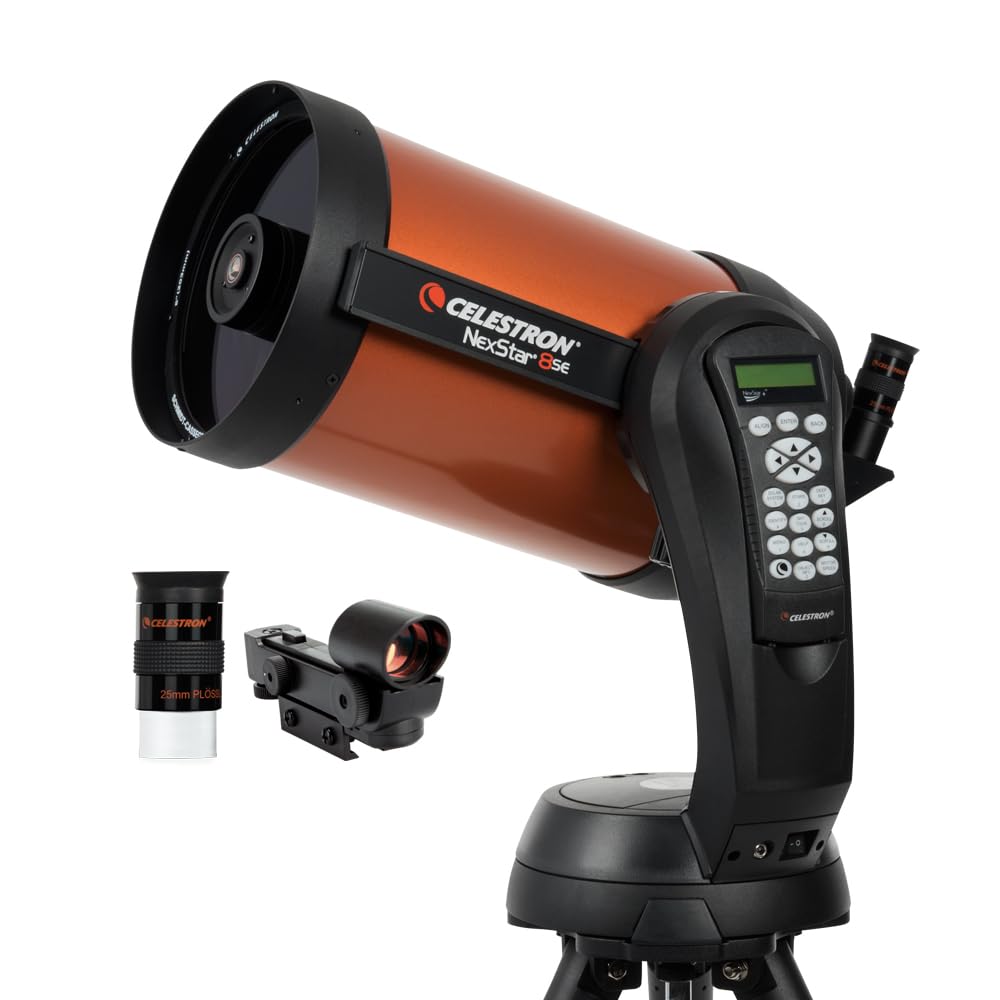
Short answer: For most visual observers the pick is the Celestron NexStar 8SE, an 8-inch Schmidt-Cassegrain on a GoTo mount that finds targets and tracks them. On a tight budget choose the Celestron 114LCM; for faint galaxies and nebulae, the Sky-Watcher GoTo Dobsonian 8-inch.


Automatic tracking is about finding objects faster and keeping them centered. Choose by use case first.
Compact aperture, GoTo pointing, and tracking in one beginner-friendly package.
Good for learning alignment and viewing bright targets without a huge setup.
For astrophotography, the mount matters more than the optical tube.
GoTo still needs power, setup, and a basic alignment routine.
Rule of thumb: If you want easy visual observing, buy a GoTo telescope. If you want long-exposure photos, prioritize the mount.
GoTo telescopes changed amateur astronomy overnight. Before computerized mounts, finding a faint galaxy or a particular nebula meant spending an hour with a star atlas, a red flashlight, and a lot of patience. Now you align on a few bright stars, punch in your target, and watch the motors do the work. The telescope swings to your object and tracks it as Earth rotates, keeping it locked in the eyepiece until you decide to move on.
That shift matters more than most people realize. The biggest reason newcomers quit astronomy early is frustration: they spend their first few sessions hunting for objects they never find, then put the scope in a closet. GoTo technology removes that barrier entirely. You see Saturn's rings clearly defined. You watch Jupiter's cloud bands roll into view. You find the Orion Nebula in three seconds instead of thirty minutes. That's what keeps people coming back.
For experienced observers, GoTo is less about finding objects and more about efficiency. A seasoned amateur can locate most Messier objects manually, but a GoTo mount lets you cover six times as many targets in the same session. It also opens the door to objects beyond the Messier catalog: faint galaxy clusters, challenging planetary nebulae, double stars listed only by catalog number. The database becomes your observing agenda.
These eight telescopes cover the full range of budgets, apertures, and use cases. Every pick here represents a genuine best choice in its category, not a crowded list padded with also-rans. Whether you're buying your first computerized scope or upgrading to something more capable, one of these eight will fit what you're looking for.
When aligning a GoTo telescope, choose alignment stars spread across different parts of the sky. Two stars close together in the same constellation will give a poor alignment model. Pick stars at least 60 degrees apart and at varied altitudes. Three-star alignment (where available) is always more accurate than two-star for tracking at the edges of the sky.
Quick Picks Summary
- Our Pick: Celestron NexStar 8SE, overall best GoTo telescope for visual observing
- Best Budget: Celestron 114LCM, full GoTo tracking on a tight budget
- Best for Astrophotography: Celestron Advanced VX 8" SCT, equatorial mount, serious EQ tracking
- Best for Deep Sky: Sky-Watcher GoTo Collapsible Dobsonian 8", an 8-inch mirror with GoTo
- Best for Planets: Celestron NexStar 6SE, sharp, high-contrast views of Jupiter and Saturn
- Best Portable: Celestron NexStar 5SE, compact SCT that fits in the trunk of any car
- Best Value: Celestron Astro Fi 130, Newtonian reflector with GoTo
- Best WiFi Control: Celestron Astro Fi 102, smartphone-controlled GoTo, no hand controller needed
Overall Best Telescope with Automatic Tracking
1. Celestron NexStar 8SE
- Aperture: 8 inches (203mm)
- Focal length: 2032mm | f/10
- Optical design: Schmidt-Cassegrain
- Mount: Single-arm alt-azimuth GoTo
- Database: 40,000+ objects
- What we like: Exceptional optics, large aperture, proven GoTo system, wide accessory ecosystem
- What we don't like: Requires external power for long sessions; single-arm mount is not suitable for deep-sky astrophotography

The NexStar 8SE has been the benchmark GoTo telescope for visual astronomy for over a decade, and it still earns that title in 2026. The 8-inch Schmidt-Cassegrain optical tube is enough for Saturn's rings and Jupiter's cloud belts. On deep-sky targets, that 8-inch aperture pulls in light that smaller scopes can only hint at. The Orion Nebula shows structure in the Trapezium cluster. Globular clusters like M13 resolve into individual stars at the edges. The Andromeda Galaxy sprawls wide enough to require a wide-field eyepiece to capture in one view.
The GoTo system is Celestron's most mature platform. After a SkyAlign or 2-star alignment, the NexStar hand controller finds objects reliably and consistently. The database covers 40,000+ targets including all Messier objects, NGC catalog, named stars, planets, and double stars.
One practical note: the single-arm fork mount is alt-azimuth only, which means field rotation accumulates during long exposures. For visual use and short planetary video captures, it's excellent. For imaging nebulae over multiple minutes, you'd need a wedge to polar-align the mount or switch to an equatorial setup like the Advanced VX. The 8SE is built for visual observing, and for that use case this scope is genuinely hard to fault. The optical tube is also compatible with Celestron's equatorial CGE and AVX mounts if you later decide to pursue deep-sky imaging.
The build quality is characteristic Celestron: solid construction, reliable electronics, and an accessory ecosystem built up over decades. The orange tube is iconic. That's ultimately why the 8SE remains our top overall pick.
Power the 8SE from a 12V lithium power station rather than AA batteries. Eight AAs drain quickly and voltage drop causes tracking errors late in the session. A small Jackery or Goal Zero power station will run the scope all night and pays for itself in frustration saved.
Read the full review: Celestron NexStar 8SE Telescope Review
Best Budget Telescope with Automatic Tracking
2. Celestron 114LCM
- Aperture: 114mm (4.5 inches)
- Focal length: 1000mm | f/8.8
- Optical design: Newtonian reflector
- Mount: Alt-azimuth computerized GoTo
- Database: 4,000+ objects
- What we like: Full GoTo tracking at budget price, Celestron SkyAlign, lightweight and portable
- What we don't like: Smaller database than premium models; not suitable for astrophotography; collimation required occasionally

For anyone who wants computerized GoTo on a tight budget, the 114LCM is the right starting point. The 114mm Newtonian aperture is meaningful: you'll see the Moon in excellent detail, split many double stars cleanly, and catch the basic features of Jupiter and Saturn. The Orion Nebula glows noticeably, and the Pleiades and Beehive clusters look stunning in a wide-field eyepiece. This isn't a toy scope; it's a real instrument with real capability.
Celestron's SkyAlign alignment procedure works here, too. Point the scope at any three bright objects (stars, planets, or the Moon) and the system figures out where it is. It's not quite as slick as the premium NexStar hand controller experience, but it works reliably. Once aligned, GoTo accuracy is solid for bright targets. Fainter objects sometimes require a manual nudge, which is expected at this price.
The Newtonian design occasionally needs collimation (mirror alignment) to maintain sharp views, particularly after transport. This is a five-minute task once you've done it a couple of times, and the included adjustment tools make it straightforward. The lightweight tripod and tube keep the whole package portable enough to carry to a dark site without effort. For someone stepping into computerized astronomy for the first time, the 114LCM delivers everything needed to start having real, productive observing sessions immediately.
Best Telescope with Automatic Tracking for Astrophotography
3. Celestron Advanced VX 8" Schmidt-Cassegrain
- Aperture: 8 inches (203mm)
- Focal length: 2032mm | f/10
- Optical design: Schmidt-Cassegrain
- Mount: Advanced VX equatorial GoTo
- Payload capacity: 30 lbs
- What we like: True equatorial tracking, no field rotation, polar alignment capability, serious astrophotography platform
- What we don't like: Heavier and bulkier than alt-az setups; equatorial polar alignment adds setup time; steeper learning curve

If you want to photograph nebulae, galaxies, and star clusters with exposures measured in minutes rather than seconds, an equatorial mount is not optional. The Advanced VX solves the core problem of alt-az GoTo tracking for imaging: field rotation. On an alt-az mount, the camera rotates relative to the sky during long exposures, turning point stars into curved arcs. An equatorial mount aligned to the celestial pole rotates on exactly the right axis to compensate for Earth's spin, keeping stars as perfect pinpoints through extended exposures.
Alt-azimuth GoTo mounts (single-arm NexStar SE series) are excellent for visual observing and short planetary video. For long-exposure deep-sky photography, you need an equatorial GoTo mount like the Advanced VX. The difference in tracking quality for imaging is dramatic: alt-az mounts introduce field rotation; equatorial mounts do not.
The Advanced VX mount carries 30 lbs of payload, which comfortably handles the 8" SCT tube and a DSLR or mirrorless camera with accessories. The GoTo system uses a database of 40,000+ objects and, once polar-aligned, tracks with enough precision for unguided exposures of 1-2 minutes at moderate focal lengths. Add a guide scope and autoguider and you can push exposures to 5-10 minutes, which is where the interesting nebula details start to appear. The Orion Nebula's wispy outer shell, the dust lanes in M82, the faint extensions of the Virgo galaxy cluster: these only emerge in stacked long exposures.
Setup is more involved than an alt-az GoTo. You need to level the mount, point the polar axis north (or south, in the southern hemisphere), and rough-polar-align using the built-in polar scope. Then do a 2-star GoTo alignment. The whole process takes 20-30 minutes the first few times, then shortens considerably as it becomes routine. For visual use, the AVX is also an excellent performer: the same 8" SCT optics deliver the same outstanding views as the NexStar 8SE, just mounted on a heavier platform. Serious astronomers who want one telescope that does everything should strongly consider this combination.
Best Telescope with Automatic Tracking for Deep Sky Objects
4. Sky-Watcher GoTo Collapsible Dobsonian 8-Inch
- Aperture: 8 inches (203mm)
- Focal length: 1200mm | f/5.9
- Optical design: Newtonian reflector (Dobsonian)
- Mount: Alt-azimuth GoTo (SynScan)
- Database: 42,900+ objects
- What we like: Large aperture at accessible price, wide fast focal ratio excellent for deep sky, collapsible for portability, SynScan database is massive
- What we don't like: Alt-az mount not suitable for long-exposure imaging; collapsible design requires careful transport; Dobsonian rocker box is larger than SCT setups

The fundamental principle of deep-sky visual astronomy is simple: more aperture equals more detail on faint objects. Galaxies, nebulae, and globular clusters are dim. They need photons. An 8-inch aperture collects about 1,300 times more light than the naked eye and significantly more than a 5- or 6-inch telescope. The Sky-Watcher GoTo Dobsonian combines that large aperture with an f/5.9 focal ratio that gives wide, bright fields of view: exactly what you want when sweeping through regions like Virgo galaxy cluster or the Sagittarius star clouds.
The SynScan GoTo system has a database of 42,900+ objects, which is one of the largest in this price range. After a 2-star or 3-star alignment, it navigates to targets consistently. The collapsible truss tube design is clever: the upper cage folds down into the rocker box for transport, reducing the overall length by about 40%. An 8-inch solid-tube Dobsonian requires a truck or large SUV; this collapsible version fits in a normal car's trunk. That portability matters because darker skies dramatically change what you can see on faint objects. Getting this scope away from city lights is worth the effort.
In the Virgo galaxy cluster, M87, M86, M84, and a dozen fainter members appear in the same field. The Veil Nebula fragments, the Ring Nebula with its central star visible at high power, the intricate dust lanes of M82: all of these are within reach on nights with good transparency. Planetary performance is also solid; f/5.9 is fast but still delivers clean views at moderate magnification with a quality eyepiece.
Best Telescope with Automatic Tracking for Planets
5. Celestron NexStar 6SE
- Aperture: 6 inches (150mm)
- Focal length: 1500mm | f/10
- Optical design: Schmidt-Cassegrain
- Mount: Single-arm alt-azimuth GoTo
- Database: 40,000+ objects
- What we like: Outstanding planetary views, high contrast SCT optics, compact for a 6-inch, fully featured GoTo
- What we don't like: Battery drain on long sessions; single-arm mount not suitable for deep-sky astrophotography

Schmidt-Cassegrain telescopes have a well-earned reputation for planetary observation, and the NexStar 6SE illustrates exactly why. The closed-tube design protects the optics from air currents that degrade planetary images, and the f/10 focal ratio produces the high magnifications needed for planetary detail with standard eyepieces. At 150x on Saturn, the Cassini Division is a clean black gap between the A and B rings. The ring shadow on the planet's disk is crisp and dark. Titan and other bright moons are easily visible. It's the kind of view that makes people reach for their phone to try to photograph what they're seeing.
Jupiter rewards attention through the 6SE. On nights of steady seeing, you'll spot at minimum four cloud belts, the Great Red Spot (when it's facing Earth), and the four Galilean moons repositioning themselves night to night. At 200x on a steady night, the NEB and SEB cloud structures show irregular detail: festoons, white ovals, and the storm outbreaks that planetary observers track over months. Mars at opposition shows polar caps and dark albedo features. Venus runs through its phases like a miniature Moon. The solar system becomes a genuinely dynamic place through a telescope this capable.
The 6SE sits in a practical size for transport: the tube is noticeably smaller than the 8SE, and the single-arm fork mount keeps the whole setup manageable for one person. Setup is identical to other NexStar SE models: SkyAlign on three bright objects, then full GoTo access to the 40,000-object database. The 6SE earns its designation as the best for planets because it balances genuine optical quality, practical portability, and the full NexStar GoTo experience at a price below the 8SE.
Read the full review: Celestron NexStar 6SE Review
Best Portable GoTo Telescope
6. Celestron NexStar 5SE
- Aperture: 5 inches (127mm)
- Focal length: 1250mm | f/10
- Optical design: Schmidt-Cassegrain
- Mount: Single-arm alt-azimuth GoTo
- Database: 40,000+ objects
- What we like: Extremely compact for a GoTo SCT, full NexStar GoTo platform, high-contrast optics, easy one-person setup
- What we don't like: Smaller aperture than the 6SE and 8SE; battery drain on extended sessions

The NexStar 5SE makes a compelling case for being the ideal travel scope for anyone who already knows what they're doing. The 5-inch SCT tube is genuinely compact: you can hold it under one arm while carrying the tripod in the other hand. The whole setup, tube and mount on tripod, fits across the back seat of a compact car. That portability means you actually take it to dark sites, which is the single biggest factor in what you can observe. A smaller scope under dark skies beats a larger scope under city glow every session.
The optics are the same high-quality Celestron SCT glass as the 6SE and 8SE, just with a 5-inch primary mirror. Saturn's rings are clearly defined and the Cassini Division is visible on good nights. Jupiter shows its main cloud bands and the Great Red Spot. M13 resolves into a salt-and-pepper scatter of stars at the edges at 150x. The Andromeda Galaxy fits nicely in the wide field of a low-power eyepiece. You're giving up light-gathering compared to the larger NexStar models, but you're gaining a telescope you'll actually carry to better skies.
The full NexStar GoTo platform is intact: SkyAlign alignment, 40,000-object database, automatic slewing and tracking. Nothing is cut down or simplified relative to the 6SE or 8SE in terms of the computerized features. The 5SE is the right choice for astronomers who travel frequently, observers in urban areas who drive regularly to dark-sky sites, and anyone who values portability alongside genuine optical performance. It also suits people who already own a larger scope but want something they'll actually bring along on vacations and camping trips.
Read the full review: Celestron NexStar 5SE Expert Review
Best Value GoTo Telescope
7. Celestron Astro Fi 130
- Aperture: 130mm (5.1 inches)
- Optical design: Newtonian reflector
- What we don't like: Occasional collimation needed

The Astro Fi 130 stands in here for the NexStar 130SLT. The 130mm aperture makes a meaningful difference over 114mm when you're looking at fainter targets.
On planets, a 130mm reflector handles respectably. Saturn's rings are well-defined at moderate magnification, and Jupiter's two main cloud belts are clear. You won't match the fine detail of the 6SE or 8SE SCT optics. On deep-sky targets, the Orion Nebula shows the Trapezium cluster and the surrounding nebulosity clearly.
Read the full review: Celestron NexStar 130SLT Review
Best Smartphone-Controlled GoTo Telescope
8. Celestron Astro Fi 102
- Aperture: 102mm (4 inches)
- Focal length: 1325mm | f/13
- Optical design: Maksutov-Cassegrain
- Mount: Alt-azimuth WiFi GoTo
- Control: Celestron StarSense/SkySafari app via WiFi
- What we like: No hand controller needed, smartphone interface is intuitive, compact Mak-Cass optics, excellent for lunar and planetary
- What we don't like: Narrower aperture limits deep-sky performance; WiFi control requires a charged phone; f/13 is slow for wide-field work

The Astro Fi 102 takes a different approach to GoTo control: instead of a traditional hand controller, the telescope creates its own WiFi hotspot and you control everything from Celestron's app on your smartphone. Tap an object on the app's sky map and the telescope slews to it. Tracking runs automatically once you're on target. For users who are already comfortable navigating a phone screen, this interaction model feels completely natural and frankly more intuitive than learning the button layout of a traditional NexStar controller.
The Maksutov-Cassegrain optical design is worth understanding. It's a compact, sealed-tube system with a very long focal ratio (f/13) that produces high magnification with standard eyepieces and excellent contrast on high-resolution targets. The Moon through the Astro Fi 102 is spectacular: crater rims, central peaks, and the texture of the mare basalt plains are all clearly rendered at 100-150x. Saturn's rings show the Cassini Division cleanly. The cloud belts of Jupiter are visible and sharper than you might expect from a 4-inch aperture because the Mak-Cass design handles atmospheric dispersion well.
Deep-sky performance is modest by aperture standards: the 102mm mirror gathers less light than the 114LCM or Astro Fi 130, and the slow focal ratio makes wide-field views dimmer. Bright nebulae like the Orion Nebula and the Lagoon are visible, but faint galaxies require careful dark adaptation and good skies. Where the Astro Fi 102 truly shines is as a solar system scope and as a telescope for observers who want the simplest possible setup experience. If you're sharing the scope with family members who won't engage with a hand controller but will happily tap objects on a screen, this is the right choice.
GoTo Telescope Buying Guide: What to Look For
Choosing a GoTo telescope involves balancing several factors that interact with each other. Here's what actually matters, in order of importance.
Aperture is the single most important specification. It determines how much light the telescope collects, which directly controls how bright faint objects appear and how much detail you can see. Doubling aperture quadruples light-gathering. A 6-inch telescope shows dramatically more than a 4-inch on dim galaxies and nebulae. For visual observing, prioritize aperture over everything else within your budget.
Mount type determines what you can do with the scope. Alt-azimuth GoTo mounts (like the NexStar SE single-arm) are lighter, easier to set up, and excellent for visual use. Equatorial GoTo mounts (like the Advanced VX) are heavier and require polar alignment, but they're the only option for serious long-exposure astrophotography. If you know you want to photograph deep-sky objects with exposures over a minute, go equatorial from the start.
Database size and GoTo accuracy vary by model. The full NexStar SE hand controller includes 40,000+ objects; the SLT and LCM models have smaller databases but still cover all the important targets. GoTo accuracy is generally good across Celestron's lineup after a careful alignment; pointing error matters much less than people expect because you can always center an object with a brief look and nudge.
Portability is often underestimated at purchase time and overestimated in reality. A telescope you can't move easily is a telescope you won't use. The 5SE fits in a car's back seat. A heavy Dobsonian needs a truck. Collapsible designs help. Weight is not just about physical effort: it's about whether you'll actually take the scope to darker sites, which transforms the observing experience.
Power source is a practical concern that catches many buyers off guard. Most GoTo mounts require 8 AA batteries or a 12V external supply. Eight AAs last roughly 2-4 hours depending on temperature and how much the motors slew. A 12V lithium power tank costs under $50 and powers a session all night. Budget for this from day one.
Price scales with aperture, mount quality, and brand. The Advanced VX SCT combination sits at the high end for a prosumer visual and imaging platform. In all categories, the scopes on this list represent the best value for what you're paying.
Auto-tracking telescopes require proper alignment before GoTo and tracking work correctly. For equatorial mounts, this means polar alignment (pointing the polar axis at Polaris in the northern hemisphere). For alt-az GoTo mounts, it means star alignment with 2-3 bright reference stars. Skipping or rushing alignment is the number-one reason objects drift out of view or GoTo slews miss their targets. Take your time with it the first few sessions.