Quick verdict: the Celestron NexStar 8SE is a powerful compact GoTo telescope for visual observers who want serious aperture without a huge tube. It is excellent for the Moon, planets, and many bright deep-sky objects, but it is not the cheapest path to 8 inches of aperture.
What we like
- Strong 8-inch light gathering in a compact SCT tube.
- GoTo mount makes target finding easier for beginners.
- Excellent lunar and planetary potential in steady seeing.
- Portable compared with many full-size 8-inch scopes.
Watch outs
- Costs much more than an 8-inch Dobsonian.
- Needs power, alignment, and dew management.
- Narrower field of view than short refractors or Dobs.
- Not a turnkey deep-sky astrophotography rig.
Budget for accessories, not just the telescope.
A dew shield, reliable external power, and a shorter eyepiece make the 8SE much easier to live with.
Best use
- one-scope setup for GoTo visual observing, planets, Moon, bright deep-sky, and beginner planetary imaging.
- Big tradeoff: costs far more than an 8-inch Dobsonian with similar visual reach.
- Budget for upgrades: shorter eyepiece, dew shield, and external 12V power should be considered part of the real cost.
- Skip it if: you want maximum aperture per dollar or wide-field deep-sky views without extra accessories.
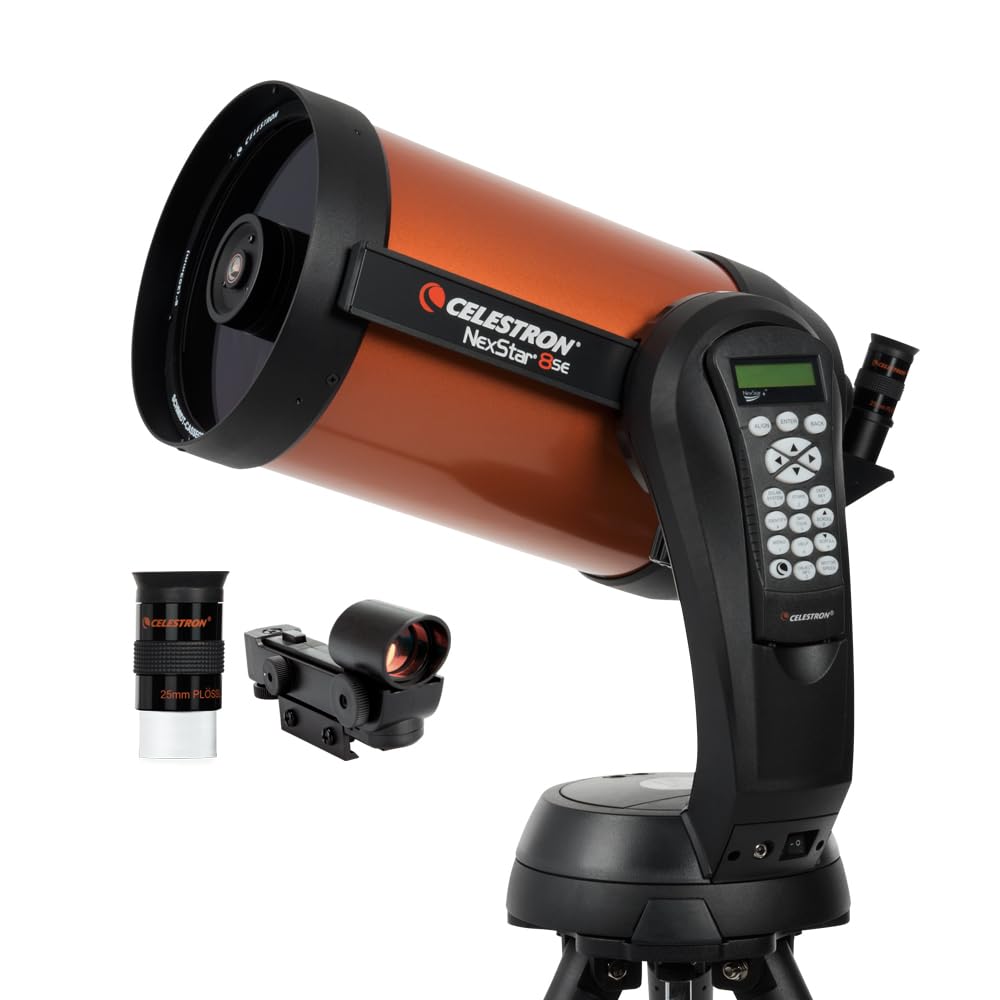
Celestron NexStar 8SE
The 8-inch SE model reviewed here. Strong visual performance, compact SCT tube, and GoTo tracking in one package.
Check Price on Amazon →The Celestron NexStar 8SE is an 8-inch Schmidt-Cassegrain telescope on a computerized GoTo mount that finds and tracks over 40,000 celestial objects automatically. With a 2032mm focal length packed into a tube only 17 inches long, it delivers high-magnification planetary views, resolves deep-sky structure, and handles planetary astrophotography - all while fitting in a car's back seat.
At roughly $1,200-$1,600 depending on bundle and sale pricing, it costs roughly double what you'd pay for an 8-inch Dobsonian with identical aperture. That premium buys three things: a computerized mount that locates objects for you and tracks them across the sky, a tube compact enough to carry in one hand, and a platform that can grow into astrophotography.
The question isn't whether the NexStar 8SE is a good telescope - it's whether those features are worth the price for you. This review gives you the data to decide.
NexStar 8SE at a Glance
| Specification | Details |
|---|---|
| Optical design | Schmidt-Cassegrain (SCT) |
| Aperture | 203.2mm (8 inches) |
| Focal length | 2032mm (80 inches) |
| Focal ratio | f/10 |
| Mount | Motorized single-fork-arm alt-azimuth |
| GoTo database | 40,000+ objects |
| Highest useful magnification | ~480× (practical sweet spot: 200-300×) |
| Optical tube length | 432mm (17 inches) |
| Optical tube weight | ~5.7 kg (12.5 lbs) |
| Mount + tripod weight | ~5.2 kg (11.5 lbs) |
| Total assembled weight | ~10.9 kg (24 lbs) |
| Power | 8× AA batteries or external 12V DC |
| Eyepiece connection | 1.25-inch nosepiece |
| Drive | DC servo motors, both axes |
How the Schmidt-Cassegrain Design Works
The NexStar 8SE uses a Schmidt-Cassegrain (SCT) optical design - the most popular compound telescope type in amateur astronomy. Understanding how it works explains most of the telescope's strengths and limitations.
Light enters through a thin corrector plate at the front, hits a concave primary mirror at the back of the tube, bounces forward to a small convex secondary mirror mounted on the corrector plate, then reflects back through a hole in the center of the primary mirror to the eyepiece at the rear. This "folded" light path achieves a 2032mm focal length in a tube only 432mm long - a 5:1 compression ratio that makes the 8SE remarkably portable for its optical power.
The corrector plate seals the tube, keeping dust off the mirrors and eliminating the internal air currents that can degrade images in open-tube Newtonian reflectors. It also means the 8SE holds collimation far better than a Newtonian - you'll rarely need to adjust the mirrors.
Unlike standard telescopes where the eyepiece moves in and out to focus, the 8SE focuses by shifting the primary mirror forward and backward inside the tube. This is normal for SCTs and works well, though it can introduce a small amount of image shift (the target moves slightly in the field as you focus). This is minor for visual use but worth noting for astrophotography.
For a detailed comparison of how the SCT design differs from Maksutov-Cassegrains and Newtonian reflectors, we have dedicated guides on both.
What Can You Actually See with the 8SE?
Eight inches of aperture is the threshold where amateur astronomy gets seriously good. The NexStar 8SE collects the same amount of light as an 8-inch Dobsonian - the views are optically identical. What the GoTo mount adds is convenience: instead of hunting for targets manually, you press a button and the telescope slews to the object and tracks it.
Moon
The Moon through the 8SE is extraordinary. At 200-300×, you'll see individual boulders in crater walls, the collapse terraces inside Copernicus, tiny secondary craterlets on the floors of larger impacts, and the delicate rille systems snaking across the maria. The long focal length (2032mm) produces large, detailed lunar images that fill the eyepiece. A Moon filter is strongly recommended - the view is bright enough at this aperture to be uncomfortable without one.
Planets
The f/10 focal ratio gives native high magnification with standard eyepieces - a 10mm eyepiece produces 203× right out of the box. This makes the 8SE a natural planetary performer.
Jupiter: Five or more cloud belts, the Great Red Spot clearly defined on good nights, festoons and barges visible during excellent seeing, all four Galilean moons showing as tiny discs at 300×+. The GoTo tracking keeps Jupiter centered for extended observation - no nudging required.
Saturn: Cassini Division sharp and clean, the shadow of the globe on the rings, subtle banding on the disc, Titan bright and easy, and fainter moons (Rhea, Dione, Tethys) detectable with patience.
Mars: During opposition, dark albedo features (Syrtis Major, Mare Erythraeum), the polar ice cap, and occasional limb clouds at 250-300×.
Venus and Mercury: Phases visible. Venus shows occasional cloud detail with UV filters.
Uranus: Visible as a small turquoise disc. Neptune appears as a similar blue-green dot, with its moon Triton detectable nearby on good nights.
For tips on getting the sharpest planetary views, our guide on how to use a telescope covers focusing technique and atmospheric seeing.
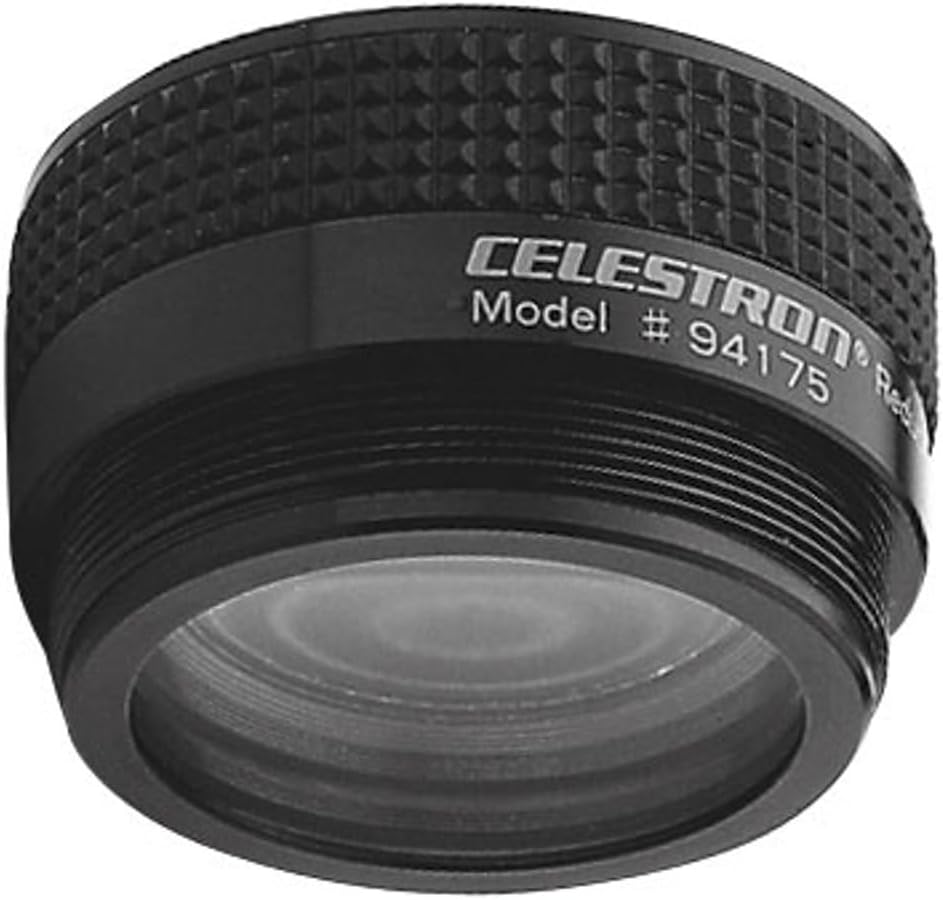
Celestron f/6.3 Reducer Corrector
Widens the 8SE field and shortens exposure times, making deep-sky viewing and beginner imaging easier.
Check reducer price →Deep-Sky Objects
The 8SE's 8-inch aperture reaches a limiting magnitude of about 14, putting the entire Messier catalog and much of the Herschel 400 within reach. The GoTo mount makes this practical - you can hop from object to object in seconds rather than spending minutes star-hopping.
Galaxies: M31 (Andromeda) with dust lanes, M51 (Whirlpool) with spiral arm structure under dark skies, M81/M82 pair showing distinct morphology, dozens of NGC galaxies as identifiable glows.
Nebulae: M42 (Orion Nebula) with wing structure and hints of color in the trapezium region, M27 (Dumbbell) with clear hourglass shape, M57 (Ring Nebula) as a clean ring, the Veil Nebula visible with an OIII filter.
Clusters: Globular clusters like M13 (Hercules) resolve to the core at 200×. Open clusters fill the field with the 25mm eyepiece.
The one limitation: the f/10 focal ratio produces a maximum true field of about 1.2° with a 2-inch wide-angle eyepiece, which is narrower than faster designs. Large objects like the Pleiades won't fit in a single view. A Celestron f/6.3 focal reducer widens the field by ~37% and is one of the most worthwhile upgrades for this scope.
The GoTo Mount: What It Does and Doesn't Do
The motorized single-fork-arm alt-azimuth mount is what separates the 8SE from a manual Dobsonian. Here's what it gives you and what to expect.
What it does well
Object location: After a 2-3 minute star alignment (you center two bright stars and the computer calculates your sky position), the mount can slew to any of 40,000+ cataloged objects. Press a button on the hand controller, and the telescope motors move it to your target. This eliminates the single biggest frustration for beginners: finding objects. It also transforms outreach sessions - showing someone Saturn takes 10 seconds instead of 5 minutes.
Tracking: Once pointed at an object, the mount's DC servo motors compensate for Earth's rotation, keeping the target centered in the eyepiece. At 200× magnification, a manually tracked object drifts out of the field in ~30 seconds. The 8SE's mount holds it indefinitely. This alone changes the observing experience - you can study planetary detail for minutes without touching the scope.
Guided tours: The hand controller includes pre-built "Tour" modes that automatically slew to the best objects visible at your time and location.
What to know
Star alignment is required every session. The mount needs to know where it's pointed before it can find anything. The SkyAlign process (center any two bright stars) takes 2-3 minutes once you're comfortable with it, but can frustrate absolute beginners on their first night. Our Stargazing 101 guide covers the process.
Battery life is limited. Eight AA batteries power the mount for roughly 3-5 hours. A Celestron PowerTank or any 12V DC power supply (plugged into the mount's power port) is strongly recommended for extended sessions. If you observe from home, an AC adapter eliminates the issue entirely.
The single-fork arm has limits. It's stable enough for visual observing and planetary photography, but it flexes slightly under wind or heavy accessories. For serious deep-sky astrophotography, the mount is the weakest link.
Is the NexStar 8SE Good for Beginners?
Yes - the 8SE is one of the best "first and last" telescopes you can buy. It's sophisticated enough to satisfy you for years, and the GoTo mount eliminates the steepest part of the beginner learning curve: finding objects in the sky.
The tradeoffs compared to a simpler beginner telescope are cost (it's $1,100+ vs. $200-400 for a beginner refractor or Dobsonian) and the initial learning curve for alignment. The alignment process trips some beginners up on the first night, but it becomes second nature by the third session.
If you're certain astronomy is for you and you have the budget, the 8SE lets you skip the traditional upgrade path (cheap scope → frustration → better scope → frustration → serious scope). You start with an instrument that does everything well.
If you're less certain or budget-conscious, a Dobsonian like the Sky-Watcher 200P delivers identical optical performance for 60% less money, and you invest the savings in eyepieces and accessories. See our full best telescopes for beginners ranking for all options.
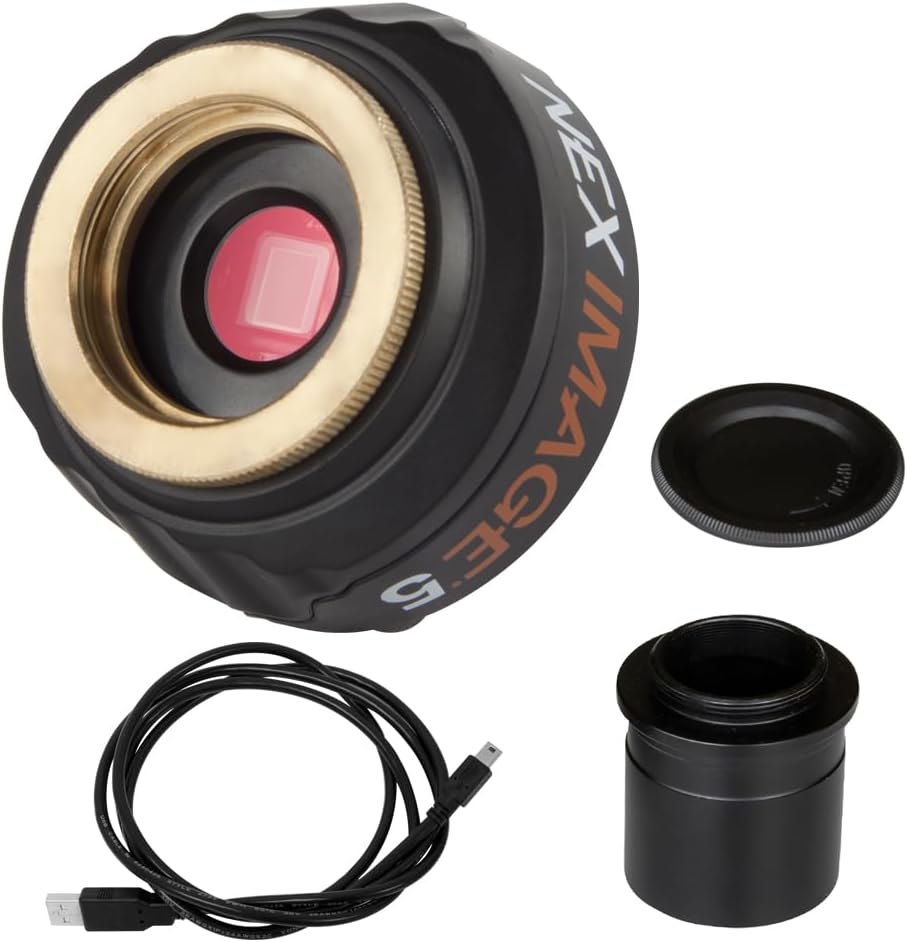
Celestron NexImage 5
Pairs well with the 8SE for short-video lunar, Jupiter, and Saturn imaging.
Check Price on Amazon →Is the NexStar 8SE Good for Astrophotography?
For planetary and lunar imaging, excellent. For deep-sky astrophotography, possible but limited without upgrades.
Planetary and Lunar Astrophotography
This is where the 8SE shines. The 2032mm focal length produces large-scale images of the Moon and planets, and the GoTo mount's tracking keeps them centered. Pair the 8SE with a planetary camera (recording high-frame-rate video), stack the sharpest frames in software like AutoStakkert, and you'll produce images that rival much more expensive setups.
The f/10 focal ratio is ideal for planetary imaging - it provides enough native magnification that you don't need a Barlow to reach useful image scale for Jupiter and Saturn.
For a detailed walkthrough, see our complete guide to astrophotography with the Celestron 8SE.
Deep-Sky Astrophotography
The alt-azimuth mount introduces field rotation during long exposures - stars at the edges of your frame trail in curved arcs. This limits unguided exposures to roughly 15-30 seconds before trailing becomes visible.
The solution: the Celestron EQ wedge. This accessory tilts the mount to match Earth's rotational axis, converting the alt-azimuth mount into a pseudo-equatorial platform. Combined with the 8SE's auto-guider port and a guide scope, this setup enables exposures of several minutes - enough to capture bright nebulae and galaxies. It's not as precise as a dedicated German equatorial mount, but it works well enough for intermediate deep-sky imaging.
For a beginner approach, see our DSLR astrophotography on a budget guide, which covers the fundamentals of telescope-camera connection and stacking.
Related: 15 Best Telescopes for Astrophotography
Pros: Where the NexStar 8SE Excels
GoTo Convenience
The 40,000-object database and motorized tracking transform the observing experience. Instead of spending time searching for objects, you spend time observing them. This matters most for: beginners who don't yet know the sky, experienced observers who want to maximize observing time, and anyone sharing views with friends or family where speed between objects keeps the session engaging.
Portability for an 8-Inch Scope
The SCT design packs 2032mm of focal length into a tube that's only 17 inches long and weighs 24 lbs with the mount. For comparison, an 8-inch Newtonian with the same aperture has a tube 36 inches long. The 8SE fits in a car's back seat, a large backpack, or a closet shelf. For an 8-inch scope, this is exceptional portability.
Low Maintenance
The sealed SCT tube protects the optics from dust and moisture. Collimation is rarely needed - the design holds alignment well under normal transport. When it does need adjustment, it's a simple process involving three screws on the secondary mirror (no laser collimator or Cheshire eyepiece needed). Replace the factory Phillips screws with "Bob's Knobs" (thumb screws) and collimation becomes a tool-free, 2-minute job.
Upgrade Path
The 8SE grows with you. Add the f/6.3 focal reducer for wider deep-sky views. Add the EQ wedge for astrophotography. Add the SkyPortal WiFi module for smartphone control. Add a 2-inch diagonal for premium wide-field eyepieces. The Vixen-style dovetail means the optical tube can eventually migrate to a full equatorial mount when you're ready.
Optical Quality
Celestron's StarBright XLT coatings on the corrector plate, primary, and secondary mirror maximize light transmission. The 8-inch aperture resolves detail to 0.57 arc seconds - sufficient to split close double stars and reveal fine planetary features that smaller scopes can't touch.
Cons: Where the NexStar 8SE Falls Short
Price
At roughly $1,200-$1,600 depending on bundle and sale pricing, the 8SE costs 2-3× more than a Dobsonian with identical aperture. You're paying for the GoTo mount, the compact tube, and the upgrade path. If you value pure aperture-per-dollar for visual observing, a Dobsonian is a better value. The 8SE is a better value when you weigh the features you're buying.
Single Eyepiece Included
The 8SE ships with a single 25mm Plössl eyepiece (81× magnification). For a telescope at this price point, this is stingy. You'll need a shorter focal length eyepiece (8-12mm range) for planetary magnification almost immediately. Budget $50-100 for an additional eyepiece on top of the telescope's price. See our eyepiece sizing guide for specific recommendations matched to this focal length.
Narrow Field of View
At f/10, the maximum true field is ~1.2° with a 2-inch wide-angle eyepiece - but the 8SE ships with a 1.25-inch visual back, limiting you to ~0.8° without an upgrade. Larger objects like the Pleiades cluster (~1.8°) won't fit in a single view. The Celestron f/6.3 focal reducer ($100-150) and a 2-inch diagonal ($60-100) solve this, but that's additional cost.
Cool-Down Time
The sealed tube traps heat. Moving the telescope from a warm house into cold air requires 30-60 minutes for the optics to reach thermal equilibrium. Until then, images appear soft and shimmering due to convective air currents inside the tube. In cold climates, this extends to 1-2 hours. Plan to set the scope outside well before your session. A dew shield helps prevent the corrector plate from fogging on humid nights.
Single-Fork Mount Limitations
The fork arm is adequate for visual observing and planetary imaging but flexes under heavy loads. Attaching a DSLR camera plus guide scope pushes the mount to its limits. For serious deep-sky astrophotography, you'll eventually want to move the optical tube to a proper equatorial mount - which adds $800-1,500 to the total investment.
Red Dot Finder is Inadequate
The included StarPointer red dot finder is the weakest accessory in the box. It shows no magnification and no stars fainter than naked-eye visibility, making initial alignment harder than it needs to be on light-polluted nights. Upgrading to a 6×30 optical finderscope ($25-40) or a Telrad reflex sight ($40-50) is one of the first upgrades most owners make.
What's in the Box
25mm Plössl eyepiece - delivers 81× magnification (2032 ÷ 25 = 81×). Functional for initial object finding and low-power views, but a single eyepiece for a telescope at this price is disappointing. Budget for at least one additional eyepiece.
StarPointer red dot finder - a zero-magnification reflex sight that projects a red dot onto the sky for aiming. Useful for initial GoTo alignment on bright stars, but not suitable for finding faint targets visually. Most owners upgrade this early.
NexStar+ hand controller - the interface for the GoTo system. Contains the 40,000+ object database, alignment routines, guided tours, and manual slewing controls. Clear LCD display with red backlight for night vision preservation.
Motorized single-fork-arm alt-azimuth mount - includes the DC servo motors, worm gear drives on both axes, and the mount head that connects to the tripod.
Steel tube tripod - adjustable-height legs with an integrated accessory tray. Sturdy for visual use; some vibration at high magnification on soft ground (place on a hard surface if possible).
NexStar 8SE vs. Alternatives: How It Compares
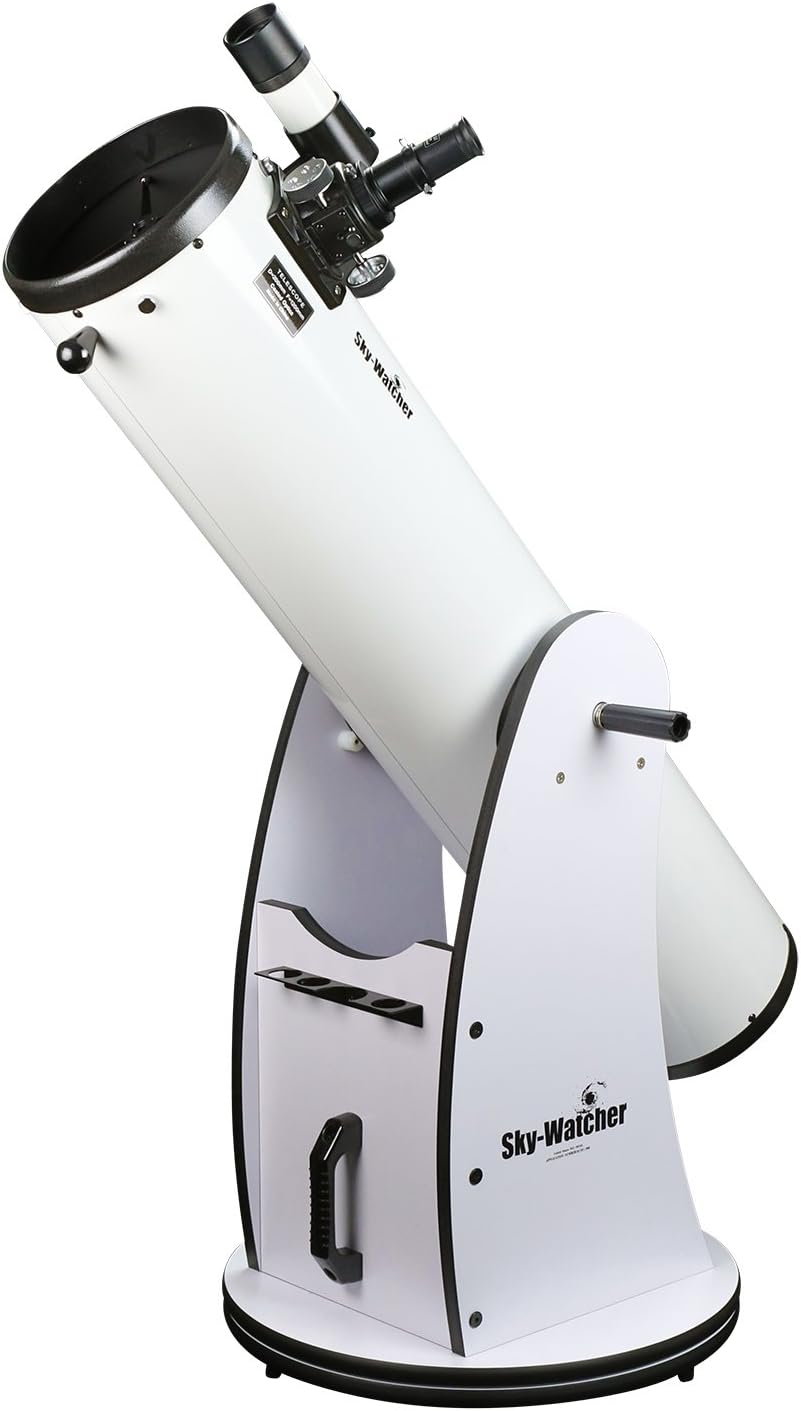
Sky-Watcher Classic 200P 8" Dob
Same aperture and similar visual reach for much less money if you do not need GoTo tracking or compact storage.
Buy at High Point →NexStar 8SE vs. Sky-Watcher 200P (8-Inch Dobsonian)
The 200P Dobsonian has identical 8-inch aperture and delivers identical views. The 200P costs $400-500 - roughly $700 less. Choose the 200P if you value aperture-per-dollar, don't mind finding objects manually, and primarily observe visually. Choose the 8SE if GoTo tracking, compact storage, and astrophotography potential justify the premium. This is the most common decision point, and our Schmidt-Cassegrain vs. Dobsonian comparison covers it in full detail.
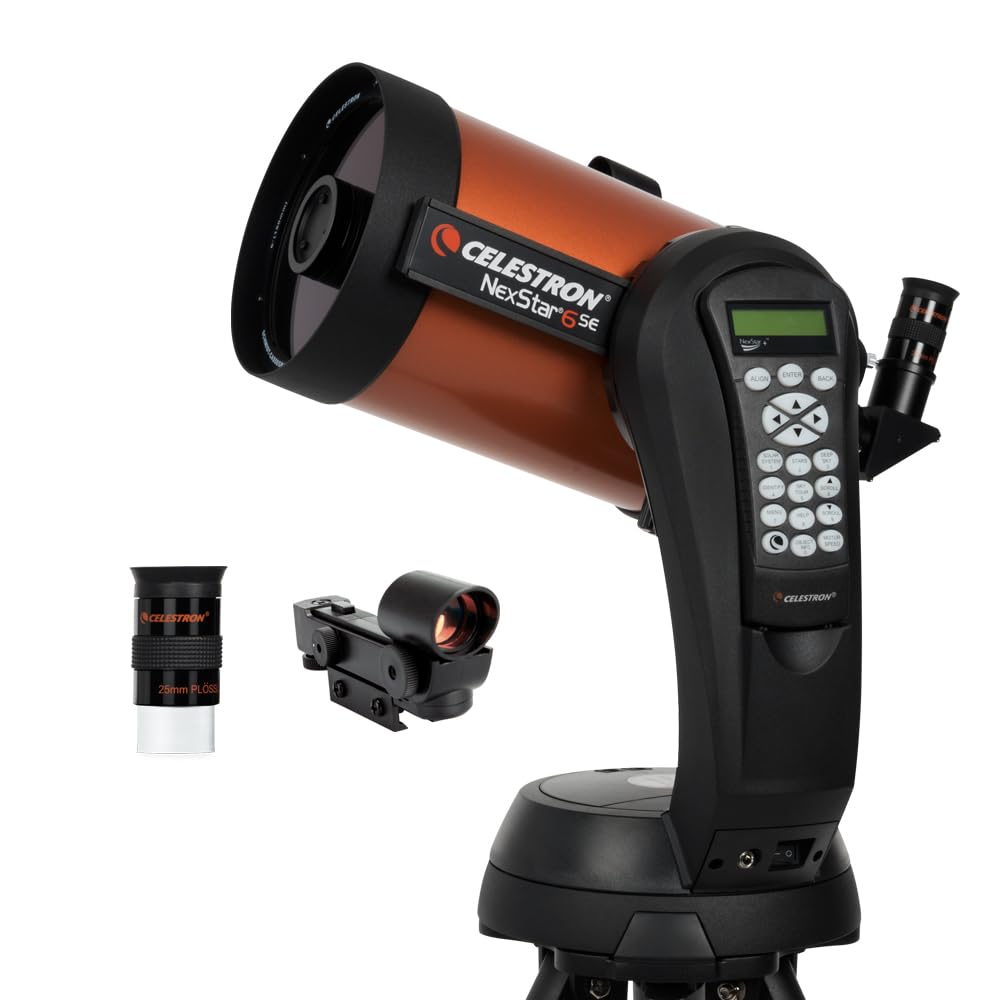
Celestron NexStar 6SE
Same SE experience in a lighter 6-inch tube. Cheaper and easier to carry, but noticeably dimmer on galaxies.
Compare 6SE price →NexStar 8SE vs. NexStar 6SE
The 6SE is the same GoTo mount with a 6-inch SCT tube. It costs ~$300 less and weighs 7 lbs less. But the 8SE's aperture collects 78% more light - a significant jump in deep-sky performance. Galaxies that are faint smudges in the 6SE show visible structure in the 8SE. Choose the 6SE if portability and budget are primary concerns. Choose the 8SE if you want the best views the SE series can deliver. For the full NexStar lineup, see our complete NexStar model breakdown.
NexStar 8SE vs. NexStar 5SE / 4SE
The 5SE (5-inch SCT) and 4SE (4-inch Maksutov) are smaller, lighter, and cheaper, but the aperture differences are substantial. The 8SE gathers 2.5× more light than the 5SE and 4× more than the 4SE. If budget constrains you to the smaller models, they're excellent for planets and bright objects - but the 8SE is in a different class for deep-sky work.
NexStar 8SE vs. Sky-Watcher Skymax 127
The Skymax 127 is a manual (non-GoTo) 5-inch Maksutov at ~$350. It's an excellent portable planetary scope but lacks tracking and collects 2.5× less light. Choose the Skymax 127 if you want a grab-and-go planetary scope at a quarter of the price. Choose the 8SE if you want tracking, deep-sky capability, and room to grow.
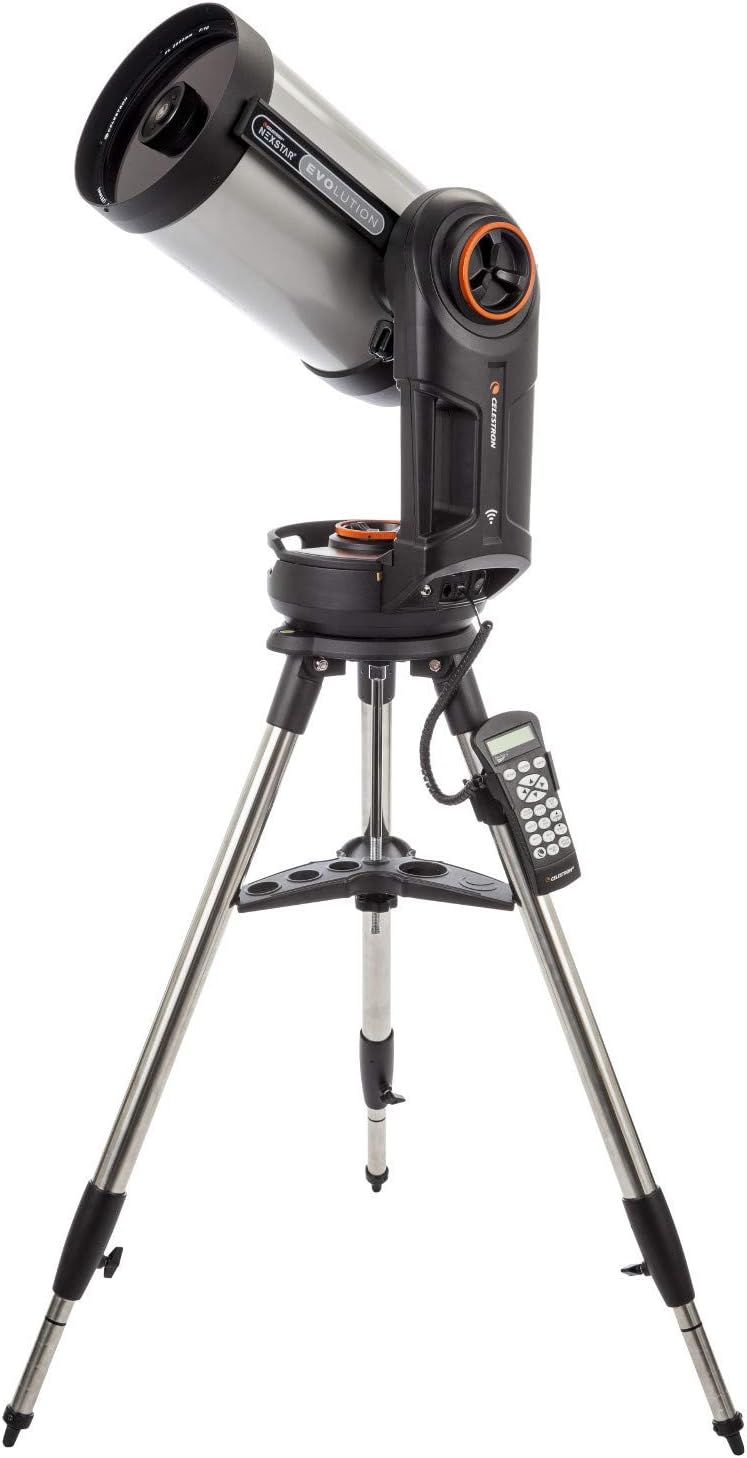
Celestron NexStar Evolution 8
Same 8-inch SCT class with built-in WiFi, internal battery, and a sturdier mount.
Compare Evolution 8 →NexStar 8SE vs. Celestron NexStar Evolution 8
The Evolution 8 is the 8SE's premium sibling - same 8-inch SCT optics, but with built-in WiFi (smartphone control via the SkyPortal app), a built-in rechargeable lithium battery (10+ hours), and a sturdier mount. It costs ~$500 more. Choose the 8SE if budget matters and you're willing to add WiFi later ($60 module). Choose the Evolution 8 if you want built-in WiFi and battery out of the box.
For the broader Celestron vs. Sky-Watcher comparison across all product lines, we have a dedicated guide.
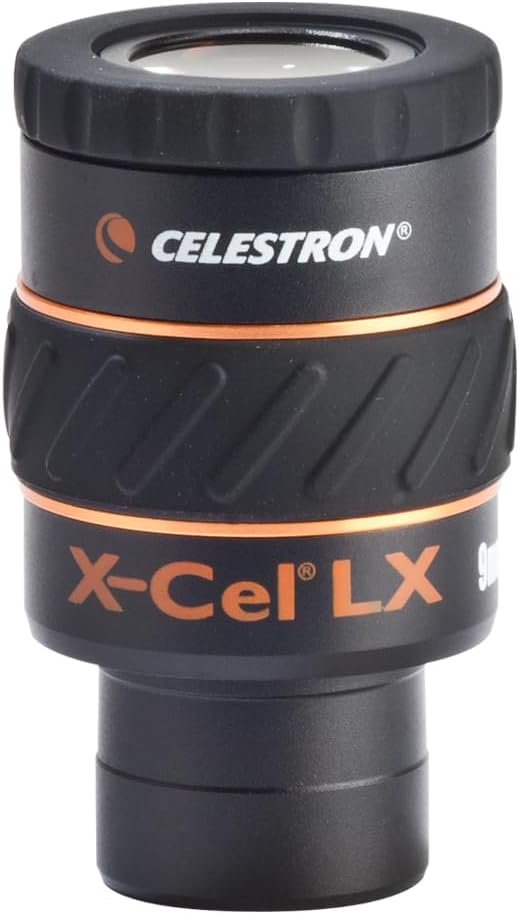
Celestron X-Cel LX 9mm
Gives about 226× in the 8SE, a useful magnification for Jupiter, Saturn, lunar detail, and double stars.
Check eyepiece price →
Celestron PowerTank Lithium Pro
Stops AA batteries from ending a GoTo session early. Useful for long backyard or field observing nights.
Check power supply →First Upgrades Worth Making
The 8SE is capable out of the box but has a few obvious gaps. These upgrades make the biggest impact, in priority order.
A shorter eyepiece for planetary magnification. The included 25mm eyepiece (81×) is too low for planetary detail. A 10mm eyepiece (~200×) and a 6-7mm eyepiece (~290-340×) cover the range you'll actually use on planets. The Celestron X-Cel LX series or the budget Goldline 66° eyepieces are popular starting points. Full breakdown in our eyepiece sizing guide.
A better finder. Replace the red dot finder with a 6×30 or 9×50 optical finderscope for easier GoTo alignment, or add a Telrad reflex sight for intuitive naked-eye aiming. Cost: $25-50.
A dew shield. The corrector plate radiates heat and collects dew on humid nights. A dew shield (an extended tube over the front) slows this. Cost: $20-40 commercial, or build one yourself.
External power supply. AA batteries die mid-session. A Celestron PowerTank or any 12V DC source keeps the mount running all night. Cost: $40-80.
A 2-inch diagonal and focal reducer (later). Opens up wide-field observing and makes deep-sky sweeping far more immersive. The Celestron f/6.3 reducer corrector is the single most transformative accessory for any SCT.
Setup and Collimation
Setup
The 8SE assembles in about 10-15 minutes once familiar. Extend the tripod legs, attach the accessory tray, mount the fork arm, and secure the optical tube onto the fork with the dovetail clamp. Insert the eyepiece into the diagonal and you're ready to align.
GoTo alignment (SkyAlign): Power on, enter your date/time/location (or use optional GPS), then center any two bright stars when prompted. The computer calculates your sky position and the mount is calibrated. The more carefully you center those alignment stars, the more accurate the GoTo pointing will be for the rest of the session.
Collimation
SCTs rarely need collimation, but when they do, it's straightforward. Point the telescope at a bright star, defocus slightly (you'll see a doughnut shape with the secondary mirror's shadow in the center), and check if the shadow is centered. If it's off-center, adjust the three small screws on the secondary mirror housing. No special tools beyond a screwdriver (or Bob's Knobs for tool-free adjustment). The procedure differs from Newtonian collimation - no laser collimator needed.
Temperature Equilibration
Set the scope outside 30-60 minutes before observing. The sealed tube traps warm air that creates shimmering "tube currents" visible as wavy star images. Patience here pays off in dramatically sharper views.
Frequently Asked Questions
Is the NexStar 8SE worth $1,100+?
If you value GoTo tracking, compact storage, astrophotography potential, and a telescope you won't outgrow for years, yes. If you primarily want to observe visually and don't mind finding objects manually, an 8-inch Dobsonian delivers identical optical performance for $400-500. The 8SE's premium buys convenience and versatility, not better views.
Can a complete beginner use the NexStar 8SE?
Yes. The GoTo mount actually makes the 8SE easier to use than a manual telescope - once alignment is complete, finding any object is a button press. The learning curve is the alignment process itself, which takes 2-3 sessions to master. Our Stargazing 101 guide walks through the process.
What's the difference between the NexStar 6SE and 8SE?
The 6SE has a 6-inch (150mm) aperture and the 8SE has an 8-inch (203mm) aperture. Same mount, same GoTo system, same accessories. The 8SE collects 78% more light, which means: brighter deep-sky objects with more visible detail, slightly more planetary detail on good nights, and the ability to see fainter objects (limiting magnitude ~14 vs ~13.4). The 8SE weighs 3 lbs more and costs ~$300 more. Full review: NexStar 6SE Review.
Does the NexStar 8SE need collimation?
Rarely. The sealed SCT design holds alignment well under normal use and transport. Check collimation every few months by defocusing a bright star - if the doughnut pattern is centered, you're fine. When adjustment is needed, it involves turning three screws on the secondary mirror and takes 5-10 minutes. No special tools required.
Can I do deep-sky astrophotography with the 8SE?
Yes, with upgrades. The alt-az mount alone limits exposures to ~15-30 seconds. Add the Celestron EQ wedge (~$200) to eliminate field rotation, plus a guide scope and camera for autoguiding, and you can take multi-minute exposures of nebulae and galaxies. This is an intermediate-level upgrade path. For a detailed walkthrough, see our astrophotography with the Celestron 8SE guide.
What power supply should I use?
For backyard observing, a 12V AC adapter plugged into a wall outlet is the simplest solution. For field use, a Celestron PowerTank or any 12V portable battery with a cigarette-lighter-style plug works. Avoid relying on AA batteries for sessions longer than 2-3 hours.
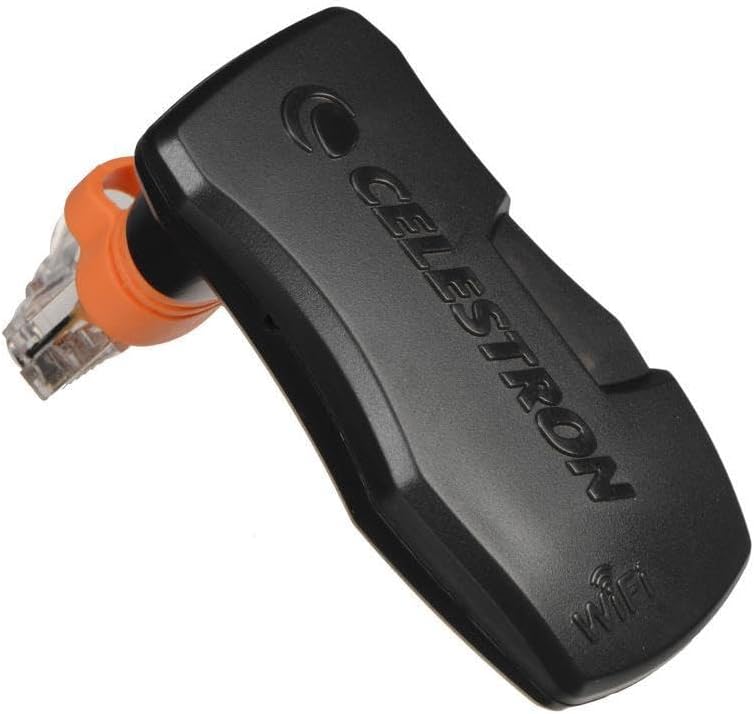
Celestron SkyPortal WiFi Module
Adds app-based GoTo control and a planetarium interface to compatible Celestron computerized mounts.
Check WiFi module →Can I control the 8SE from my phone?
Yes, with the Celestron SkyPortal WiFi module (sold separately, ~$60). It plugs into the mount's AUX port and creates a WiFi network. The free SkyPortal app (iOS/Android) then provides wireless GoTo control, a planetarium view, and a 120,000+ object database.
How does the 8SE compare to the NexStar Evolution 8?
Same 8-inch SCT optics. The Evolution adds built-in WiFi, a built-in rechargeable lithium battery (10+ hours), a sturdier mount, and comes with a 2-inch diagonal. It costs ~$500 more. If you plan to add the WiFi module to the 8SE anyway, the Evolution's total value proposition is stronger - but the 8SE gives you 90% of the experience at a lower entry price.
Is the mount stable enough for visual use?
Yes, for visual observing the single-fork arm is adequately stable. You'll see brief vibrations when touching the scope (focusing, changing eyepieces) that dampen within 2-3 seconds. On windy nights or soft ground, vibration increases. Hanging a weight from the accessory tray and observing on hard surfaces helps. For serious astrophotography with heavy cameras, the mount is the limiting factor.
Verdict: Is the Celestron NexStar 8SE Worth It?
The NexStar 8SE is the gold standard "do-everything" telescope for amateur astronomers who want one scope that handles visual observing, planetary imaging, and introductory deep-sky photography in a package that fits in a car. No other telescope at this price matches its combination of 8-inch aperture, computerized GoTo, and compact portability.
Buy the 8SE if you:
- Want GoTo tracking to find and follow objects automatically
- Value portability - the 17-inch tube and 33 lb total weight is manageable for one person
- Plan to try astrophotography eventually (the upgrade path exists)
- Want a telescope you'll use for 5-10+ years without outgrowing it
- Are a beginner willing to invest in a scope that skips the traditional upgrade cycle
Consider something else if you:
- Want maximum aperture per dollar for visual observing - get an 8-inch Dobsonian for half the price
- Primarily want wide-field deep-sky views - the f/10 focal ratio is narrow; consider a faster Newtonian or refractor
- Are on a tight budget - the NexStar 6SE or 5SE deliver the GoTo experience at a lower price with less aperture
- Want the most portable option possible - the Sky-Watcher Skymax 127 or Heritage 130P are far smaller and lighter
The NexStar 8SE has been the most recommended GoTo telescope for over 15 years for a reason: it balances power, convenience, portability, and upgrade potential better than anything else on the market. If you can afford it, it's one of the best investments in amateur astronomy.
Explore the NexStar family:
- NexStar 4SE Review
- NexStar 5SE Review
- NexStar 6SE Review
- All Celestron NexStar Models Compared
- Top Celestron Telescopes for Planets
- Celestron vs. Sky-Watcher: Which Brand?
New to stargazing? Our Stargazing 101 guide covers everything from your first night out to building an observation log.