Short answer: this guide's five picks by goal are the Sky-Watcher Virtuoso GTi 130P overall, the Gskyer 70mm on a small budget, the Celestron StarSense Explorer DX 102AZ for app guidance, the Celestron Astro Fi 130 for deep-sky objects and the Celestron 80mm Travel Scope for grab-and-go use.
| Goal | Pick | Type |
|---|---|---|
| Overall | Sky-Watcher Virtuoso GTi 130P | 130mm tabletop reflector with GoTo |
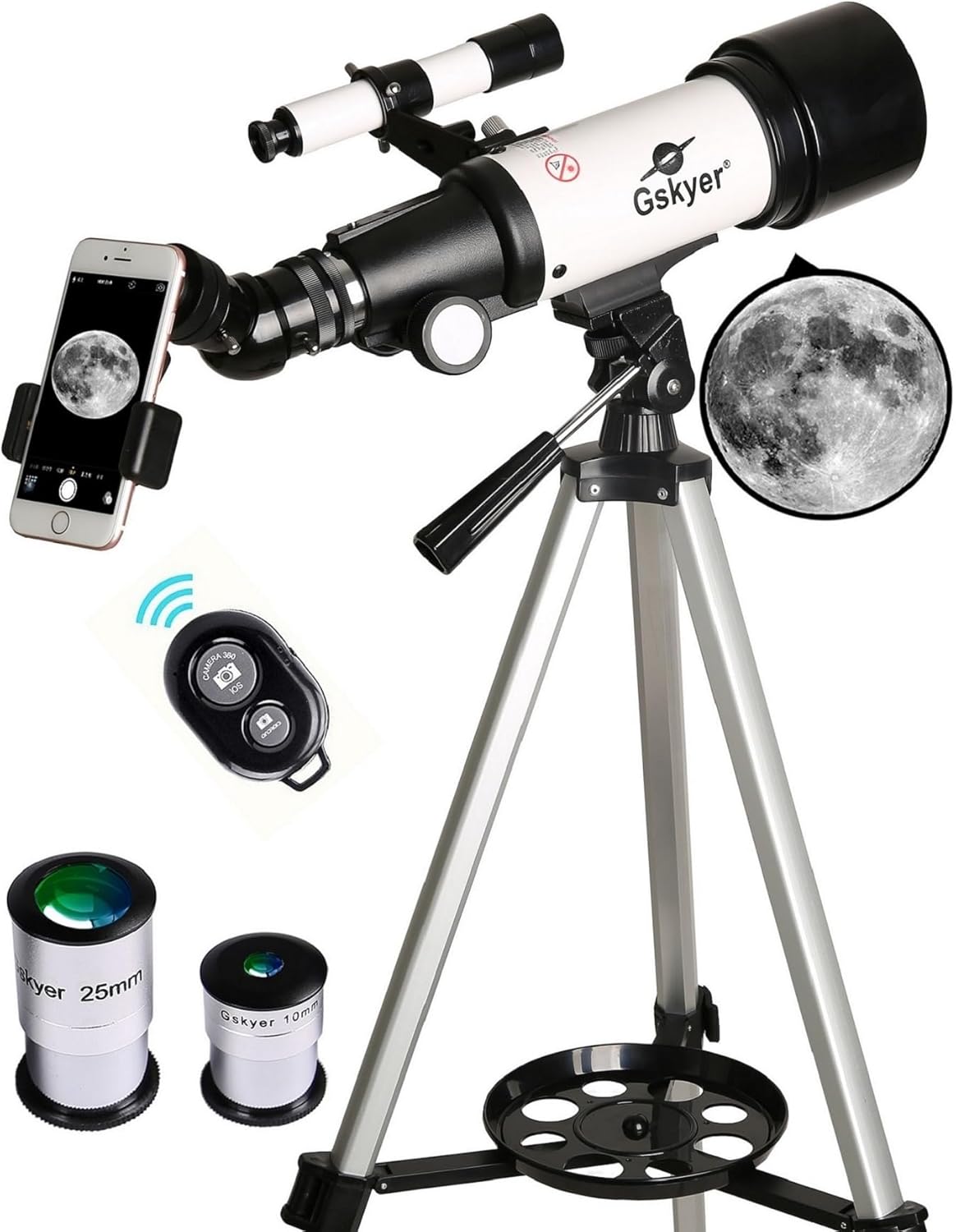
| Small budget | Gskyer 70mm AZ | 70mm refractor, manual |
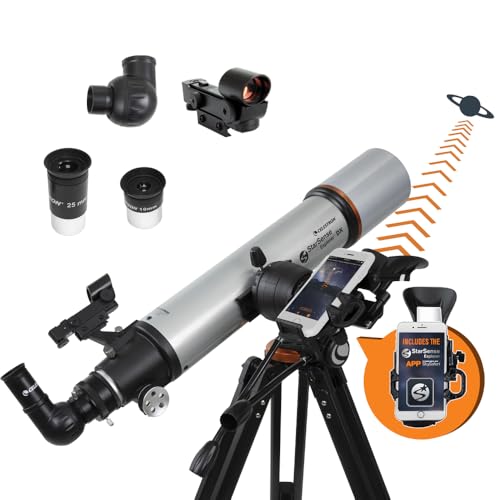
| App-guided | Celestron StarSense Explorer DX 102AZ | 102mm refractor, phone-guided |
| Deep-sky objects | Celestron Astro Fi 130 | Substitute for the NexStar 130SLT described below |
| Grab-and-go | Celestron 80mm Travel Scope | 80mm refractor, manual |
- Top 5 beginner telescopes by goal
- Overall Best telescope for beginners
- Best budget beginner telescope
- Best app-guided beginner telescope
- Best beginner telescope for deep-sky objects
- Best grab-and-go beginner telescope
- Best of the rest
- Takeaway: Choose the ideal beginner’s telescope for an optimal stargazing experience
Selecting the perfect telescope as a novice stargazer can be a daunting task with the multitude of options available.
To help you navigate this choice, here are some key considerations:
- Aperture: The aperture of a telescope impacts its light-gathering ability and image clarity. For beginners, recommended aperture sizes typically range from 2.8 inches to 10 inches.
- Focal length: The focal length affects both magnification and field of view. Longer focal lengths provide higher magnification but a narrower field of view, making them ideal for detailed planetary observations. In contrast, shorter focal lengths offer a wider field of view, suitable for capturing broader celestial scenes.
- Mount type: Telescopes come with different mount types, with altazimuth and equatorial being common options. Altazimuth mounts are user-friendly, making them suitable for beginners. Equatorial mounts, while more complex for beginners, are designed for tracking celestial objects as they move across the sky.
- Magnification: Magnification is essential for detailed views of celestial objects. For a beginner telescope, aiming for an ideal magnification level of around 50x is recommended.
In this guide, we’ll evaluate and rank the best telescopes tailored for beginners, simplifying the complexities of telescope specifications.
As an Amazon Associate, we earn from qualifying purchases. We may also earn a commission from other retailers linked on this page, at no extra cost to you.
Top 5 beginner telescopes by goal
- Overall best telescope for beginners:
 AmazonSky-Watcher Virtuoso GTi 130PView on Amazon →
- Best budget beginner telescope:
 AmazonGskyer Telescope, 70mm Aperture 400mm AZ MountView on Amazon →
- Best app-guided beginner telescope:
 AmazonCelestron StarSense Explorer DX 102AZView on Amazon →
- Best beginner telescope for deep-sky objects:
 AmazonCelestron Astro Fi 130View on Amazon →
- Best grab-and-go beginner telescope:
 AmazonCelestron 80mm Travel ScopeView on Amazon →
Overall Best telescope for beginners
1. Sky-Watcher Virtuoso GTi 130P Telescope
- Aperture: 130 mm
The Sky-Watcher Virtuoso GTi 130P stands in here for the larger GTi 150P that this guide used to rank first.
It has an Altazimuth Mount that eliminates the need for complicated setups or polar alignments. This makes it a favorite for families or those wanting a straightforward, hassle-free stargazing experience. Its GTi mount can also find and track objects through the SynScan phone app over Wi-Fi, powered by AA batteries or a 12V supply.
See also: Celestron StarSense Explorer 8" Dob Review (#1 Beginner Telescope)
Best budget beginner telescope
2. Gskyer Telescope, 70mm Aperture 400mm AZ Mount
- Aperture: 70 mm
- Focal length: 400 mm
- What we like: Delivers remarkable clarity and resolution for its price and an easy assembly process suitable for beginners
- What we don’t like: Its compact size, while excellent for portability, may not offer the same depth of view as larger models
The Gskyer Telescope, 70mm Aperture 400mm AZ Mount, is a shining example of getting more for less. For a telescope positioned in the budget category, it boasts an impressive set of features that make it beginner-friendly and efficient in its performance.
The optical tube length of 400 mm paired with the Barlow eyepiece ensures that budding astronomers get crisp, clear, and high-resolution images of celestial entities.
The fully coated optics glass lens enhances image brightness and clarity, ensuring vibrant and detailed visuals. And with the 3x Barlow lens, magnification can soar up to 120X.
Adding to its user-friendly nature is the 5×24 finderscope with a wireless remote and smartphone adapter. These features allow even the most novice of astronomers to locate objects in the night sky effortlessly and capture stunning visuals.
Yet, what truly adds to the appeal of the Gskyer Telescope is its portability. Its compact dimensions, an adjustable aluminum alloy tripod, and a carry bag make transporting the telescope a breeze.
Best app-guided beginner telescope
3. Celestron StarSense Explorer DX 102AZ
- Aperture: 102 mm
- Focal length: 660 mm
- What we like: The integration of patented StarSense sky recognition technology with smartphone compatibility
- What we don’t like: Despite its innovative features, manual adjustment without the smartphone can be challenging for beginners
The StarSense Explorer DX 102AZ is built to help you find targets, not for long-exposure astrophotography. Its manual mount does not track, so photos are limited to phone snapshots of the Moon and bright planets. It has a 102 mm aperture and a 660 mm focal length.
In the age of smartphones, Celestron intelligently harnesses their capabilities with the patented StarSense sky recognition technology. This feature analyzes star patterns overhead, allowing the telescope to calculate its position in real time accurately.
The StarSense app provides a user-friendly interface coupled with detailed tutorials. The app guides the user in real time and generates a curated list of celestial objects currently visible from one’s location.
Its high-transmission XLT optical coatings amplify its clarity. The added features, like the two eyepieces, a red dot finderscope, and an adjustable tripod, ensure you have everything you need in one complete package.
Best beginner telescope for deep-sky objects
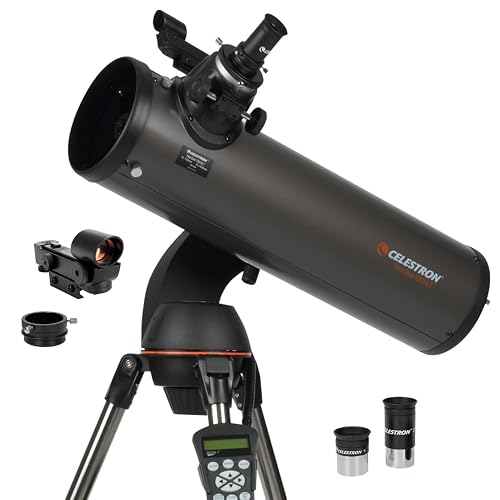
4. Celestron NexStar 130SLT Computerized Telescope
- Aperture: 130 mm
- Focal length: 650 mm
- What we like: Effortlessly marries technology and clarity, offering computerized star locating with an expansive database
- What we don’t like: Its dependency on a battery power source might limit extended observations in remote locations
The Celestron NexStar 130SLT encapsulates the essence of a high-quality telescope with its 130 mm aperture and 650 mm focal length. It can identify objects from a database of over 40,000 celestial entities and then track them.
This particular telescope excels in light-gathering capability due to its Newtonian reflector optical design.
The SkyAlign feature makes setup swift, and stargazers can immerse themselves in the vastness of the universe in minutes.
Just center any three bright objects in the eyepiece, and this smart telescope will calibrate itself and unveil the secrets of the night sky.
This Celestron telescope comes equipped with two distinct eyepieces, 25mm and 9mm. Eyepieces function as the telescope’s magnifying glass, determining the magnification and field of view.
The 25mm eyepiece offers a wider field of view, ideal for observing larger celestial objects or vast star clusters. On the other hand, the 9mm eyepiece provides higher magnification, allowing for detailed views of planets and closer celestial bodies.
Best grab-and-go beginner telescope
5. Celestron 80mm Travel Scope
- Aperture: 80mm
- Focal length: 400mm
- What we like: Its superior optics and ease of use make it one of the best telescopes for beginners eager to spot planets
- What we don’t like: Its beginner-level scope means amateur astronomers might outgrow it sooner than expected
The Celestron Travel Scope 80 packs an 80mm lens, two eyepieces and a backpack into a light kit. Its short 400mm focal length suits the Moon and wide star fields. For sharper planets, a longer telescope such as the DX 102AZ or the 130SLT does better.
This beginner-level telescope comes with two powerful eyepieces: the 20mm for low-power and the 10mm for high-power viewing. They ensure that both celestial and land-based targets appear in splendid detail.
The large 80mm aperture lens, while being notably brighter, ensures that the added weight is minimal, making it perfect for on-the-go observations.
The full-height tripod accompanying the scope supports an altitude azimuth mount. It is known for its ease of use and is especially favored by amateur astronomers.
Best of the rest
Orion and Meade: both companies stopped operating in 2024, and their assets went to auction in January 2025, so this list no longer includes their telescopes.
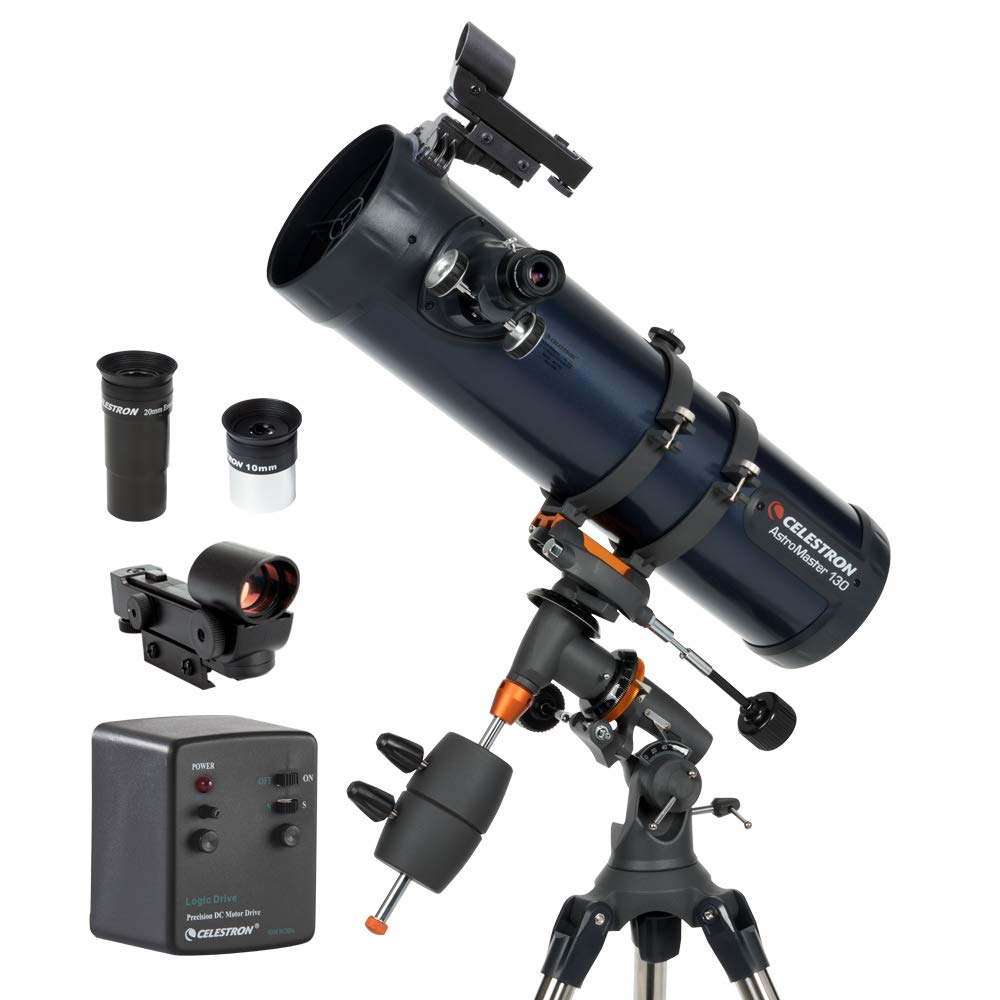
6. Celestron AstroMaster 130EQ MD Newtonian Telescope
- Aperture: 130 mm
- Focal length: 1000 mm
- What we like: The intuitive equatorial mount and precise optics make celestial observation seamless and enjoyable
- What we don’t like: Some beginners may find the initial setup of the equatorial mount slightly challenging
The Celestron AstroMaster 130EQ-MD Newtonian Telescope is a symbolic fusion of a Newtonian reflector mount type with an objective lens diameter of 130 millimeters.
- 6. Celestron AstroMaster 130EQ MD Newtonian Telescope
- 7. Sky-Watcher Heritage 130P
- 8. Celestron 76mm Signature Series FirstScope
- 9. Celestron StarSense Explorer 10-inch Dobsonian
- 10. Celestron PowerSeeker 127EQ Telescope
- 11. Celestron Astro Fi 102 Wi-Fi Maksutov Wireless Reflecting Telescope
- 12. Celestron StarSense Explorer LT 80AZ
- 13. Celestron AstroMaster 114EQ Newtonian Telescope
- 14. Celestron AstroMaster 102AZ Refractor Telescope
- 15. Gskyer Telescope 80mm Astronomical Refractor Telescope
- 16. Celestron PowerSeeker 50AZ Telescope
- 17. Celestron 70mm Portable Refractor Telescope
Celestron’s attention to detail is highlighted by the two Plossl eyepieces, each with different magnifications. The 20mm eyepiece, with its 45x magnification, offers broader, sweeping views of the night sky.
It is ideal for stargazing sessions where you wish to explore vast celestial expanses.
On the other hand, the 10mm eyepiece pushes the telescope’s capabilities with a 90x magnification. You can use it to hone in on distant cosmic entities with unparalleled clarity and perception.
Its reflex finderscope, colloquially known as the StarPointer red dot finderscope, aids users in aligning the telescope’s main optics to the desired celestial object with sheer precision. It acts as a navigational beacon for those new to stargazing.
The AstroMaster’s rugged, pre-assembled tripod guarantees stability, ensuring the telescope remains steadfast during prolonged viewing sessions.
The additional Starry Night Basic Edition astronomy software provides interactive sky simulations, printable sky maps, and a vast celestial object database.
7. Sky-Watcher Heritage 130P

- Aperture: 130 mm
The Sky-Watcher Heritage 130P takes this slot from the Meade LightBridge Mini 114, which is discontinued.
 AmazonDiscontinued. Current alternative: Sky-Watcher Heritage 130PView on Amazon →
Its Newtonian reflector ensures crisp views of planets, nebulae, star clusters, and more, encapsulating the true essence of a stargazing experience.
8. Celestron 76mm Signature Series FirstScope
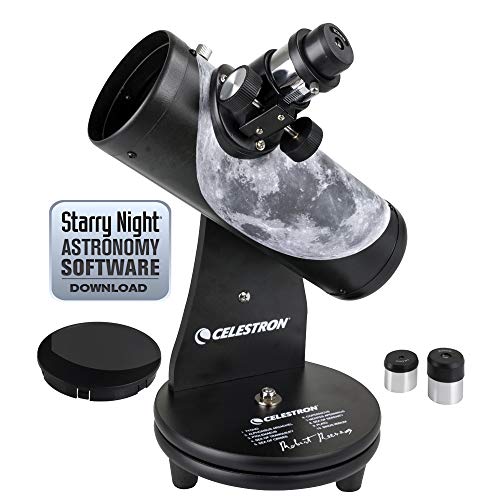
- Aperture: 76mm
- Focal length: 300mm
- What we like: The blend of a 76mm aperture with a concise 300mm focal length offers brilliant, detailed lunar landscapes
- What we don’t like: Its dependence on a tabletop Dobsonian mount may limit viewing positions
Dobsonian telescopes stand out for their user-friendly design, and the Celestron 76mm Signature Series FirstScope is a prime example. With a substantial 76mm aperture housed in a Dobsonian-style tabletop stand, this reflector telescope promises crisp, clear views of celestial wonders.
From the rings of Saturn to the stunning Orion Nebula, its optics ensure that users get the most out of their nighttime observations.
The FirstScope boasts a custom wrap showcasing iconic lunar landmarks, turning the telescope into a moon exploration guide. Whether captivated by the crater Tycho or the Sea of Tranquility, you’re in for a treat.
The telescope’s 300mm focal length, complemented by its two eyepieces, allows for up to 75x magnification.
This Celestron telescope comes with many resources, such as the Starry Night educational software and the SkyPortal planetarium app. It equips stargazers to dive deeper into the mysteries of the cosmos.
The inclusion of Robert Reeves’ Lunar Landscapes eBook further enriches the experience, offering insights into our celestial neighbor.
However, its size does mean that it may not capture deep-space objects as vividly as larger models.
9. Celestron StarSense Explorer 10-inch Dobsonian

- Aperture: 10 inches
- Focal length: 1200 mm
- What we like: The patented StarSense sky recognition technology seamlessly integrates with your smartphone to offer real-time celestial guidance with pinpoint accuracy
- What we don’t like: Despite the high-tech features, beginners might require some time to utilize its massive 10-inch aperture for optimal viewing
The Celestron StarSense Explorer 10-inch Dobsonian has a remarkable 10-inch aperture and a focal length of 1200 mm. This Dobsonian telescope is perfectly engineered to capture night sky objects in exquisite detail.
The high-quality parabolic primary mirror equipped with XLT reflective coatings ensures you have enough light-gathering prowess to satisfy your curiosity.
The Celestron StarSense Explorer has an ultra-stable Dobsonian base. It features large-diameter altitude bearings with variable tensioning and Teflon azimuth bearings, guaranteeing smooth tracking and precise aiming.
The additional braces on the side panels only further the stability, ensuring your observation sessions remain uninterrupted.
Its thoughtful accessories further complement the standout capabilities of this telescope. Its 2″ Crayford focuser ensures precise and smooth adjustments to achieve sharp images.
The StarSense smartphone dock integrates your phone for real-time star pattern analysis. The 25mm Plössl eyepiece provides clear and broad views of celestial objects, while the StarPointer red-dot finder aids in quickly aligning and locating these objects in the sky.
10. Celestron PowerSeeker 127EQ Telescope

- Aperture: 127mm
- Focal length: 1000mm
- What we like: Impeccable light-gathering ability, showcasing detailed views of the celestial wonders
- What we don’t like: For newcomers, the manual German Equatorial mount may initially present a steeper learning curve
Embarking on a journey through the cosmos has never been more accessible, thanks to the Celestron PowerSeeker 127EQ Telescope. This entry-level giant with a 127mm aperture and a 1000mm focal length stands as an exemplar of combining power, quality, and value.
Its manual German Equatorial mount is integral to the PowerSeeker’s design. It is aided by large slow-motion control knobs to ensure smooth and precise tracking of celestial bodies as they traverse the night sky.
While this mount type offers exceptional stability and accuracy, the manual operation may necessitate a brief familiarization period for those new to astronomy.
The PowerSeeker 127EQ houses 20mm and 4mm eyepieces, each catering to different magnification needs. An additional 3x Barlow lens triples the magnifying power of each eyepiece.
The 20mm and 4mm eyepieces give 50x and 250x. The Barlow pushes the numbers higher, but a 127mm telescope rarely shows a sharp view much above 250x, so treat the top figures as marketing.
Celestron includes a free download of its top-rated Starry Night Basic Edition astronomy software. This digital companion, compatible with Macs, PCs, and laptops, provides a comprehensive guide to over 10,000 celestial objects, complete with printable sky maps.
Rounding off the package is an adjustable, full-height tripod with a deluxe tray. It ensures stability while providing convenient storage for all your stargazing tools.
11. Celestron Astro Fi 102 Wi-Fi Maksutov Wireless Reflecting Telescope

- Aperture: 102mm
- Focal length: 1325mm
- What we like: The seamless smartphone integration that makes celestial navigation a breeze
- What we don’t like: The reliance on a consistent Wi-Fi connection might deter stargazers in more remote locations
With a 102mm aperture and a lengthy 1325mm focal length, the Celestron Astro Fi 102 Maksutov-Cassegrain wireless reflecting telescope is at the cutting edge of beginner telescopes, boasting a focal ratio that guarantees sharp image quality of planetary and deep-sky wonders.
WiFi integration allows you to command it effortlessly via the SkyPortal app. You can convert any tablet or smartphone into a telescope control hub.
While many beginner telescopes may fumble with alignment, Celestron’s proprietary SkyAlign procedure simplifies the process - pick any three bright celestial objects, center them, and let the computerized mount calibrate itself to the night sky.
Once calibrated, tracking down thousands of celestial bodies becomes a matter of pointing, tapping, and observing as the motorized mount does the heavy lifting for you.
The Astro Fi 102 comes generously equipped with a red dot StarPointer finderscope and Kellner eyepieces (10mm and 25mm), which aids in easy celestial targeting.
The mirror star diagonal enhances image quality by diverting the light path, providing a comfortable viewing angle. It also features a unique accessory tray designed with organization in mind.
12. Celestron StarSense Explorer LT 80AZ
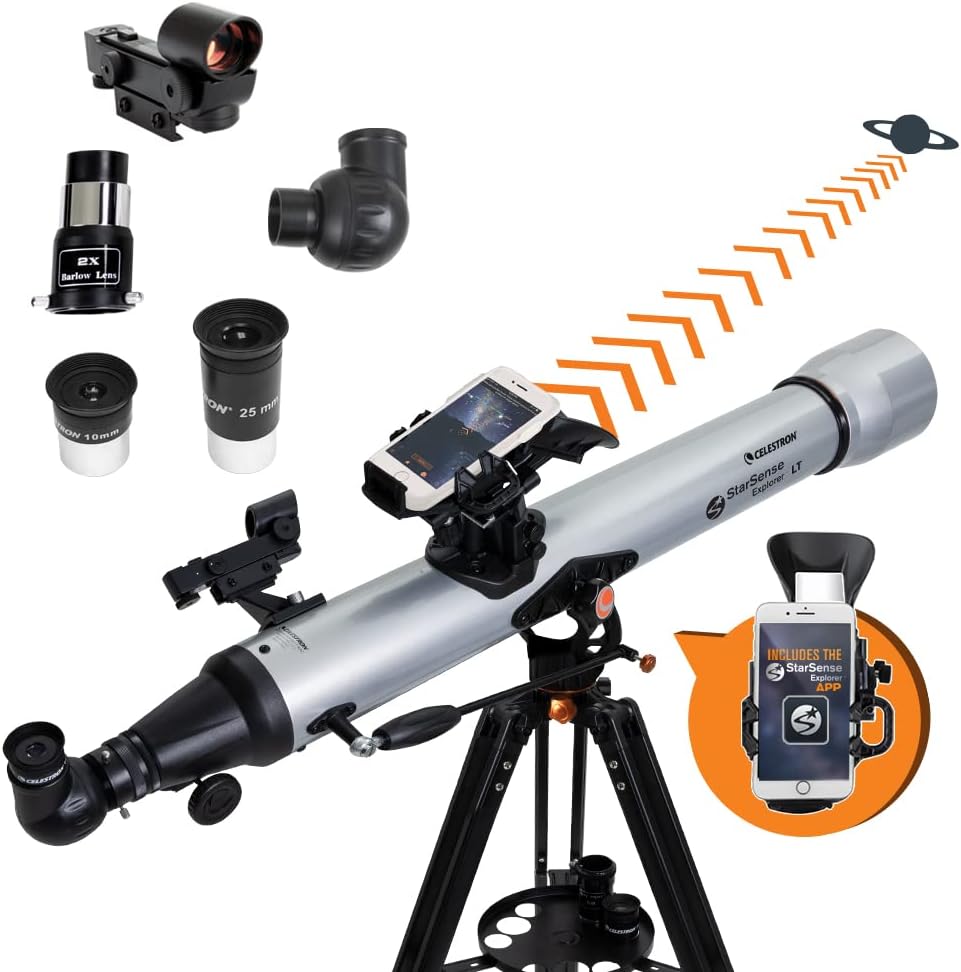
- Aperture: 80mm
The Celestron StarSense Explorer LT 80AZ takes this slot from the Meade Infinity 80mm AZ Refractor, which is discontinued.
 AmazonDiscontinued. Current alternative: Celestron StarSense Explorer LT 80AZView on Amazon →
13. Celestron AstroMaster 114EQ Newtonian Telescope

- Aperture: 114mm
- Focal length: 1000mm
- What we like: The seamless blend of power and user-friendly design makes it a leading choice as a first telescope
- What we don’t like: Manual tracking may be challenging for some beginners during extended viewing sessions
The Celestron AstroMaster 114EQ Newtonian Telescope features a generous 114mm aperture and a focal length of 1000mm. This telescope guarantees crisp, detailed views of the solar system, such as the rings of Saturn to the far reaches of deep sky objects.
The AstroMaster 114EQ has a dual-purpose design for both terrestrial and celestial viewing. The Newtonian reflector optical design harnesses light effectively, making the night sky accessible and vivid.
The telescope’s German Equatorial mount, equipped with two slow-motion control knobs, facilitates smooth tracking of celestial objects as they traverse the sky.
The package comes replete with essential accessories designed to elevate your stargazing experience. Two eyepieces (20mm and 10mm) offer versatile magnification options: a wider, expansive view at 45x with the 20mm and a closer, detailed perspective up to 90x with the 10mm.
Complementing these is the StarPointer red dot finderscope, aiding in quickly aligning and locating celestial objects.
This ensemble, combined with the telescope’s robust optics, delivers exceptional clarity, whether you’re gazing at the moon’s craters or distant galaxies.
14. Celestron AstroMaster 102AZ Refractor Telescope

- Aperture: 102mm
- Focal length: 660mm
- What we like: It beautifully marries powerful optics with user-friendly mechanics, making it a top contender in refractor telescopes
- What we don’t like: The manual Altazimuth mount, while smooth, may require frequent adjustments during extended viewing
The Celestron AstroMaster 102AZ steps into the refractor telescope realm with a flourish. Boasting a 102mm objective lens, it gathers light efficiently to project crisp images, making it one of the best telescope choices for budding astronomers.
Its 660mm focal length and quality optics ensure breathtaking celestial and terrestrial views.
The AstroMaster’s frame is lightweight and ensures a hassle-free setup, perfect for spontaneous stargazing sessions.
With its unique panning handle, the manual Altazimuth mount offers precision in pointing, ensuring your cosmic target remains within sight.
The Celestron AstroMaster 102AZ package includes two eyepieces (20mm and 10mm) suitable for varying magnifications. The erect image star diagonal corrects the orientation, making land observations pleasing.
The StarPointer red dot finderscope is a handy guide, easily pinpointing objects.
With the added perk of a free astronomy software download, identifying and learning about celestial bodies becomes a breeze.
15. Gskyer Telescope 80mm Astronomical Refractor Telescope

- Aperture: 80mm
- Focal length: 400mm
- What we like: The telescope’s quality optics deliver ultra-clear views, making it a top pick among the best telescopes for beginners
- What we don’t like: The tripod, although adjustable, might not be sturdy enough for more serious observations
The Gskyer 80mm Astronomical Refractor Telescope encapsulates what beginner telescopes should aim for: clarity, ease of use, and educational potential. With an 80mm aperture and 400mm focal length, this refractor telescope captures bright, detailed images of celestial objects.
Its quality optics, coated for enhanced brightness, make it stand out among telescopes for beginners, ensuring not just stunning views but also protection for the eyes.
It comes with three replaceable eyepieces (16X, 40X, 80X), enhancing its range of magnification options. The 3X Barlow lens, when combined with these eyepieces, can triple the magnification, allowing users to get up-close views of distant celestial wonders.
The 6*30 finder scope, paired with an erect-image diagonal, is a user-friendly addition that aids in pinpointing and centering objects in the sky.
The telescope is set atop an adjustable tripod and can be positioned at various viewing angles, catering to observers of different heights and preferences.
16. Celestron PowerSeeker 50AZ Telescope

- Aperture: 50mm
- Focal length: 600mm
- What we like: Its user-friendly design makes it one of the best telescopes for beginners craving an introduction to stargazing
- What we don’t like: The basic telescope structure might leave advanced astronomers yearning for more
The Celestron PowerSeeker 50AZ features a 50mm aperture and a 600mm focal length. This refractor telescope is finely tuned to gather light efficiently, revealing the celestial wonders from the Moon s captivating craters to distant planets.
Telescopes for beginners should offer simplicity, and the PowerSeeker’s manual yoke mount delivers on this front. The yoke mount’s slow-motion altitude rod ensures smooth navigation across the night sky.
This basic telescope is complemented by a suite of accessories designed to elevate your viewing experience. With three eyepieces (20mm, 12mm, and 4mm), users have a range of magnification options.
The 3x Barlow lens triples the power of each eyepiece, giving a more detailed look at distant cosmic bodies.
Moreover, Celestron includes a top-rated astronomy software download that enhances your knowledge and experience.
17. Celestron 70mm Portable Refractor Telescope

- Aperture: 70mm
- Focal length: 400mm
- What we like: The robust optics combined with a lightweight frame make it one of the best telescopes for beginners seeking portability without compromising quality
- What we don’t like: The tripod, while portable, may not offer the stability desired by some advanced users
The Celestron 70mm Portable Refractor Telescope has high-quality, fully-coated glass optics and a robust 70mm objective lens. Its compact 400mm focal length further complements this, ensuring vivid images without cumbersome weight.
Celestron includes two powerful eyepieces (20mm and 10mm) to elevate the viewing experience.
While the 20mm eyepiece offers broader, more expansive views, the 10mm zooms in for a closer look, suitable for observing the moon’s craters or distant planets.
With its clutch mechanism, the pan handle Alt-Az control ensures smooth and precise pointing, catering to those celestial curiosities with ease.
It features a full-height tripod that provides stability during observations.
The free top-rated astronomy software program helps beginners navigate the night sky and identify celestial objects, enhancing the overall stargazing experience.
Takeaway: Choose the ideal beginner’s telescope for an optimal stargazing experience
Stepping into stargazing is exhilarating, offering novices a passport to the universe. Today’s telescope presents many choices tailored to cater to multiple interests.
Whether it is the thrill of capturing celestial wonders through astrophotography or having specific interests like planetary viewing or deep-sky explorations, our guide meticulously breaks down the best options available for budding astronomers.
Every telescope has its strengths, and what matters most is aligning your cosmic curiosity with the right telescope. If the telescope is a present, our astronomy gift guide sorts gifts by budget and by who they are for.
You may also like: