Knowledge Base
Telescope Magnification: How It Works [+ Calculator]
Last updated: March 27, 2026
Magnification cheat sheetUse this before buying eyepieces or chasing huge “600x” claims.
FormulaScope ÷ eyepiece1200mm telescope ÷ 25mm eyepiece = 48x magnification.
Useful ceilingAbout 2x aperture in mmA 100mm telescope usually tops out around 200x on a steady night.
Best first range40x–120xMost beginners get sharper, easier views here than at extreme power.
Red flagBox claims like 675xHigh magnification is empty if the image is dim, shaky, or blurry.
Rule of thumb: Start low, focus sharply, then increase power only when the object and sky conditions can handle it.
Telescopes offer a fascinating glimpse into the universe, allowing us to observe distant celestial objects in greater detail. However, selecting the right telescope magnification can be a daunting task, particularly for beginners.
Understanding telescope magnification is crucial to get the most out of your equipment and achieving the desired results.
In this beginner’s guide, we’ll explore telescope magnification in detail, including what it is, how it works, and how to calculate it.
#1 Eyepiece Upgrade
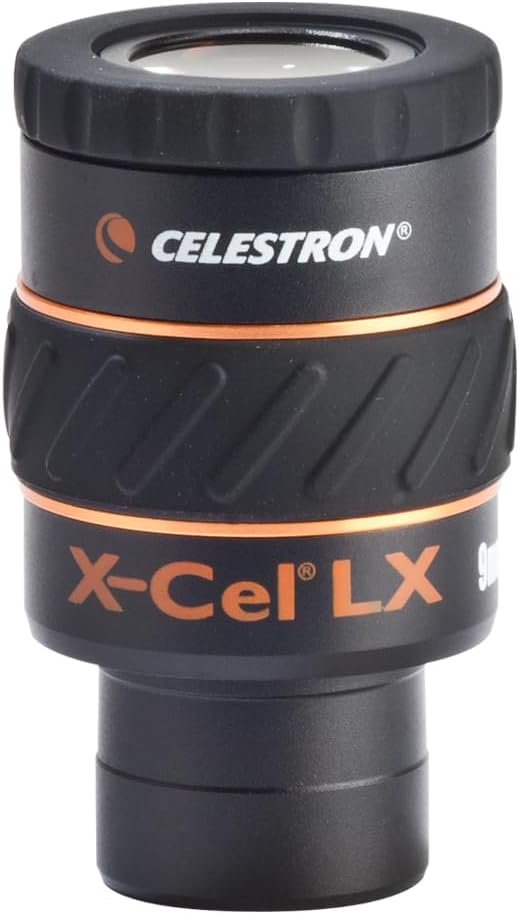
Celestron X-Cel LX 9mm
★★★★★
The single best eyepiece upgrade you can make. 60° field of view, sharp to the edge, transforms any telescope.
1.25" Eyepiece
View on Amazon →How does telescope magnification work?
Telescope magnification is achieved by increasing the apparent size of the object being viewed. This is done using a combination of lenses and mirrors in the telescope’s optical system.
The telescope’s objective lens or primary mirror collects and focuses light from the object. The eyepiece lens magnifies the image formed by the objective lens, making it appear larger.
Pro Tip
Start with your lowest magnification eyepiece (highest mm number) to find objects first, then swap to higher power eyepieces to zoom in. Jumping straight to high magnification makes it nearly impossible to locate targets.
How to calculate telescope magnification
The magnification of a telescope is determined by dividing the focal length of the telescope by the focal length of the eyepiece. This gives the telescope's magnification power, which is also known as the magnification factor.
For example, if the telescope has a focal length of 1000mm and the eyepiece has a focal length of 20mm, the magnification power would be 50x.
Telescope magnification formula
The formula to calculate the magnification power of a telescope is:
Magnification Power = Telescope Focal Length / Eyepiece Focal Length
Where:
- Telescope Focal Length = the distance between the objective lens or primary mirror and the point where the image is formed in the telescope.
- Eyepiece Focal Length = the distance between the eyepiece lens and the point where the image is formed in the eyepiece.
Telescopes come in different sizes and designs, and eyepieces also have different focal lengths.
The magnification of a telescope is determined by the focal length of the same and the focal length of the eyepiece being used. Calculating a telescope's magnification can be done using these elements.
Here are some examples of telescope magnification in different eyepieces and telescopes using the telescope magnification formula:
- A 1000mm focal length telescope with a 10mm eyepiece will give a magnification of 100x (1000/10=100).
- A 1200mm focal length telescope with a 6mm eyepiece will give a magnification of 200x (1200/6=200).
- A 2000mm focal length telescope with a 25mm eyepiece will give a magnification of 80x (2000/25=80).
- A 500mm focal length telescope with a 4mm eyepiece will give a magnification of 125x (500/4=125).
How do I find my eyepiece focal length?
The focal length of an eyepiece is the distance from the eyepiece’s optical center to the point where it forms a focused image of an object being observed. You can find the focal length of an eyepiece by looking for the specifications on the eyepiece itself or the manufacturer’s website.
If the focal length of an eyepiece is not written on the body, you can determine it experimentally using a telescope and a distant object with a known size.
You can achieve this by doing the following:
- Choose a distant object of known size, such as the Moon or a terrestrial landmark.
- Set up your telescope and select a low-magnification eyepiece.
- Adjust the focus until the object appears sharp and clear.
- Measure the distance between the eyepiece and the object being observed. This can be done by measuring the distance between the eyepiece and the primary mirror or objective lens and then adding the distance from the mirror or lens to the object.
- Measure the size of the object’s image formed by the eyepiece. This can be done by measuring the diameter of the image with a ruler or a caliper.
- Use the following formula to calculate the focal length of the eyepiece: fE = FL x d / D
where:
fE = focal length of the eyepiece
FL = focal length of the telescope
d = distance between the eyepiece and the object being observed
D = size of the object’s image formed by the eyepiece
Note: Use the same units for all measurements (e.g. millimeters or inches).
For example, let's say you have a telescope with a focal length of 1000mm and observe the Moon with an eyepiece. The distance between the eyepiece and the Moon is 1500mm, and the size of the Moon’s image formed by the eyepiece is 12mm; then you can calculate the focal length of the eyepiece as:
fE = 1000 x 1500 / 12
fE = 125,000 / 12
fE = 10,416.67mm
Therefore, the focal length of the eyepiece is approximately 10,416.67mm.
How do I find my telescope focal length?
The focal length of a telescope is typically listed in the telescope’s specifications. If it is not provided, you can measure the distance from the objective lens or primary mirror to the point where the image is formed.
Here are the steps to measure the focal length of a telescope:
- Remove the eyepiece from the telescope so that you can see the objective lens or primary mirror.
- Place a piece of paper a few inches away from the end of the telescope.
- Adjust the focus until you get a sharp image of a distant object, such as a building or tree.
- Measure the distance from the paper to the objective lens or primary mirror. This is the focal length of the telescope.
It’s important to note that the above method only provides an approximate measurement of the focal length. For a more accurate measurement, you may need to use more advanced equipment or consult with a professional.
Telescope magnification calculator
A telescope magnification calculator is a useful tool that helps you determine the magnification of your telescope based on the focal length of the telescope and the eyepiece.
You can find many online calculators by searching for “telescope magnification calculator.” Simply input the focal lengths of your telescope and eyepiece, and the calculator will give you the magnification.
Features of a telescope magnification calculator
A telescope magnification calculator usually has the following features:
Input fields for telescope aperture
This is the diameter of the telescope’s main lens or mirror, measured in millimeters or inches. It is a crucial factor in determining the telescope’s light-gathering ability, which affects the image’s brightness and clarity.
Input fields for telescope focal length
This is the distance between the telescope’s main lens or mirror and its focal point, measured in millimeters or inches. It determines the magnification power of the telescope, as a higher focal length provides higher magnification.
Input fields for eyepiece focal length
This is the distance between the eyepiece lens and the telescope’s focal point, measured in millimeters or inches. It determines the magnification power of the eyepiece, which, combined with the telescope’s focal length, provides the overall magnification.
Input fields for Barlow lens usage
This is an optional field for users who want to increase the magnification of their telescope by using a Barlow lens. Users can input the Barlow lens’s magnification factor to calculate the final magnification.
Magnification calculation
Once the user inputs the necessary values, the calculator automatically calculates the telescope’s magnification.
User-friendly interface
A good telescope magnification calculator should have a user-friendly interface with clear input fields and easy-to-read results.
Additional features
Some calculators may also include additional features such as the highest useful magnification of a telescope based on its aperture, the size of the exit pupil, and the field of view.
How to use a telescope magnification calculator
Here are the steps on how to use a telescope magnification calculator:
- Enter the aperture and focal length of your telescope into the calculator.
- Enter the focal length of your eyepiece into the calculator.
- Click on the “Calculate” button to find out the magnification of your telescope and eyepiece combination.
- If you want to see the same object with a different magnification, simply change the focal length of your eyepiece in the calculator and click on “Calculate” again to see the new magnification.
You can also use the telescope magnification calculator to determine the highest useful magnification of your telescope, which is the point at which the image starts to degrade due to factors like atmospheric conditions or telescope stability.
Simply enter the aperture of your telescope into the calculator and click on “Calculate” to find out the highest useful magnification.
Key Insight
More magnification is not always better. The "sweet spot" for most deep-sky objects is 50x to 150x. Planets can handle 150x to 250x on nights with good atmospheric seeing.
Telescope magnification chart
A telescope magnification chart is a table that lists the optimal magnification for different celestial objects. The chart is based on the aperture size of the telescope and the atmospheric conditions.
The magnification range for a given object is usually provided as a range with a lower and upper limit. You can find many magnification charts online or in astronomy books.
Want to go deeper? Our Stargazing Secrets course covers everything from your first night out to advanced observation techniques.
🔭 Stargazing Secrets — $19 →
What is the angular magnification of a telescope?
The angular magnification of a telescope is the ratio of the apparent angle of the object when viewed through the telescope to the apparent angle of the object when viewed with the naked eye.
It is given by the following formula:
Angular Magnification = Objective Lens Diameter / Eyepiece Focal Length
Angular magnification depends on the telescope’s focal length and the eyepiece being used.
For example, if you have a telescope with a focal length of 1000mm and an eyepiece with a focal length of 20mm, the angular magnification will be 50x.
Similarly, if you have a telescope with a focal length of 500mm and an eyepiece with a focal length of 5mm, the angular magnification will be 100x.
Different telescopes and eyepieces can have varying angular magnifications.
- A 6-inch Dobsonian telescope with a focal length of 1200mm and an eyepiece with a focal length of 10mm will provide an angular magnification of 120x.
- A 90mm Maksutov-Cassegrain telescope with a focal length of 1250mm and an eyepiece with a focal length of 25mm will provide an angular magnification of 50x.
It’s important to note that the quality of the eyepiece can also impact the angular magnification, with higher-quality eyepieces generally providing better image quality and a clearer view.
What’s a good telescope magnification?
A good telescope magnification depends on what you want to observe. For viewing planets, a magnification of around 30x to 50x per inch of aperture is recommended.
For deep sky objects, a lower magnification of around 20x to 30x per inch of aperture is better.
Here are some general guidelines for telescope magnification.
Telescope magnification to see planets
A good rule of thumb is to use a magnification power that is equal to or greater than the aperture size of the telescope in millimeters. For example, a 6-inch telescope (150mm aperture) would require a magnification of at least 150x to observe planets.
Planets are small, bright objects that require high magnification to observe in detail. The recommended magnification for observing planets varies depending on the planet and its distance from Earth.
For more detailed information on the magnification required to observe planets, check out this article on What Magnification Do You Need to See Planets?
When getting a telescope for planets, we recommend Orion StarBlast 4.5 Astro Reflector Telescope. With its 4.5-inch aperture, this telescope offers clear and bright views of planets and other celestial objects.
It also comes with a tabletop mount that makes it easy to set up and use, making it a great choice for beginners who are just starting out in astronomy.
Celestron PowerSeeker 127EQ Telescope is another beginner telescope for observing planets. The telescope also comes with a sturdy equatorial mount that makes it easy to track objects in the night sky.
Read also: Celestron PowerSeeker 127EQ Review (Before Purchasing)
Telescope magnification for deep sky objects
A magnification power of 30x to 50x is usually sufficient for observing deep sky objects. Deep sky objects, such as galaxies and nebulae, require low to moderate magnification to observe.
This is because these objects are often large and dim, and high magnification will only make them appear fainter.
If you are looking for a good beginner telescope for deep sky objects, consider Celestron NexStar 130SLT Computerized Telescope. It is an excellent choice for beginners who are interested in deep sky observing but want a more automated experience.
The computerized mount and database of celestial objects make it easy to find and track deep sky objects, even for those who are new to astronomy.
Another great option is Celestron StarSense Explorer 8" Dobsonian. It is a good choice for beginners looking to observe deep sky objects. The Dobsonian design provides a stable and easy-to-use platform, making it perfect for those who are new to using telescopes.
Telescope magnification to observe the moon
The moon is a unique object to observe, as it is bright and has a relatively large apparent size. A magnification of around 30x to 40x per inch of aperture is recommended for lunar observing.
However, the optimal magnification can vary depending on the phase of the moon and atmospheric conditions.
Telescope magnification for solar viewing
Viewing the sun requires special equipment and precautions, such as a solar filter. The recommended magnification for solar viewing is typically between 20x and 30x per inch of aperture.
However, remember to only view the sun with appropriate equipment and precautions to avoid eye damage.
For solar filters, one option is the Thousand Oaks Optical Black Polymer Solar Filter, which is available in different sizes to fit various telescope apertures.
Another option is the Baader Planetarium AstroSolar Safety Film, which can be cut to fit any telescope aperture and is known for its high-quality solar views.
Ensure that any solar filter used for observing the sun is designed specifically for this purpose and has the appropriate level of filtration to protect your eyes and equipment.
Lowest magnification of a telescope
The lowest magnification of a telescope is determined by the eyepiece with the longest focal length that you own. For example, if you have an eyepiece with a focal length of 25mm and a telescope with a focal length of 1000mm, the lowest magnification would be 40x (1000mm / 25mm).
When do I use low power?
Low power is useful for observing large objects, such as the moon or large deep sky objects. It provides a wider field of view and can help to increase brightness and contrast.
Telescope maximum magnification
The maximum useful magnification of a telescope is determined by the aperture, or the diameter of the objective lens or mirror.
The maximum useful magnification is typically around 50x per inch of aperture, but this can vary depending on the atmospheric conditions and quality of the telescope.
When do I use high power?
High power is used when you want to see more detail in an object, such as observing the intricate features of a planet or the fine details of a nebula.
However, high power magnification also means a narrower field of view, making it difficult to find and track objects. Therefore, it is recommended to use high power once you have found and centered the object using low or medium power.
To increase the magnifying power of your telescope, there are several factors to consider, such as the eyepiece used, telescope focal length, and atmospheric conditions.
To learn more about how to increase telescope magnification, you can read this detailed article: Increase the Power of Your Telescope (Magnification & Focal Length)
Common Mistake
Cheap eyepiece kits bundled with budget telescopes often include a 4mm eyepiece that promises extreme magnification. In practice, these produce dim, blurry images. Invest in one or two quality eyepieces instead of using the entire bundled set.
Factors affecting telescope magnification
Several factors can affect telescope magnification and image quality. Let's discuss them in detail.
Atmospheric conditions
Atmospheric conditions can greatly affect telescope performance and image quality. Air turbulence, or “seeing,” can cause images to appear blurred or distorted, making it difficult to achieve high magnification.
Conditions such as humidity, temperature, and air pressure can also affect the quality of the image. In general, the best viewing conditions occur on clear, cool nights with stable atmospheric conditions and an absence of light pollution.
Telescope stability
The stability of a telescope mount is also important for achieving high magnification. Vibrations or movement can cause the image to appear shaky or wobbly, making it difficult to focus and observe.
Stability can be improved by using a sturdy mount and making sure it is set up on a stable surface.
Eyepiece quality
The quality of the eyepiece is another important factor in achieving high-quality images. Eyepieces are available in a range of qualities, from basic to premium, and can greatly affect image clarity and sharpness.
A higher quality eyepiece collection generally provides better contrast, less distortion, and sharper images. Additionally, the eyepiece focal length affects magnification, with a shorter focal length providing higher magnification.
You can get the Celestron 1.25" Eyepiece and Filter Accessory Kit. It is an excellent kit for beginners and seasoned astronomers alike. This kit includes five Plossl eyepieces with focal lengths of 6mm, 8mm, 13mm, 17mm, and 32mm, providing a wide range of magnification options.
The kit also includes a 2x Barlow lens that doubles the magnification of any eyepiece used with it, and six color filters (red, blue, green, yellow, orange, and neutral density) that can enhance the viewing of specific celestial objects.
Barlow lens usage
A Barlow lens is an optical accessory that can increase magnification by doubling or tripling the effective focal length of the telescope.
While this can be a useful tool for achieving high magnification, it can also reduce image quality by introducing additional optical elements that can cause image distortion or reduce light transmission. Using a high-quality Barlow lens can minimize these effects.
One good option for a Barlow lens is the Celestron 2x Barlow Lens. It is a high-quality, multi-coated lens that can double the magnification of any eyepiece it is used with. This lens is compatible with 1.25″ eyepieces and can be used with telescopes of any brand.
Takeaway: Achieve an unforgettable viewing experience with optimal telescope magnification
Understanding telescope magnification is essential for any astronomer or telescope user. It is necessary to know how to calculate and use magnification to get the best results when observing celestial objects.
With the right telescope and eyepiece combination, the possibilities are endless, and the beauty of the cosmos becomes even more outstanding.
Using a telescope magnification calculator, finding the perfect magnification, and knowing when to increase or decrease it can significantly affect your viewing experience.
Don’t forget to Free course sampler where you’ll find the latest cosmic discoveries, expert stargazing tips, and exclusive subscriber deals. Embark on your cosmic journey if you haven’t already!
❓ Frequently Asked Questions
How do I calculate telescope magnification?
Divide your telescope's focal length by your eyepiece's focal length. Example: 1000mm scope divided by 10mm eyepiece = 100x magnification.
What is the maximum useful magnification of a telescope?
Roughly 2x your aperture in mm. A 150mm (6") scope maxes around 300x. Beyond that, images get dim and blurry due to atmospheric limitations.
Why are my views blurry at high magnification?
Common causes include atmospheric turbulence ("bad seeing"), exceeding the useful magnification limit, or optics that haven't cooled down or been properly collimated.
Is a Barlow lens worth buying?
Yes. A quality 2x Barlow doubles the magnification of every eyepiece you own, effectively doubling your eyepiece collection. Avoid cheap ones that degrade image quality.