- Our team’s telescope light pollution filters top picks
- Best overall light pollution filter
- Top-rated light pollution filter for the money
- Top-rated light pollution filter for astrophotography
- Top-rated light pollution filter for deep-space objects
- Top-rated light pollution filter for galaxies
- Best of the rest
- FAQs about light pollution filters
- Takeaway: Enjoy stargazing in the city with the right light pollution filter for your telescope
Light pollution filters enhance your celestial viewing experience by filtering out unwanted wavelengths of light emanating from streetlights, neon signs, and other urban light sources.
These filters permit only the essential wavelengths to reach your telescope’s eyepiece, allowing faint celestial objects, such as galaxies, nebulae, and star clusters, to stand out against the darkened sky.
Choosing the right light pollution filter can be complex. The market has various options tailored to different needs and preferences.
They come in various types, each optimized for specific scenarios: Here is what you should know:
- Broadband filters, such as CLS (City Light Suppression) filters, are designed to reduce the overall impact of light pollution, making them suitable for various observing conditions.
- Narrowband filters, such as UHC (Ultra High Contrast) filters, target specific wavelengths associated with emission nebulae and other celestial phenomena.
- These filters are available in both 1.25-inch and 2-inch sizes. 1.25-inch filters offer versatility with various telescopes, while 2-inch filters amplify light capture, improving object clarity and detail.
In this post, we’ll guide you through the 16 top-rated light pollution filters for your telescope, helping you understand the differences, benefits, and features of each.
Our team’s telescope light pollution filters top picks
- Best overall light pollution filters:
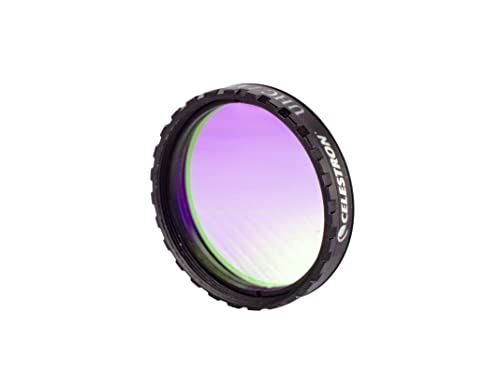 AmazonCelestron 94123 1.25-Inch UHC/LPR FilterView on Amazon →
 - Top-rated light pollution filters for the money:
 AmazonSVBONY Telescope 2-inch City Light Pollution Reduction FilterView on Amazon →
 - Top-rated light pollution filters for astrophotography:
 AmazonOptolong 2 L-ProView on Amazon →
 - Top-rated light pollution filters for deep-space objects:
 AmazonLumicon LF3015 2 Deep-Sky FilterView on Amazon →
 - Top-rated light pollution filters for galaxies:
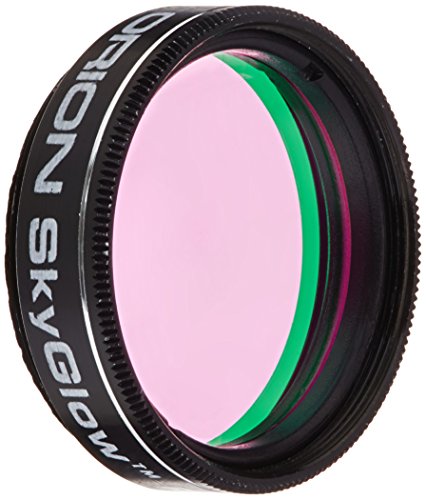 AmazonOrion SkyGlow Broadband FilterView on Amazon →
Best overall light pollution filter
1. Celestron 94123 1.25-Inch UHC/LPR Filter
- TG Score: 4.3/5
- Photo filter size: 1.25-inch
- Photo filter effect type: Enhancing
- Material: premium-grade glass with a unique coating
- What we like: Exceptional build quality and effectiveness in filtering common streetlight emissions
- What we do not like: Potential alteration of natural color in certain objects.
The Celestron 94123 1.25-Inch UHC/LPR Filter offers a stellar solution to light pollution for astronomers of all skill levels. Its full-size, standard 1.25-inch filter thread size ensures compatibility with a broad range of telescopes.
This filter boasts both durability and performance and is constructed from premium-grade glass and a specialized coating.
The coating significantly mitigates glare and unwanted reflections, factors that can impede observational quality.
Coupled with the glass’s pristine image clarity and over 97% light transmission rate, it delivers a visually pleasing experience.
An outstanding feature of the Celestron 94123 1.25-Inch Filter is its UHC/LPR combination, enhanced by a highly efficient H-Alpha passband at 656nm.
The Ultra High Contrast (UHC) function amplifies the contrast between celestial objects and the night sky’s backdrop, while the Light Pollution Reduction (LPR) targets the wavelengths related to urban lighting.
This blend not only refines clarity but also boasts high transmission and sharp cutoffs with a more moderate 60nm passband.
Together, these elements enable the viewer to perceive intricate details that might remain hidden.
This filter undergoes a specialized coating process, ensuring regular wear and tear resilience while enhancing light transmission.
It has an impressive 90% transmission of main nebula emission lines such as Ha 656nm, OIII 496nm, 500nm, SII 672nm, and H-beta 486nm, delivering clarity and enhancing desired celestial visuals.
The filter’s CLS (City Light Suppression) particularly appeals to urban stargazers.
It focuses on wavelengths commonly found in city lighting and efficiently blocks them. It allows for a stargazing experience reminiscent of remote locations, free from intrusive city lights.
Furthermore, the SVBONY Telescope Filter has a 0.1% transmission of off-band.
Top-rated light pollution filter for astrophotography
3. Optolong 2″ L-Pro
- TG Score: 4.7/5
- Photo filter size: 2-inch
- Photo filter effect type: Enhancing
- Material: Premium optical glass, finely polished to 1/4 wave accuracy on Schott substrate
- What we like: Specially designed for astrophotography with high-quality material and coatings for sharp long-exposure shots
- What we do not like: It may be cost-prohibitive for amateur astrophotographers.
The Optolong 2 L-Pro light pollution filter has a superb 2-inch thread size offering compatibility across different telescope models and camera adapters. It extends opportunities to capture stunning celestial images even in light-polluted locations.
The Optolong 2″ L-Pro is made from premium optical glass and precisely treated with a multi-coating process that ensures high transmission of wavelengths crucial for long-exposure photography.
The quality of the material, polished to 1/4 wave accuracy on Schott substrate, contributes to delivering flawless and vivid images. Its surface quality of 60/40 further underscores its excellence.
The L-Pro in the name stands for the broad-spectrum filter capability, which targets various types of light pollution while retaining a balanced color output.
The filter dramatically reduces the impact of light pollution, rejecting mercury and sodium light, and increases contrast.
This quality makes it excellent for observing and photographing reflection nebulae and galaxies.
Top-rated light pollution filter for deep-space objects
4. Lumicon LF3015 2″ Deep-Sky Filter
- TG Score: 4.9/5
- Photo filter size: 2-inch
- Photo filter effect type: Enhancing
- Material: Glass
- What we like: Exceptional build quality and effectiveness in blocking all high & low-pressure mercury and sodium vapor lamp light, neon lights, and airglow
- What we do not like: Potential alteration of natural color in certain objects
The Lumicon LF3015 2 Deep-Sky Filter is an unparalleled solution to light pollution for amateur and professional astronomers. Its standard 2-inch filter thread size ensures broad compatibility with various telescopes, further solidifying its value.
The Lumicon LF3015 2 Deep-Sky Filter is an unparalleled solution to light pollution for amateur and professional astronomers. Its standard 2-inch filter thread size ensures broad compatibility with various telescopes, further solidifying its value.
AmazonLumicon LF3015 2 Deep-Sky FilterView on Amazon →
This filter is fortified with glass with a specialized multi-coating that enhances durability and optimizes performance.
The coating significantly reduces glare and unwanted reflections while transmitting over 97% of the light in the visible spectrum.
An aspect that sets the Lumicon LF3015 2″ Deep-Sky Filter apart is its enhancing effect.
This selective screening transforms the visual experience, enabling the viewer to observe H-Alpha, H-Beta, and OIII emission lines. It unveils intricate details of celestial objects that might otherwise remain hidden.
Top-rated light pollution filter for galaxies
5. Orion SkyGlow Broadband Filter
- TG Score: 4.4/5
- Photo filter size: 1.25-inch
- Photo filter effect type: Enhancing
- Material: High-quality metal
- What we like: Optimized for galaxy observation and improving views of nebulas, galaxies, as well as open and globular star clusters
- What we do not like: It may not be suitable for specialized observations like specific nebulae.
The Orion SkyGlow Broadband Filter has a 1.25-inch thread size that aligns perfectly with various telescopes. This makes it a sought-after accessory for those exploring expansive celestial objects, particularly galaxies.
The Orion SkyGlow Broadband Filter has a 1.25-inch thread size that aligns perfectly with various telescopes. This makes it a sought-after accessory for those exploring expansive celestial objects, particularly galaxies.
This filter is crafted with top-grade metal treated with a specialized multi-coating designed to last and perform at a high level.
Unlike narrowband filters focusing on particular emission lines, the Orion SkyGlow Broadband Filter permits a wide spectrum of light to traverse while strategically blocking unwanted artificial light.
This process enhances the visibility of galaxies, nebulas, and star clusters without sacrificing natural beauty or color fidelity.
The filter is engineered to allow a detailed exploration of celestial phenomena.
The broad-spectrum approach ensures that light from galaxies, emitting across various wavelengths, is transmitted clearly, enabling intricate studies without compromising the authentic view.
The Orion SkyGlow Broadband eyepiece filters are designed to improve the views of not just galaxies but also nebulas, and open and globular star clusters. This feature amplifies the filter’s appeal, broadening its application and offering enriched visual experiences.
Best of the rest
6. Baader Planetarium 1.25″ Moon and Skyglow Filter
- TG Score: 4.7/5
- Photo filter size: 1.25-inch
- Photo filter effect type: Enhancing
- Material: Constructed with Neodymium glass, featuring unique coatings
- What we like: Ideal for enhancing views of the Moon, planets, and stars, and offers versatility in fitting most amateur telescopes
- What we do not like: It may not be suitable for deep-sky observation.
The Baader Planetarium 1.25 Moon and Skyglow Filter is a robust solution for city-based astronomers with its standard 1.25-inch filter thread size.
- 6. Baader Planetarium 1.25 Moon and Skyglow Filter
- 7. Explore Scientific Nebula Filter 2 UHC
- 8. IDAS Filter Nebula Booster NB1 48mm
- 9. Astromania 2 UHC (Ultra High Contrast) Filter
- 10. Celestron Narrowband Oxygen III 1.25 Filter
- 11. Orion 5657 2-Inch UltraBlock Narrowband Eyepiece Filter
- 12. SVBONY SV115 O-III Filter Narrowband Cuts Light Pollution Filter
- 13. ICE 77mm LiPo Didymium Filter Light Pollution Reduction for Night Sky/Star 77
- 14. SOLOMARK 1.25 Light Pollution Filter for Telescopes
- 15. Celestron Narrowband Oxygen III 2 Filter
- 16. SVBONY Telescope Filter SII CCD Narrow Band Filter 2 inch 7nm for Deep Sky
The Baader Planetarium 1.25 Moon and Skyglow Filter is a robust solution for city-based astronomers with its standard 1.25-inch filter thread size.
It accommodates a broad spectrum of telescopes, making it an adaptable and convenient accessory for various observational setups.
The filter is specifically designed to filter out certain wavelengths associated with streetlights and skyglow from the moon.
This Neodymium glass and coatings ensure reliability for those struggling with light pollution in urban environments.
What sets the Baader Planetarium 1.25″ Moon and Skyglow Filter apart is its balance between performance and versatility. It is optimized for urban observing, enhancing the views of the Moon, planets, and stars.
Its unique ability to counter artificial light sources makes it one of the best light pollution filters for city stargazers.
7. Explore Scientific Nebula Filter 2″ UHC
- TG Score: 4.6/5
- Photo filter size: 2-inch
- Photo filter effect type: UHC (Ultra High Contrast)
- Material: Superior optical glass with special multi-coatings
- What we like: Specialization in enhancing nebula observation and compatibility with various telescopes
- What we do not like: It may be less effective in observing other celestial objects.
The Explore Scientific Nebula Filter 2 UHC has a 2-inch thread, a standout feature allowing compatibility with various telescopes. This size plays a pivotal role in offering a broader field of view, thereby significantly enhancing the observation of nebulae.
The increased viewing area lets observers soak in the grandeur and subtlety of these astronomical wonders without feeling constrained by a limited field of view.
The material and construction of the Explore Scientific Nebula Filter are of superior quality, incorporating optical glass that ensures durability and consistently high performance.
The special multi-coatings applied to this glass are calibrated for an ultra-violet and neutral density photo filter effect.
These coatings act as a selective barrier, finely tuned to allow only the most relevant wavelengths to reach the observer’s eye or camera sensor.
The Ultra High Contrast (UHC) label on this filter is more than just a name; it represents its core functionality. It boosts the contrast between the nebulae and the surrounding sky, enhancing the inherent differences in brightness and color.
This leads to a more vivid and detailed view where the intricacies of nebulae are accentuated and rendered with stunning clarity.
The filter’s success in obstructing common wavelengths of artificial lights, such as street lamps, adds another layer to its appeal. Light pollution is a common problem for astronomers, especially those based in urban areas.
It combats this issue by allowing only the beautiful light emitted by nebulae to pass through. This enables a breathtaking view of these celestial clouds, untainted and undisturbed by man-made light interference.
8. IDAS Filter Nebula Booster NB1 48mm
- TG Score: 4.0/5
- Photo filter size: 48mm
- Photo filter effect type: Narrowband
- Material: Highest-quality optical glass with coatings
- What we like: Unique tailoring for detailed nebula observation, and enhanced wavelength selection for precision viewing
- What we do not like: Limited compatibility due to specialized thread size
The IDAS Filter Nebula Booster NB1 48mm has a unique 48mm thread size. Unlike standard filter sizes, this exceptional dimension is meticulously designed to cater to specialized telescope and camera setups.
 AmazonIDAS Filter Nebula Booster NB1 48mmView on Amazon →
This feature demonstrates IDAS’s commitment to innovation and its deep understanding of the specific needs of nebula observers.
The 48mm size ensures high-resolution observation and capture, making it an ideal choice for professionals who require precise detail within celestial clouds.
It is crafted from the highest-quality optical glass, promising durability and crystal-clear transmission of desired wavelengths. The quality construction ensures that the filter can withstand prolonged use, even in challenging conditions, without degradation in performance.
The coatings guarantee that the subtle details within nebulae are revealed with breathtaking accuracy.
Such a coating methodology ensures that structures, colors, and varying brightness levels within nebulae are displayed with a rarely matched fidelity level.
The resulting images are rich and deep, allowing observers to immerse themselves in the captivating beauty of these astronomical phenomena.
The IDAS Filter Nebula Booster NB1 has a narrowband filtering capability that selectively allows specific wavelengths to pass through while blocking others.
This ability to work within specific spectral lines makes it particularly adept at revealing the light that nebulae naturally emit.
The IDAS Filter is suitable for both visual observation and astrophotography.
9. Astromania 2″ UHC (Ultra High Contrast) Filter
- TG Score: 4.1/5
- Photo filter size: 2-inch
- Photo filter effect type: Ultra High Contrast
- Material: Combination of plastic and premium optical glass
- What we like: Designed with quality materials and coatings for high-contrast viewing
- What we do not like: It may not perform well in highly light-polluted areas
The Astromania 2 UHC (Ultra High Contrast) Filter is a compelling choice for those looking to delve into deep-space objects. This light pollution filter guarantees compatibility with an array of telescopes with its 2-inch size.
It allows for an extraordinary viewing experience that unveils faint and distant celestial objects, such as Orion, Lagoon, Swan, and other extended Nebulae, even under light-polluted skies.
Despite the use of plastic in conjunction with premium optical glass, this filter offers unparalleled performance.
The specially formulated coatings are designed to maximize contrast levels, revealing otherwise hidden details in the night sky.
The UHC characteristic in its name is a testimony to its specialized function.
Unlike standard broadband light pollution filters, this narrowband filter operates in a manner that accentuates the details of deep-space objects.
It carefully selects the wavelengths that emit light from the celestial objects, offering an immersive and highly detailed view.
The Astromania 2″ UHC Filter is more than just a piece of equipment; it’s a tailored tool for those enthusiastic about high-contrast viewing.
10. Celestron Narrowband Oxygen III 1.25 Filter
- TG Score: 4.4/5
- Photo filter size: 31.75 millimeters (1.25-inch)
- Photo filter effect type: Enhancing
- Material: Crafted from high-quality glass
- What we like: Superior optical clarity due to its high-quality glass construction
- What we do not like: Lack of water resistance can be a concern in damp conditions or unexpected weather changes
The Celestron Narrowband Oxygen III 1.25 Filter emerges as a trusted ally for amateur astronomers. Its 31.75mm (1.25-inch) size ensures a snug fit with telescopes bearing the same dimension.
The Celestron Narrowband Oxygen III 1.25 Filter is tailored to reduce the blight of light pollution, paving the way for clearer and more detailed observations of the cosmos.
One of the standout qualities of this filter is its ability to enhance the night sky, making celestial objects pop against the backdrop.
By mitigating the effects of light pollution, the filter assists in bringing forth a clearer, more vivid representation of the universe.
11. Orion 5657 2-Inch UltraBlock Narrowband Eyepiece Filter
- TG Score: 3.7/5
- Photo filter size: 2-inch
- Photo filter effect type: Narrowband
- Material: High-quality optical glass complemented by a durable metal cell construction
- What we like: Unparalleled effectiveness in filtering out light pollution
- What we do not like: The specialization for narrowband filtering may not be suitable for general stargazing
The Orion 5657 2-Inch UltraBlock Narrowband Eyepiece Filter features a 2-inch thread, ensuring compatibility with an array of telescopes, from those used by enthusiastic hobbyists to the more advanced tools employed by professional astronomers.
The filter offers clarity and precision in observation by utilizing high-grade optical glass.
Including a metal cell construction adds robustness that speaks volumes about the filter’s durability. It is designed to withstand the test of time, promising years of reliable service.
Its narrowband filtering capability allows astronomers to delve into the universe’s hidden treasures by providing a highly selective view of celestial objects.
It shines particularly in urban environments or light-polluted suburban areas, where artificial lights often hinder the natural beauty of the night sky.
Observers of nebulae and other specific deep-sky objects will find this filter indispensable, as it elevates the experience to new heights.
12. SVBONY SV115 O-III Filter Narrowband Cuts Light Pollution Filter
- TG Score: 4.4/5
- Photo filter size: 2-inch
- Photo filter effect type: Narrowband O-III filter
- Material: High-quality optical glass and plastic
- What we like: Capability to enable detailed observations of specific nebulae emitting light at Oxygen III wavelengths
- What we do not like: The filter’s narrow focus may limit its applicability for broader stargazing requirements
The SVBONY SV115 Telescope Filter has been crafted to fit various telescopes. This feature highlights its appeal to a diverse user base, ranging from astronomy enthusiasts to professionals in the field.
Ensuring compatibility with different telescope models enhances usability and access, allowing more people to benefit from its specialized functions.
It offers a scientific approach to observing the night sky by employing high-quality optical glass and a specialized coating that isolates Oxygen III emissions.
The coating focuses on the 500.7nm line, a crucial wavelength when examining certain deep-sky objects like planetary nebulae. The SV115 filter also offers clear and detailed astrophotography opportunities.
Providing an unparalleled view of nebulae and other astronomical phenomena emitting the specific Oxygen III wavelength gives photographers—both amateurs and professionals—a unique tool for capturing the awe-inspiring beauty of the universe.
13. ICE 77mm LiPo Didymium Filter Light Pollution Reduction for Night Sky/Star 77
- TG Score: 4.4/5
- Photo filter size: 77mm
- Photo filter effect type: Light pollution reduction
- Material: Didymium optical glass
- What we like: Broad spectrum reduction to enhance night sky photography
- What we do not like: Limited mainly to photography applications, possibly not as effective for specific celestial objects
The ICE 77mm LiPo Didymium Filter explicitly targets a niche in astrophotography. Unlike traditional telescope filters, it is tailored to fit the common diameter used in photography lenses.
This compatibility expands its usability, offering an optimal solution for photographers and stargazers seeking to explore the night sky without urban light pollution’s interference.
Utilizing Didymium, a substance with distinct properties, it selectively reduces yellow and orange hues.
This characteristic is especially powerful in counteracting the pervasive effects of sodium-vapor lamps that dominate urban night skies.
Moving on to the filter’s effects, the targeted reduction of yellow and orange glows stands out. This feature emphasizes the authentic beauty of celestial objects, minimizing the color distortions often caused by artificial city lights.
The ICE 77mm LiPo Didymium Filter is a groundbreaking tool in astrophotography. Its marriage of technological innovation with artistic endeavor offers a pathway for photographers to explore the night sky without the hindrances of modern urbanization.
This filter’s design and functionality make it a compelling choice for anyone seeking to delve into the vastness of the universe through the lens of a camera.
14. SOLOMARK 1.25″ Light Pollution Filter for Telescopes
- TG Score: 4.1/5
- Photo filter size: 1.25-inch
- Photo filter effect type: Ultraviolet
- Material: Carefully selected optical materials targeting wavelengths associated with artificial lights to preserve the night sky’s natural beauty
- What we like: Broad compatibility with the 1.25″ size, remarkable effectiveness in reducing artificial light interference, affordability for a wide audience
- What we do not like: Potential alteration of natural color balance.
The SOLOMARK 1.25 Light Pollution Filter for Telescopes is a versatile and adaptable tool for astronomers seeking clarity in their night sky observations. By offering universal compatibility with a 1.25 thread size; this filter appeals to a broad range of users.
The filter’s thread size enables it to be affixed easily to most standard telescopes, fostering accessibility across different user levels. This inclusive design is a thoughtful feature, ensuring that the benefits of a light pollution filter are within reach of many.
The SOLOMARK filter’s carefully selected optical materials are engineered to minimize interference from urban light sources.
They focus on wavelengths emitted by street lights, neon signs, and other artificial illumination, successfully preserving the night sky’s innate beauty.
The filter’s effect-enhancing property significantly contributes to the user’s experience.
The SOLOMARK 1.25″ Light Pollution Filter is designed to improve the observation of galaxies, star clusters, and nebulae by reducing the ambient light pollution that often clouds our view of the universe.
This focused approach provides an enriched, satisfying exploration of the night sky, particularly for those located in densely populated areas.
15. Celestron Narrowband Oxygen III 2 Filter
- TG Score: 4.5/5
- Photo filter size: 2-inch
- Photo filter effect type: Neutral density
- Material: Cutting-edge glass construction
- What we like: Precise targeting of O-III lines for specialized observation
- What we do not like: Limited versatility for observing a broader spectrum of celestial objects
The Celestron Narrowband Oxygen III 2 Filter is crafted with a 2 thread size and precise construction, ensuring compatibility with various 2 telescopes.
This Celestron filter showcases innovation with its cutting-edge glass construction.
The filter’s focus on isolating O-III emissions opens the door to exploring some of the universe’s most intriguing phenomena, from planetary nebulae to supernovae remnants.
Emphasizing the 500.7nm wavelength associated with O-III emissions, the filter’s effect type is markedly specialized.
The Celestron Narrowband Oxygen III 2″ Filter aims to enable those keen on studying or photographing deep sky objects at this precise wavelength to do so with an unobstructed view.
This filter offers a crystal-clear glimpse of the targeted celestial wonders by efficiently eliminating unwanted light pollution. This focus on O-III emissions makes it unique and a valuable tool for advanced study and photography.
16. SVBONY Telescope Filter SII CCD Narrow Band Filter 2 inch 7nm for Deep Sky
- TG Score: 4.9/5
- Photo filter size: 2-inch
- Photo filter effect type: Ultraviolet
- Material: Glass
- What we like: Precise 7nm SII targeting for an enriched study of intricate nebulae
- What we do not like: Its highly specialized nature might constrain its usability for broader astronomical purposes
The SVBONY Telescope Filter SII CCD is a valuable tool for those deeply involved in astronomy, particularly in studying complex nebulae structures. Its 2-inch design meshes perfectly with telescopes of the same dimension, often found in professional setups.
Thanks to its state-of-the-art multi-coating technology, the filter distinguishes itself by isolating the Sulfur II (SII) emission lines.
This specificity, honed into the narrow 7nm band, allows astronomers to observe celestial phenomena in unmatched detail.
Such a concentration on this particular spectral region unravels facets of the universe that might remain concealed without such specialized equipment.
The SVBONY filter’s effect type is notably unique. Focusing on the 7nm band around the SII lines becomes an indispensable tool for astronomers and astrophotographers passionate about intricate nebulae formations.
The high-contrast imaging capabilities and its observational clarity ensure this filter provides a window to the universe like no other.
Such precision offers an unparalleled viewing experience for those zeroing in on these astronomical elements.
FAQs about light pollution filters
Below are some frequently asked questions about these filters:
Can light pollution filters work on telescopes?
Light pollution filters can work on telescopes, and they are specifically designed to enhance the viewing experience for astronomers. Here’s how they work:
- Most light pollution filters come with standard thread sizes, such as 1.25-inch or 2-inch, making them compatible with various telescopes.
- A light pollution filter selectively allows certain light wavelengths to pass through, mitigating the effects of light pollution.
Are light pollution filters any good?
Light pollution filters are not just good; they are essential tools for many astronomers, offering several benefits, such as:
- They significantly improve the quality of celestial observation by reducing the glare and scattering effects caused by artificial light.
- They are versatile, ensuring that professional astronomers and hobbyists can find a filter that fits their interests and requirements.
- Made from high-quality materials and treated with specialized coatings, light pollution filters are built to last.
Takeaway: Enjoy stargazing in the city with the right light pollution filter for your telescope
With the increasing prevalence of artificial lighting in urban and suburban areas, light pollution has become a significant hindrance to clear astronomical observation.
With the increasing prevalence of artificial lighting in urban and suburban areas, light pollution has become a significant hindrance to clear astronomical observation.
These 16 top-rated light pollution filters outlined in this article offer a variety of solutions tailored to different needs, preferences, and budgets.
From narrowband filters that emphasize specific celestial phenomena to broadband filters that cut through general light pollution, these filters open up new vistas in the night sky.
Selecting the best light pollution filter for your telescope can transform your stargazing experience, revealing the hidden details and vibrant colors of distant galaxies, nebulae, and stars.
Consider your specific needs, telescope compatibility, and desired areas of exploration as you choose among these top-rated options.
Prepare to embark on a clearer, more immersive journey through the stars with reliable telescope light pollution filters.
You may also like: