The Celestron AstroMaster 114EQ is a 114mm reflector on a German equatorial mount that sells for $200–250 and can show you the Moon's craters, Saturn's rings, Jupiter's cloud belts, and brighter deep-sky objects like the Orion Nebula. For a beginner on a budget, it offers real aperture on a tracking-capable mount at a low price.
However, there's a critical detail that most reviews gloss over: the 114EQ uses a Bird-Jones optical design, not a true parabolic Newtonian reflector. This means a spherical primary mirror with a corrector lens built into the focuser tube. The Bird-Jones design produces acceptable but noticeably softer images compared to a true parabolic reflector, limits eyepiece compatibility, and makes collimation more difficult. It's the single most important thing to understand before buying this telescope.
This review covers what the 114EQ actually delivers, where its optical design holds it back, and whether you should buy it or spend the same money on a better alternative.
AstroMaster 114EQ at a Glance
| Specification | Details |
|---|---|
| Optical design | Bird-Jones (spherical primary + corrector lens) |
| Aperture | 114mm (4.5 inches) |
| Focal length | 1000mm (effective) |
| Focal ratio | f/8.8 (effective) |
| Mount | CG-2 German equatorial |
| Highest useful magnification | ~228× (practical: 120–150×) |
| Resolving power | 1.02 arc seconds |
| Included eyepieces | 20mm (50×) and 10mm (100×) |
| Finder | StarPointer red dot |
| Tripod | 1.25-inch steel tube legs, pre-assembled |
| Weight | ~8.6 kg (19 lbs) total |
The Bird-Jones Design: What It Means for You
This is the single most important section of this review, because it affects everything about how the telescope performs.
Most Newtonian reflector telescopes use a parabolic primary mirror that focuses all incoming light to a single point, producing sharp images. The AstroMaster 114EQ uses a spherical primary mirror instead, which is cheaper to manufacture but produces blurry images due to spherical aberration. To compensate, Celestron places a corrector lens inside the focuser tube. This combination is called a Bird-Jones design.
What this means in practice:
Images are softer. The corrector lens reduces spherical aberration but doesn't eliminate it completely. Compared to a true parabolic reflector of the same aperture (like the AstroMaster 130EQ or the Sky-Watcher Heritage 130P), stars appear slightly less crisp and planetary detail is less defined, particularly at higher magnifications.
Eyepiece compatibility is limited. The corrector lens sits inside the focuser tube at a specific position. Some aftermarket eyepieces may not reach focus correctly because the focus point is in a different location than a standard Newtonian. This limits your upgrade path.
Collimation is harder. Aligning the mirrors on a Bird-Jones telescope is more complex than on a standard Newtonian because the corrector lens adds another optical element that must be properly aligned.
Should this be a dealbreaker? Not necessarily. The 114EQ still shows you real detail on the Moon and planets and delivers genuine views of bright deep-sky objects. But you should know what you're buying — and whether a better optical design is available at the same price (it is — see the alternatives section below).
What Can You See with the AstroMaster 114EQ?
Despite the Bird-Jones limitation, 114mm of aperture still gathers a meaningful amount of light. Here's what to realistically expect.
Moon
The Moon is the 114EQ's best target. At 100× (the 10mm eyepiece), you'll see sharp crater walls, mountain ranges, rilles, and the texture of the maria. The detail is impressive for a beginner and will keep you engaged for many sessions. The equatorial mount's slow-motion controls help you track features smoothly as the Moon moves.
Planets
Jupiter: Two main cloud belts clearly visible, the Great Red Spot detectable on good nights at 100–150×, and all four Galilean moons resolved as distinct points. Detail is somewhat softer than through a parabolic reflector, but Jupiter is bright enough that the Bird-Jones limitation is less pronounced.
Saturn: Rings clearly visible and separated from the disc. The Cassini Division may be glimpsed on nights with very steady atmosphere. Titan visible as a nearby point of light.
Mars: During opposition, a small orange disc with hints of dark surface markings at higher magnification. Mars is demanding even through premium telescopes — the 114EQ shows you it's a disc, not a dot, but fine detail requires more aperture and better optics.
For a deeper look at what different apertures reveal, see our guide on planets through a telescope.
Deep-Sky Objects
The 114mm aperture reaches a limiting magnitude of roughly 12.5, which puts the entire Messier catalog within reach under dark skies.
What you'll see clearly: M42 (Orion Nebula) with visible nebulosity and the Trapezium star cluster, M31 (Andromeda Galaxy) as a fuzzy oval glow, M13 (Hercules Cluster) as a grainy ball of light, the Double Cluster as a rich field of stars, and bright open clusters like M45 (Pleiades — though the wide field needed to frame it is limited by the f/8.8 focal ratio).
What will be faint or featureless: Most galaxies beyond M31 appear as small fuzzy spots. Planetary nebulae (like M57, the Ring Nebula) are tiny and difficult to distinguish from stars. Extended nebulae like the Veil Nebula require filters and darker skies.
For a broader overview of what telescopes at different apertures reveal, see our guide on what you can see through a telescope.
The Equatorial Mount: Genuine Advantage
The CG-2 German equatorial mount is the 114EQ's strongest selling point relative to alt-azimuth alternatives at the same price. Once polar-aligned (pointed roughly at Polaris), a single slow-motion cable moves the telescope to track objects as Earth rotates. This means:
- Objects stay in the field of view for extended observation without constant re-centering
- You can share views with others without losing the target between observers
- The optional motor drive attachment ($30–50) automates tracking entirely
- The mount supports basic astrophotography of the Moon and planets (short exposures)
The tradeoff: equatorial mounts have a steeper learning curve than alt-azimuth mounts. Beginners may find the counterweight system, polar alignment, and slow-motion cables confusing at first. An alt-azimuth mount (push up/down, left/right) is more intuitive. This is worth considering if the telescope is for a younger user.
What's in the Box
20mm eyepiece (50×): A "erecting image" eyepiece designed for terrestrial (daytime) use as well as astronomy. Produces an upright image. Adequate for locating objects and scanning the Moon, but the apparent field of view is narrow.
10mm eyepiece (100×): The primary astronomy eyepiece. Good for planetary views and closer lunar detail. Functional but not high-quality — upgrading this eyepiece to a Goldline 66° or Celestron X-Cel LX in the 9–10mm range makes a noticeable difference. See our eyepiece sizing guide for recommendations.
StarPointer red dot finder: A zero-magnification reflex sight for aiming. Works for finding the Moon and bright planets but doesn't show stars fainter than naked-eye visibility, making deep-sky object finding harder.
CG-2 equatorial mount with counterweight: Steel-legged tripod, counterweight bar, and 4.5 lb counterweight. Pre-assembled tripod legs simplify setup.
Starry Night software: A desktop planetarium program for learning the sky and planning observing sessions. The Stellarium desktop app (free, open-source) is a comparable alternative.
Pros
Real Aperture at a Low Price
114mm gathers enough light for genuine astronomy — not just Moon-gazing. Bright deep-sky objects, planetary detail, and double stars are all within reach. At the $200–250 price point, this amount of aperture is competitive.
Equatorial Mount with Tracking
The CG-2 mount is a real EQ mount with slow-motion cables and motor drive compatibility, not a toy tripod. For beginners learning the sky, the ability to track objects at higher magnification is a genuine advantage that cheaper alt-az mounted telescopes don't offer.
Upgrade Path
The mount accepts the optional Celestron motor drive for automated tracking. A T-adapter allows DSLR attachment for lunar and planetary photography. The 1.25-inch focuser accepts standard eyepieces and filters (with the caveat about focus compatibility on Bird-Jones designs).
Cons
Bird-Jones Optical Design
This is the primary weakness. The spherical primary mirror with a corrector lens produces noticeably softer images than a true parabolic mirror. Stars show more coma and aberration at the field edges. The corrector lens limits eyepiece compatibility and makes collimation significantly more complex. At the same price, telescopes with parabolic mirrors exist and deliver sharper views.
Collimation Is Difficult
All Newtonian reflectors require periodic collimation, but the Bird-Jones design makes this harder because the corrector lens adds an extra alignment variable. A collimation cap (not included — buy the Celestron Cheshire Collimation Eyepiece, ~$30) is recommended, but expect a learning curve.
Included Eyepieces Are Weak
The 20mm "erecting" eyepiece is designed for terrestrial viewing and has a narrow field. The 10mm eyepiece is functional but produces a dim, restricted view. Budget $40–70 for at least one quality eyepiece upgrade to see what the telescope can actually do.
Mount Can Be Wobbly Under Wind
The CG-2 is adequate but not rock-solid. Wind, accidental bumps, and vibration from focusing settle within 3–4 seconds, but at higher magnifications this can be annoying. Hanging a weight from the accessory tray and observing on hard surfaces helps.
AstroMaster 114EQ vs. Alternatives: Better Options at the Same Price
This is where the review gets important. Several telescopes in the $200–300 range deliver better optical performance. Here's how they compare.
AstroMaster 114EQ vs. AstroMaster 130EQ
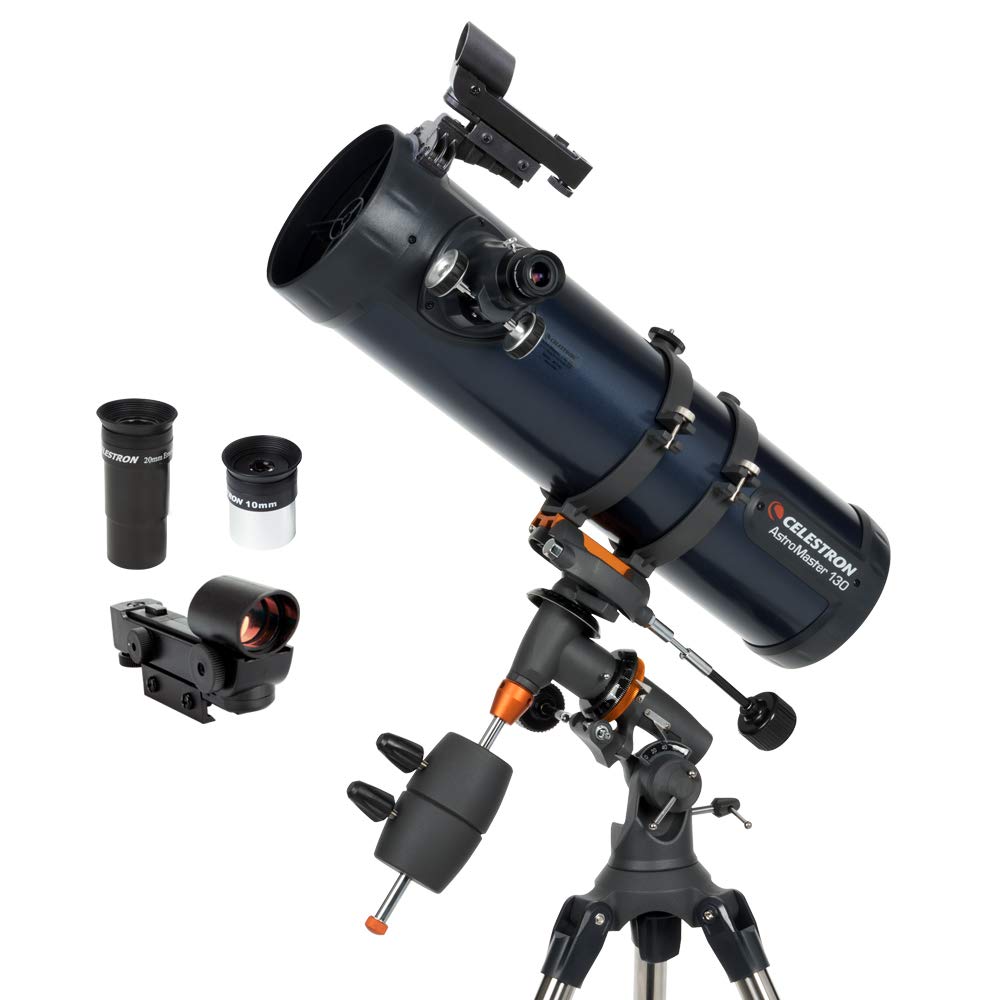
The AstroMaster 130EQ uses a true parabolic 130mm mirror (not Bird-Jones) on the same equatorial mount. It gathers 30% more light, produces sharper images at every magnification, and accepts all standard eyepieces without focus compatibility issues. It costs $50–80 more. This is the better telescope. If your budget can stretch to the 130EQ, it's the clear recommendation over the 114EQ.
AstroMaster 114EQ vs. Celestron StarSense Explorer LT 114AZ
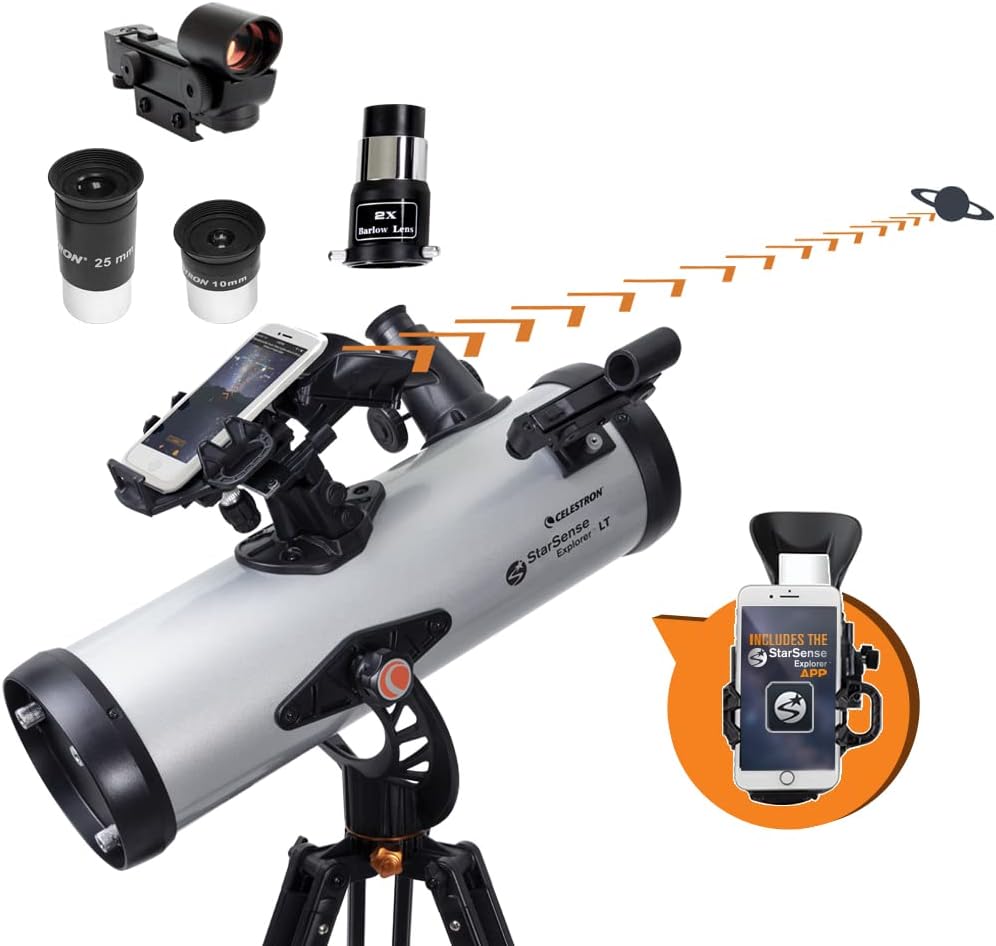
The StarSense Explorer LT 114AZ uses a 114mm Newtonian reflector on an alt-azimuth mount with Celestron's StarSense smartphone app for guided object finding. It costs roughly the same as the 114EQ. The optical design is standard Newtonian (not Bird-Jones on some configurations — check the specific model). The StarSense app is a genuine innovation for beginners who struggle to find objects. The tradeoff: no equatorial tracking. Choose the StarSense if finding objects is your biggest concern. Choose the 114EQ if tracking is more important.
AstroMaster 114EQ vs. Sky-Watcher Heritage 130P
The Heritage 130P is a 130mm tabletop Dobsonian with a parabolic mirror and a collapsible FlexTube design. It costs $200–250 — the same as the 114EQ. The optics are sharper (parabolic mirror, no Bird-Jones), and it's more portable. The tradeoff: it's a tabletop design (needs a table or sturdy surface) with an alt-azimuth mount (no EQ tracking). For visual-only observing, the Heritage 130P delivers better images. The 114EQ wins only if you need equatorial tracking for astrophotography.
AstroMaster 114EQ vs. Zhumell Z130
The Zhumell Z130 is another 130mm tabletop Dobsonian with a parabolic mirror. Similar to the Heritage 130P in concept and performance, with a slightly different accessory bundle. Same recommendation: sharper optics, but no EQ tracking.
For a comprehensive comparison of all options in this range, see our best telescopes for beginners and best telescopes under $300 rankings.
Setup and Collimation
Setup
Assembly takes 20–30 minutes the first time. Extend the tripod legs, attach the counterweight bar, mount the counterweight, attach the telescope tube to the dovetail, and install the eyepiece and finder. The equatorial mount requires polar alignment — point the mount's polar axis roughly at Polaris (North Star). Exact alignment isn't critical for visual observing, but close alignment makes tracking smoother. For a full explanation of how EQ mounts work, see our alt-azimuth vs. equatorial mount guide.
Collimation
The 114EQ arrives uncollimated and needs alignment before first use. Because of the Bird-Jones corrector lens, the process is more involved than with a standard Newtonian:
- Remove the eyepiece and rack the focuser inward completely
- Insert a collimation cap (purchased separately) into the focuser
- Adjust the secondary mirror screws until the primary mirror's edge appears centered in the view (do not adjust the center screw)
- Adjust the primary mirror's three collimation screws until the secondary mirror's reflection appears centered
- Perform a star test: point at a bright star, defocus slightly, and check if the doughnut pattern is concentric
- Repeat as needed
Expect collimation to take 15–20 minutes the first time and 5–10 minutes on subsequent sessions. A YouTube tutorial specific to Bird-Jones collimation is strongly recommended before attempting this for the first time.
Frequently Asked Questions
Is the Celestron AstroMaster 114EQ good for beginners?
It's acceptable for beginners on a strict budget, but there are better options at the same price. The Bird-Jones optical design produces softer images than a true parabolic reflector, and collimation is more difficult. The AstroMaster 130EQ ($50–80 more) or the Sky-Watcher Heritage 130P (same price) are stronger first telescopes.
What's the difference between the 114EQ and 130EQ?
The 130EQ has a 130mm parabolic mirror (vs. the 114EQ's 114mm spherical + corrector). This means 30% more light, sharper images, better eyepiece compatibility, and easier collimation. The mount is the same. The 130EQ costs $50–80 more and is the better investment.
Can I do astrophotography with the 114EQ?
Basic lunar and planetary photography works — attach a phone adapter to the eyepiece or a DSLR via a T-adapter. The equatorial mount allows short-exposure tracking. Deep-sky astrophotography is not practical — the mount lacks the precision and payload capacity, and the Bird-Jones optics limit image quality. For an introductory astrophotography setup, see our DSLR astrophotography on a budget guide.
Does the 114EQ need collimation?
Yes, before every session — especially after transport. The Bird-Jones design makes collimation more involved than on a standard Newtonian. A collimation cap (~$15–30) is essential and not included. Budget for this accessory when purchasing.
What eyepieces should I buy for the 114EQ?
A quality 10mm eyepiece with a wider apparent field (like the Goldline 66° or Celestron X-Cel LX 9mm) is the most impactful upgrade. Note that some eyepiece designs may not reach focus on the Bird-Jones optical train — stick to standard Plössl or Kellner types unless you've confirmed compatibility. See our eyepiece guide for full recommendations.
Is the AstroMaster 114EQ a Bird-Jones telescope?
Yes. Despite being marketed as a "Newtonian reflector," the 114EQ uses a spherical primary mirror with a corrector lens in the focuser tube — a Bird-Jones design. This is cheaper to manufacture than a parabolic mirror but produces softer images. The AstroMaster 130EQ, by contrast, uses a true parabolic mirror and does not have this limitation.
What magnification can the 114EQ actually use?
The theoretical maximum is ~228× (2× the aperture in mm), but the Bird-Jones optics and included eyepieces limit practical performance to around 120–150×. Beyond that, images become soft and dim. Do not buy a 5× Barlow for this telescope — 500× magnification on a 114mm scope produces an unusable image regardless of optical design.
Can I see galaxies with the 114EQ?
You can detect bright galaxies (M31, M81, M82) as fuzzy glows, but you won't see spiral arms, dust lanes, or other structural detail. Galaxies require larger aperture and darker skies to reveal meaningful detail. For galaxy viewing, an 8-inch Dobsonian is the entry point for seeing real structure.
Verdict: Should You Buy the AstroMaster 114EQ?
The AstroMaster 114EQ is a functional beginner telescope at a low price, but the Bird-Jones optical design makes it hard to recommend when better alternatives exist at the same price.
Consider buying the 114EQ if:
- You specifically need an equatorial mount for tracking or basic astrophotography at the lowest possible cost
- You understand the Bird-Jones tradeoff and accept slightly softer images
- You're buying for casual use and aren't planning to upgrade eyepieces aggressively
Buy one of these instead if:
- You can spend $50–80 more → AstroMaster 130EQ — same mount, true parabolic optics, more aperture. The clear better choice.
- You want the sharpest images at this price → Sky-Watcher Heritage 130P — parabolic mirror, more aperture, but tabletop Dobsonian (no EQ tracking)
- You want app-guided object finding → Celestron StarSense Explorer LT 114AZ — same aperture, smartphone-guided finding, but alt-az mount
- You want maximum aperture per dollar → Sky-Watcher 6-inch Dobsonian at ~$300 — dramatically more aperture and parabolic optics
The 114EQ won't ruin your experience of astronomy — it shows real objects in real detail, and the EQ mount is a genuine feature at this price. But the Bird-Jones design means you're getting less optical performance than the aperture size suggests, and spending a little more on the 130EQ eliminates this compromise entirely.
Related Celestron AstroMaster reviews: