- What is a telescope mount?
- What is an Alt-Azimuth mount?
- What is an equatorial mount?
- What is the difference between the Alt-Azimuth mount and the equatorial mount?
- Alt-Azimuth mount for astrophotography
- Equatorial mount for astrophotography
- Alt-Azimuth vs. equatorial mount Which one should you choose?
- Two other mount alternatives
- Takeaway The right type of mount depends on your needs
- Frequently Asked Questions
If you want to buy your first telescope, you have to decide what type of mount you want. The mount is the most important factor of the telescope assembly. There are two main types of telescope mounts: the Alt-Azimuth mount and the Equatorial mount.
The best type of telescope mount to start with is the Alt-Azimuth mount because it is easy to use and set up. Equatorial mounts are more advanced mounts that require polar alignment and are tricky to set up for a beginner.
Alt-Azimuth mounts are also a cheaper option compared to Equatorial mounts. However, Equatorial mounts are necessary to do astrophotography.
But let’s take a closer look at Alt-Azimuth and Equatorial mounts to see where each of them excels and the advantages and disadvantages so you can decide for yourself.
What is a telescope mount?
The telescope mount is the most crucial part of the whole telescope setup. What type of telescope mount you choose will determine what you can do with your telescope.
The telescope mount sits on top of the tripod. Remember, the tripod is not the mount. But it is also important because it has to be sturdy to have the best stargazing experience, whether you use an Alt-Azimuth mount or equatorial mount, so keep this in mind.
Avoid flimsy aluminum or wooden tripods, and look for a sturdy steel legs tripod because it can ruin your experience even if you have the best telescope and mount on it. It needs to be stable to avoid vibrations and the shakiness of the telescope.
There is also a telescope mount that doesn’t use a tripod called the Dobsonian mount, but I will discuss it later.
What is an Alt-Azimuth mount?
The Alt-Azimuth (AZ) mount is the simplest mount for the telescope. Alt means altitude, and Azimuth is, of course, azimuth. The name tells you how the mount moves.
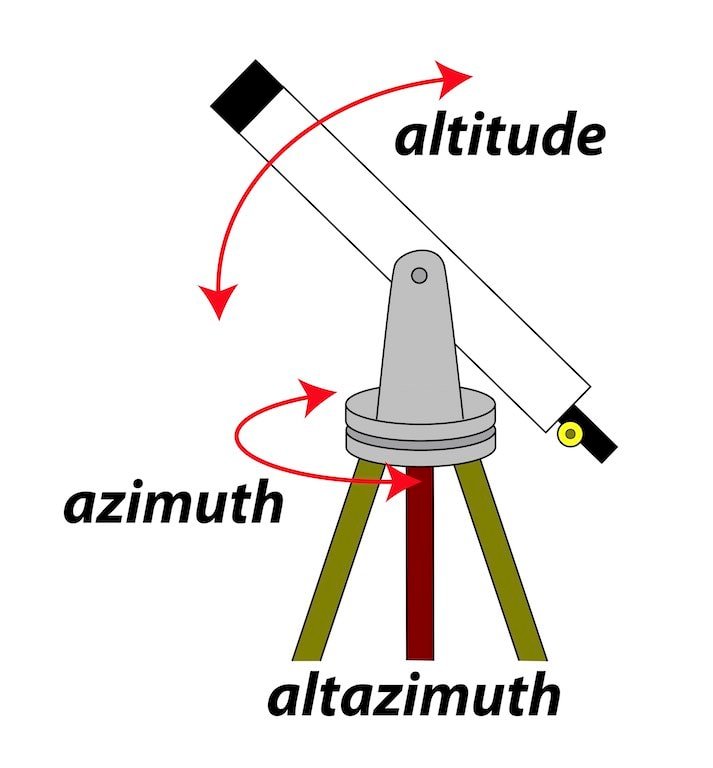
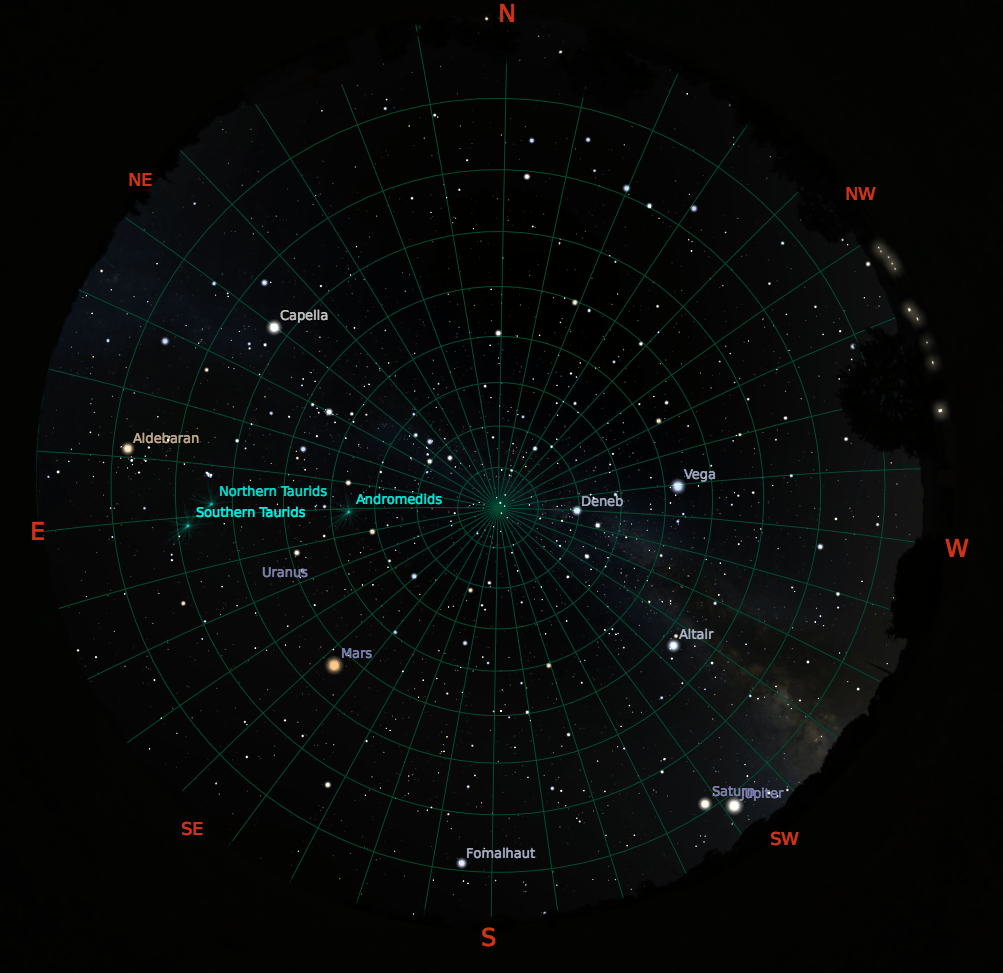
It uses simple movements following Alt-Azimuth grid coordinates; up/down is altitude, and left/right is azimuth. The center of this grid is called Zenith. The mount Azimuth axis is at a right angle to the ground.
The Alt-Azimuth mount doesn’t need any polar alignment because of this simple design. You point it wherever you want and can start observing the sky.
Alt-Azimuth mounts come in different shapes and sizes and are usually sold with cheap beginner scopes. But that doesn’t mean that they are made only for beginners. Almost all big telescopes in observatories are placed on Alt-azimuth mounts.
This issue is noticeable after doing more than 15-30s exposures with an Alt-Azimuth mount because you get star trails around the edges and blurry result objects.
However, it can be done if you limit the exposure to, at most, the 30s. I have done it, and you can read more about AZ astrophotography in my article Budget Astrophotography with DSLR Camera.
On the other hand, you can do planetary or moon astrophotography with no problem because you don’t need to do long exposures here. All you need to do is attach a simple webcam or a smartphone to your telescope and capture a short video or make images.
Equatorial mount for astrophotography
The equatorial mount is made for astrophotography. If your main goal with the telescope is to do astrophotography, you must buy a german equatorial mount.
The equatorial mount is made for astrophotography. If your main goal with the telescope is to do astrophotography, you must buy a german equatorial mount.
With the equatorial mount, you can do long exposures lasting for a few minutes with no field rotation or star trail when properly polar aligned. But I must say one important thing – it would help if you had a motorized equatorial mount to track the object and do long-exposure astrophotography.
There is no way you can do it with the manual mount. It also applies to Alt-Azimuth mounts. Astrophotography needs a computerized mount; in this case, you have to do not only a polar alignment but star alignment with the mount.
Astrophotography is a complicated hobby and a bottomless money pit, so you have been warned.
Alt-Azimuth vs. equatorial mount – Which one should you choose?
A good telescope mount depends on your needs and preferences. Choosing the suitable one would depend on what deep sky objects you want to view.
A good telescope mount depends on your needs and preferences. Choosing the suitable one would depend on what deep sky objects you want to view.
Alt-Azimuth mounts are great for beginners. They are simple to use and relatively cheaper than equatorial mounts. However, they are not very stable for astrophotography.
On the other hand, equatorial mounts are more stable and generally computerized. That means they can automatically track the objects across the night sky. They are almost a need for people who are into professional astrophotography.
Two other mount alternatives
There are some other mounts that you can consider besides the Equatorial (eq) mounts and the alt-az mounts.
There are some other mounts that you can consider besides the Equatorial (eq) mounts and the alt-az mounts.
Dobsonian mount
If we are talking about Alt-Azimuth and equatorial mounts, I must also mention the Dobsonian mounts. The Dobsonian mount is an Alt-Azimuth mount without the tripod.
The mount is a base on the ground capable of holding big Newtonian telescopes. Dobsonian telescopes are the number one telescopes recommended for beginners starting with astronomy.
The advantages are the ease of use because of the Alt-Azimut design and affordable price. You can buy quite a big aperture telescope on Dobsonian mount and not break the bank.
An excellent example is the Orion SkyQuest XT8 Dobsonian telescope. With this telescope, you can see almost everything in the night sky for a great price.
Hybrid telescope mounts
And to make things more confusing for you, there are also telescope mounts that I call hybrid mounts. They are a hybrid of the alt-azimuth and equatorial mount.
These mounts work primarily as alt-azimuth mounts. You can add a special equatorial wedge to them and transform an alt-azimuth mount to a german equatorial mount anytime.
The well-known hybrid mounts are the Celestron Nextar series with Schmidt Cassegrain telescopes. An example is the Celestron Nexstar 8SE, a great telescope.
This is a smart option for beginners because if you are unsure you want to start with long-exposure astrophotography, you can have an amazing Schmidt Cassegrain telescope on an easy-to-use Alt-Azimuth mount.
Later, when you try astrophotography, you can add an equatorial wedge to it—no need to buy a new telescope on a German equatorial mount.
You may also like:
❓ Frequently Asked Questions
Q: What is the main difference between an alt-azimuth and equatorial mount?
A: An alt-azimuth (alt-az) mount moves in two simple directions — up/down (altitude) and left/right (azimuth). An equatorial mount is tilted to match Earth’s rotation axis, allowing one motor to track stars smoothly across the sky. Alt-az mounts are simpler and more intuitive; equatorial mounts are essential for long-exposure astrophotography.
Q: Which mount is better for beginners?
A: Alt-azimuth mounts are much more beginner-friendly. They’re intuitive to use (move telescope up, down, left, right), require no polar alignment, and are generally lighter and more portable. For casual visual observing and basic planetary photography, an alt-az mount is ideal to start with.
Q: Do I need an equatorial mount for astrophotography?
A: For long-exposure deep sky astrophotography (exposures longer than a few seconds), yes — an equatorial mount with accurate tracking is essential. Without it, stars trail across your image. For planetary and lunar photography using short exposures (milliseconds), an alt-az mount works fine since the motion blur is negligible.
Q: What is polar alignment and why does it matter?
A: Polar alignment is the process of pointing an equatorial mount’s rotation axis toward Polaris (the North Star). Once aligned, a single tracking motor can counteract Earth’s rotation and keep stars perfectly centered in the eyepiece or camera. Without polar alignment, stars will still drift and long exposures will show star trails.
Q: Can a computerized alt-az mount track objects like an equatorial?
A: A motorized GoTo alt-az mount can track objects for visual observing by moving both axes simultaneously. However, this creates a “field rotation” effect where the image slowly rotates in the eyepiece or camera. For visual use it’s acceptable, but for deep sky imaging it limits exposure time significantly compared to a properly polar-aligned equatorial mount.
📚 You Might Also Like
🔭 Want to Master Your Telescope?
Get our complete guide: Stargazing Secrets — 133 pages, 6 modules, everything from setup to deep-sky observation.
Get It for $19 →
$27 $19 — 30-day money-back guarantee