The Unistellar eVscope and Vaonis Stellina are two pioneering smart telescopes that helped launch the automated astronomy revolution. The eVscope offers a larger 114mm mirror aperture, a built-in electronic eyepiece, and faster deep-sky image accumulation. The Stellina delivers a wider field of view, autofocus, superior star roundness, and easier raw file export. Both are now legacy products — Unistellar's current lineup includes the Odyssey and eVscope 2, while Vaonis now sells the Vespera II and Vespera Pro.
If you're choosing between these two specific models (perhaps buying used), this guide breaks down every meaningful difference. If you're buying new in 2026, skip to our which smart telescope to buy now section — the market has changed dramatically since these were released.
- Aperture: eVscope has a 114mm reflector mirror; Stellina has an 80mm apochromatic refractor lens. The eVscope gathers more light, reaching fainter objects faster.
- Image quality: Stellina produces rounder stars and cleaner images out of the box thanks to its refractor design, autofocus, and mechanical field derotator. The eVscope requires manual focus and collimation, and star elongation is a common complaint.
- Eyepiece: The eVscope has a built-in Nikon OLED electronic eyepiece for a "looking through the telescope" experience. Stellina has no eyepiece — everything is viewed on your phone or tablet.
- Ease of use: Stellina is simpler — no focusing, no collimation, no manual adjustments. The eVscope offers more manual control but demands more from the user.
- Raw files: Stellina exports TIFF and FITS files to a USB stick easily. The eVscope's raw file access has historically been more restricted.
- Both are discontinued in favor of newer models. Stellina → Vespera II / Vespera Pro. eVscope → eVscope 2 / Odyssey / Odyssey Pro.
eVscope vs Stellina: Head-to-Head Specifications
| Specification | Unistellar eVscope (original) | Vaonis Stellina |
|---|---|---|
| Manufacturer | Unistellar (France) | Vaonis (France) |
| Optical Design | Reflector (mirror-based) | Apochromatic Refractor (lens-based) |
| Aperture | 114mm (4.5") | 80mm (3.15") |
| Focal Length | 450mm | 400mm |
| Focal Ratio | f/3.9 | f/5 |
| Sensor | Sony IMX224 (1.2MP) | Sony IMX178 (6.2MP) |
| Pixel Size | 3.75µm | 2.4µm |
| Field of View | 27' × 37' (0.45° × 0.62°) | 1° × 0.7° |
| Eyepiece | Built-in electronic OLED eyepiece | None (screen only) |
| Autofocus | No (manual focus) | Yes |
| Field Derotator | No | Yes (mechanical) |
| Collimation Required | Yes (periodic) | No |
| Light Pollution Reduction | Enhanced Vision (algorithmic) | Dual-band filter |
| App Control | Unistellar app (iOS/Android) | Stellina app (iOS/Android) |
| Raw File Export | Limited (request via Unistellar) | Easy (USB stick, TIFF/FITS) |
| Battery Life | ~9 hours (internal) | ~5 hours (removable) |
| Weight | ~9 kg (20 lbs) with tripod | ~11.2 kg (24.7 lbs) |
| Citizen Science | Yes (SETI Institute partnership) | No |
| Original Launch Price | ~$2,999 | ~$3,999 |
| Current Status | Discontinued | Discontinued |
Optical Design: Reflector vs Refractor
This is the most fundamental difference between the two and drives many of their performance characteristics.
eVscope: 114mm f/3.9 Reflector
The eVscope uses a Newtonian-style reflector with a 114mm primary mirror. The larger aperture (compared to Stellina's 80mm) gathers significantly more light — roughly 103% more, which means the eVscope reaches fainter objects and builds up signal faster during live stacking. The fast f/3.9 focal ratio accelerates image accumulation further.
The trade-off: reflectors require periodic collimation (alignment of the mirrors), and the eVscope is no exception. Many owners report that collimation can drift between sessions, especially during transport. The eVscope also has no autofocus — you must manually adjust focus, and getting it precisely dialed in is critical for sharp images.
Stellina: 80mm f/5 Apochromatic Refractor
The Stellina uses an 80mm apochromatic refractor — a lens-based design that requires no collimation and produces inherently round, well-corrected stars across the field. Vaonis added a mechanical field derotator that physically rotates the sensor to compensate for the alt-azimuth mount's field rotation, producing cleaner stacked images than the eVscope's purely algorithmic correction.
The trade-off: 80mm of aperture gathers less light than 114mm, meaning Stellina takes longer to build up comparable signal on faint objects. The wider field of view (1° × 0.7° vs the eVscope's 0.45° × 0.62°) is an advantage for large targets like the Andromeda Galaxy but means smaller objects like planetary nebulae appear smaller in the frame.
For a deeper understanding of how these optical designs differ, see our refractor vs reflector guide.
Image Quality: Which Produces Better Photos?
This is the question most buyers care about, and the answer is nuanced.
Stellina generally produces more polished, "cleaner" images out of the box. The autofocus, field derotator, and refractor optics combine to deliver round stars edge-to-edge with consistent quality. Users on Cloudy Nights who own both telescopes frequently note that Stellina's images are more pleasing straight out of the app, particularly in terms of star roundness and color accuracy.
The eVscope accumulates signal faster thanks to its larger aperture and faster focal ratio. On faint deep-sky objects — dim galaxies, nebulae at the edge of visibility — the eVscope shows more in less time. Experienced users who nail collimation and focus can produce excellent images. But the variability is higher: a poorly collimated eVscope produces noticeably worse images than a Stellina, which has no such failure mode.
For post-processing: Stellina has a clear advantage. TIFF and FITS files are easily exported via USB, giving you raw data to process in Siril, PixInsight, or Photoshop. The eVscope's raw file export has historically been cumbersome — requiring emailing Unistellar and requesting data within 30 days.
Verdict on image quality: Stellina for consistency and ease; eVscope for raw light-gathering speed if you can keep it collimated and focused.
Ease of Use
Stellina is the easier telescope to use. Setup is genuinely simple: unfold the tripod, power on, open the app, and the telescope aligns itself. There is no focusing, no collimation, and no manual adjustment of any kind. The app does everything.
The eVscope requires more user involvement. Manual focus is required at the start of each session, and collimation needs periodic checking. The Unistellar app is intuitive, and the Autonomous Field Detection feature (which plate-solves the sky automatically) works well. But the overall experience demands more astronomy knowledge than Stellina.
The eVscope's electronic eyepiece is its unique feature. Looking into the built-in OLED eyepiece and seeing the live-stacked image in real time is a genuinely compelling experience that Stellina cannot replicate. It creates a "looking through a telescope" feeling, even though you're viewing a processed digital image. For star parties and sharing with non-astronomers, this is a meaningful advantage.
For a broader look at beginner-friendly computerized telescopes, see our guide.
Portability and Build
| Factor | eVscope | Stellina |
|---|---|---|
| Weight (with tripod) | ~9 kg (20 lbs) | ~11.2 kg (24.7 lbs) |
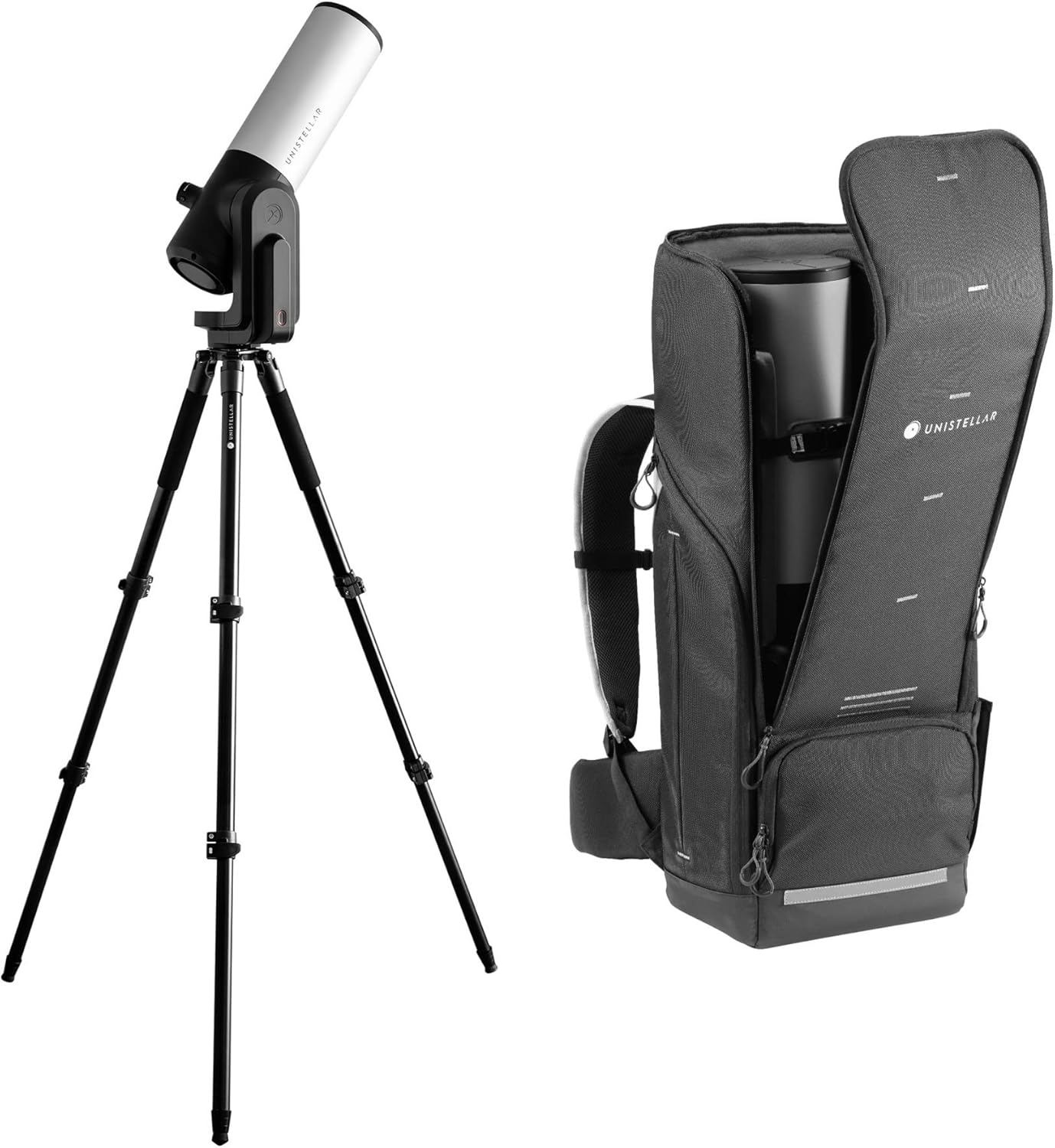
| Carrying solution | Included backpack | Included carry case |
| Battery | Internal, ~9 hrs | Removable, ~5 hrs (spares possible) |
| Power alternative | N/A (charge via USB) | USB-C continuous power |
| Weather resistance | Basic | Basic |
The eVscope is lighter and comes in a backpack — genuinely grab-and-go. Stellina's removable battery means you can carry a spare for longer sessions, but the unit itself is heavier and bulkier. Neither is weather-sealed enough for rain or heavy dew.
Price and Value
When both were actively sold:
- Unistellar eVscope (original): ~$2,999
- Vaonis Stellina: ~$3,999
The Stellina was roughly $1,000 more expensive. The price gap was difficult to justify on specifications alone (the eVscope has more aperture and a faster focal ratio), but Stellina's fit-and-finish, autofocus, field derotator, and zero-maintenance design made it feel like a more premium product.
On the used market in 2026, both can be found at significant discounts. However, be aware that software updates and app support for discontinued models may eventually diminish.
For an in-depth look at whether these premium smart telescopes are worth their asking price, see our Is Stellina Worth the Money? analysis and our Unistellar eVscope review.
What Should You Buy in 2026 Instead?
Both the original eVscope and Stellina are discontinued. The smart telescope market has exploded since their launch, and newer models offer better performance at lower prices. Here is the current landscape:
Budget smart telescopes (~$300–$700)
- ZWO Seestar S50 (~$500) — 50mm APO refractor with autofocus, GoTo, live stacking, and app control. The best value entry point into smart telescopes by a wide margin.
- Dwarflab Dwarf 3 (~$400–500) — Dual-camera system (astro + telephoto), lightweight, versatile. Extremely popular in 2025–2026.
- Vaonis Hestia (~$400) — Vaonis' budget entry, clips onto your smartphone camera.
Mid-range smart telescopes (~$1,500–$3,000)
- Vaonis Vespera II (~$1,590) — Stellina's direct successor. Same refractor philosophy, improved sensor (8.3MP), smaller and lighter.
- Vaonis Vespera Pro (~$2,799) — Top-end Vaonis with advanced sensor and wider field.
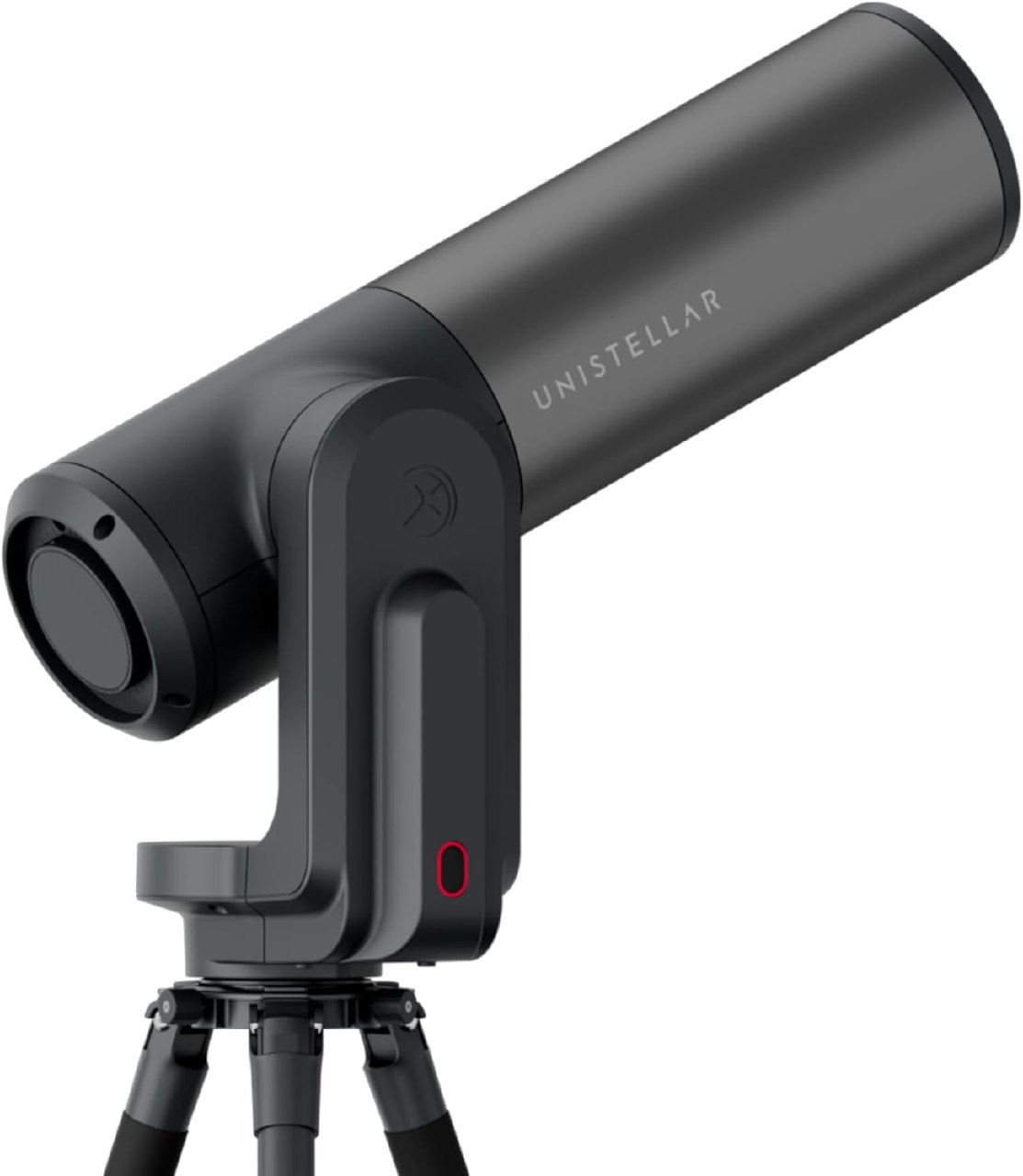
- Unistellar Odyssey (~$2,299) — Unistellar's successor to the eVscope line. 85mm f/3.9, sealed optics (no user collimation), autofocus.
- Unistellar Equinox 2 (~$2,499) — 114mm aperture like the original eVscope, but with improved sensor and app.
Premium smart telescopes (~$4,000+)
- Unistellar eVscope 2 (~$4,899) — The eVscope with a Nikon micro-OLED eyepiece and improved 7.7MP Sony IMX347 sensor.
- Unistellar Odyssey Pro (~$3,999) — Larger sensor and enhanced optics.
- Celestron Origin (~$3,999) — 6-inch RASA reflector with 6.4MP sensor. The largest aperture smart telescope available. Heaviest at 40+ lbs.
Our recommendation for most buyers in 2026: The ZWO Seestar S50 or Dwarflab Dwarf 3 if you're exploring smart telescopes for the first time. The Vaonis Vespera II if you want a premium Stellina-like experience. The Unistellar Odyssey if you want the eVscope experience without the collimation hassle.
For the full breakdown, see our related comparisons: eVscope vs eVscope 2, Stellina vs eVscope 2, and Vespera vs Stellina.
eVscope vs Stellina: Which Is Better?
Neither is strictly "better" — they optimize for different priorities.
Choose the eVscope if:
- You want the built-in electronic eyepiece experience (unique to Unistellar)
- You prioritize light-gathering power for faint deep-sky objects
- You're comfortable with manual focus and periodic collimation
- You're interested in citizen science projects (Unistellar partners with SETI Institute)
- You can find one used at a significant discount
Choose the Stellina if:
- You want the simplest possible setup — no focusing, no collimation, no adjustments
- Image consistency matters more than raw speed
- You want easy access to raw TIFF/FITS files for post-processing
- You prefer a wider field of view for large objects (Andromeda, Orion region)
- You value the mechanical field derotator for cleaner stacked images
Or, skip both and buy a current-generation smart telescope — the ZWO Seestar S50 at $500 delivers 80–90% of either telescope's capability at a fraction of the cost, and the Vaonis Vespera II and Unistellar Odyssey are direct successors with meaningful improvements.
Frequently Asked Questions
Is the eVscope or Stellina better for beginners?
Stellina is easier for complete beginners because it requires no manual focus, no collimation, and no technical adjustments. You turn it on, open the app, and start imaging. The eVscope requires manual focus at each session and periodic collimation — manageable tasks, but a steeper learning curve. For true beginners, the current-generation Seestar S50 is even simpler and far cheaper than either.
Which has better image quality, eVscope or Stellina?
Stellina generally produces more polished images out of the box — rounder stars, more consistent quality, better color accuracy. The eVscope reaches fainter objects faster due to its larger aperture and faster focal ratio, but image quality is more dependent on accurate collimation and focus. For post-processing, Stellina's easy TIFF/FITS export is a significant advantage.
Can the eVscope or Stellina show planets?
Both can image bright planets (Jupiter, Saturn), but neither excels at planetary detail the way a traditional telescope does. Smart telescopes are designed for deep-sky live stacking, not high-magnification planetary observation. The eVscope's electronic eyepiece shows a processed live-stack, not a real-time optical view. For planetary viewing, a traditional telescope is a better choice.
Are the eVscope and Stellina still worth buying in 2026?
Only on the used market at a significant discount. Both have been superseded by improved models. The Stellina's successor (Vespera II) is smaller, lighter, and has a better sensor. The eVscope's successors (Odyssey, eVscope 2) add autofocus and sealed optics. Budget models like the ZWO Seestar S50 deliver comparable results for a fraction of the price.
What is the eVscope's electronic eyepiece?
It is a built-in Nikon OLED micro-display that shows the live-stacked digital image. You look into it like a traditional telescope eyepiece, but you're viewing a processed image from the sensor, not direct optical light. It creates a compelling "observing" experience that is unique to Unistellar. Stellina has no eyepiece — all viewing is on your phone or tablet screen.
Do these smart telescopes work in light-polluted cities?
Yes — this is one of their primary selling points. Both use algorithmic or filter-based light pollution reduction to produce usable deep-sky images from urban locations. The eVscope's Enhanced Vision technology is particularly effective. Neither eliminates light pollution entirely, but both produce dramatically better results from city skies than a traditional telescope would for visual observation. See our guide on using a telescope in the city.
Does the eVscope need collimation?
Yes. As a reflector telescope, the eVscope's mirrors can shift during transport and need periodic realignment. This is one of the most common complaints from eVscope owners. The Stellina, as a sealed refractor, never needs collimation. Unistellar's newer Odyssey model addresses this with sealed optics that eliminate user collimation.
Can I do "real" astrophotography with these telescopes?
In a limited sense. Both produce stacked images that can be shared and printed, but serious astrophotographers find the image data quality limited compared to a dedicated camera on an equatorial mount. Stellina offers better raw file access (TIFF/FITS). If astrophotography is your primary goal, a DSLR on an equatorial mount or a dedicated astrophotography setup will produce superior results.
What replaced the Stellina?
Vaonis now sells the Vespera II (~$1,590), Vespera II-X (~$2,290), and Vespera Pro (~$2,799). All use the same refractor philosophy with improved sensors, smaller form factors, and updated apps. The Stellina is no longer in production. See our Vespera vs Stellina comparison.
What replaced the original eVscope?
Unistellar now sells the Odyssey (~$2,299), Equinox 2 (~$2,499), Odyssey Pro (~$3,999), and eVscope 2 (~$4,899). The Odyssey is the closest spiritual successor — it adds autofocus and sealed optics (no collimation). The eVscope 2 adds a Nikon micro-OLED eyepiece and improved sensor. See our eVscope vs eVscope 2 comparison.
Explore our free course sampler and browse the latest guides on TelescopeGuides.
Related Articles
- eVscope vs eVscope 2 (In-Depth Analysis)
- Stellina vs eVscope 2 (Full Breakdown)
- Is Stellina Worth the Money?
- Unistellar eVscope Review
- Which Is Better: Vespera or Stellina?
- eVscope 2 vs eQuinox: 3 Key Differences
- Best Telescopes for Beginners
- Best Computerized Telescopes
- Are Computerized Telescopes Good for Beginners?
- Budget DSLR Astrophotography Setup Guide