The Sky-Watcher Explorer 130P SynScan AZ GoTo is a 130mm (5.1-inch) f/5 parabolic Newtonian reflector on a computerized alt-azimuth GoTo mount with a 42,900-object database. At roughly £350–400 / $450–550, it delivers more aperture than most GoTo telescopes in its price range, produces sharp views of planets and bright deep-sky objects, and comes with WiFi app control via the free SynScan app.
The Explorer 130P occupies a rare niche: affordable GoTo convenience with a proper parabolic mirror rather than the spherical mirrors found in cheaper 130mm reflectors. That parabolic primary eliminates spherical aberration, giving noticeably sharper images at the edges of the field — a real advantage at f/5.
This review covers what you can realistically see through the 130P, how the SynScan GoTo system performs, the honest drawbacks, and how it compares to alternatives like the Celestron NexStar 130SLT and a manual Dobsonian.
- 130mm parabolic mirror gathers 30% more light than 114mm scopes and eliminates the spherical aberration common in cheap reflectors.
- f/5 focal ratio (650mm focal length) provides wide true fields of view — over 2° with the included 25mm eyepiece — making it excellent for large deep-sky objects.
- SynScan GoTo mount with 42,900+ object database. Available in two versions: the older SynScan handset model and the newer AZ Go-2 with built-in WiFi for smartphone control.
- Includes two eyepieces (25mm and 10mm), a 2x Barlow lens, and a 6×30 finderscope — a more complete accessory package than most competitors.
- Stainless steel tripod legs are sturdier than the aluminum legs on most budget telescopes.
- Requires regular collimation — as a fast Newtonian, the mirrors shift easily during transport and need realignment.
- Alt-az mount limits astrophotography to lunar, planetary, and short-exposure deep-sky captures.
Sky-Watcher Explorer 130P Specifications
| Specification | Detail |
|---|---|
| Optical Design | Parabolic Newtonian Reflector |
| Aperture | 130mm (5.1 inches) |
| Focal Length | 650mm |
| Focal Ratio | f/5 |
| Highest Useful Magnification | ~260x |
| Limiting Stellar Magnitude | ~13.1 |
| Resolution (Dawes) | 0.89 arcseconds |
| Secondary Mirror Supports | 0.5mm ultra-thin vanes |
| Focuser | 2" rack-and-pinion with 1.25" adapter |
| Included Eyepieces | 25mm Plössl (26x), 10mm Plössl (65x) |
| Barlow Lens | 2x (1.25"), with M42 camera thread |
| Finder | 6×30 optical finderscope |
| Mount | SynScan AZ GoTo, motorized alt-azimuth |
| GoTo Database | 42,900+ objects (M, NGC, IC, SAO catalogues) |
| Tracking Rates | Sidereal, Lunar, Solar |
| Motor Resolution | 0.89 arcsec (1,452,425 steps/revolution) |
| Tripod | Stainless steel legs with accessory tray |
| Power | 12V DC or 8× AA batteries (not included) |
| Dovetail | 45mm Vixen-style |
| Approximate Price | £350–400 / $450–550 |
What Can You See with the Sky-Watcher Explorer 130P?
130mm of aperture at f/5 delivers a bright, wide-field view that performs best on the Moon, planets, and large deep-sky objects. Here is a realistic breakdown of what to expect.
The Moon
The Moon is stunning through the 130P. At 65x (10mm eyepiece), craters down to 5–6 km in diameter are visible. Push to 130x with the Barlow and you resolve terraced crater walls, central peaks, rilles, and the textured lava flows of the maria. The f/5 focal ratio means the Moon's brightness can be overwhelming — a neutral density Moon filter is a worthwhile $10 addition. See our list of best telescopes to see the Moon for comparisons.
Planets
At 130x–200x (10mm eyepiece + Barlow, or a dedicated 5mm eyepiece), the 130P shows:
- Jupiter: Cloud bands, the Great Red Spot (when facing Earth), and all four Galilean moons. The fast f/5 focal ratio can show slightly less contrast than a slower f/10 Schmidt-Cassegrain, but detail is still excellent.
- Saturn: Rings clearly separated from the disk, Cassini Division visible on good nights, Titan easily spotted, and the shadow of the planet on the rings.
- Mars: At opposition, polar ice caps and dark surface features are resolvable. Mars is demanding regardless of telescope — atmospheric seeing is the limiting factor.
- Venus: Clean phase detail from crescent to gibbous.
For more on what different apertures reveal, see our guide to planets through a telescope.
Deep-Sky Objects
The 130P's fast f/5 ratio and wide field of view (over 2° with the 25mm eyepiece) make it particularly strong on large deep-sky objects:
- Star clusters: The Double Cluster in Perseus fills the field beautifully. M13 (Hercules Globular) resolves individual stars at its edges at 130x. The Pleiades is stunning at low power.
- Nebulae: The Orion Nebula (M42) shows wispy structure and a hint of color. The Dumbbell Nebula (M27) and Ring Nebula (M57) are both clearly non-stellar. An OIII or UHC filter dramatically improves nebula contrast from light-polluted skies.
- Galaxies: The Andromeda Galaxy (M31) and its companion M32 are impressive at low power. Bode's Galaxy (M81) and the Cigar Galaxy (M82) are a beautiful pair in the same field. Fainter galaxies appear as elongated smudges — 130mm won't resolve spiral arms on most galaxies.
- Double stars: Albireo (gold and blue pair) is a visual treat. Epsilon Lyrae (the Double Double) splits cleanly at 130x+.
For observers in light-polluted areas, the 130P performs well on the Moon, planets, and double stars. Deep-sky performance improves dramatically under darker skies — even a short drive to a suburban-rural boundary makes a visible difference.
The SynScan GoTo System: How It Works
The SynScan GoTo mount is what distinguishes the Explorer 130P from manual alternatives. After a simple star alignment procedure, the mount automatically slews to and tracks any of the 42,900+ objects in its database.
Two versions exist:
SynScan Handset version (older model): Controlled via a wired hand controller with a physical keypad and LCD screen. Contains the full database. Requires manual entry of time, location, and time zone on power-up.
AZ Go-2 WiFi version (current model): No hand controller included. Instead, the mount has a built-in WiFi module that creates its own network. You connect your smartphone and control everything via the free SynScan Pro app (iOS and Android). The app interface is more intuitive than the handset, particularly for younger users accustomed to touchscreen control. The app pulls GPS coordinates automatically from your phone.
Star alignment:
Both versions use the same alignment process. You choose either a brightest star alignment (easiest) or a two-star alignment (more accurate). The mount prompts you to center one or two known bright stars in the eyepiece, then calculates its orientation. The process takes 3–5 minutes.
Tip: Don't rely on the built-in bubble level on the tripod — these are often slightly off. Use a separate hardware-store spirit level to ensure the tripod is properly level before alignment. Accurate leveling directly improves GoTo pointing accuracy.
After alignment, enter any object from the database and press GoTo. The mount slews to the target and begins tracking at the sidereal rate, keeping the object centered in the eyepiece.
Tracking performance:
Pointing accuracy is rated at 10 arcminutes — meaning the target lands within or near the field of view of the 25mm eyepiece on most slews. Occasionally you'll need to nudge the mount slightly to center the object. Tracking is smooth enough for extended visual observation without constant adjustment.
For more on GoTo telescopes and whether they are worth it, see our experience-based guide. For a broader look at computerized telescope options, see our ranked list.
Included Accessories
The Explorer 130P ships with a more complete accessory kit than most competitors:
- 25mm Plössl eyepiece — 26x magnification, ~2° true field. Good for wide-field deep-sky scanning and finding targets.
- 10mm Plössl eyepiece — 65x magnification. Good general-purpose power for the Moon, planets, and smaller deep-sky objects.
- 2x Barlow lens (1.25") — Doubles the magnification of either eyepiece (52x with the 25mm, 130x with the 10mm). The lens element unscrews for 1.5x magnification — giving you effectively six focal lengths from two eyepieces.
- M42 camera thread on the Barlow — Accepts a T-ring for DSLR astrophotography. No additional adapters needed for basic lunar and planetary imaging. See our camera-to-telescope connection guide.
- 6×30 optical finderscope — A real optical finder (not a red dot), which is helpful for star alignment and manual target finding.
- 2" rack-and-pinion focuser with 1.25" adapter — The 2-inch focuser accepts larger eyepieces for wider fields of view, a feature rarely found on telescopes at this price.
Recommended upgrades:
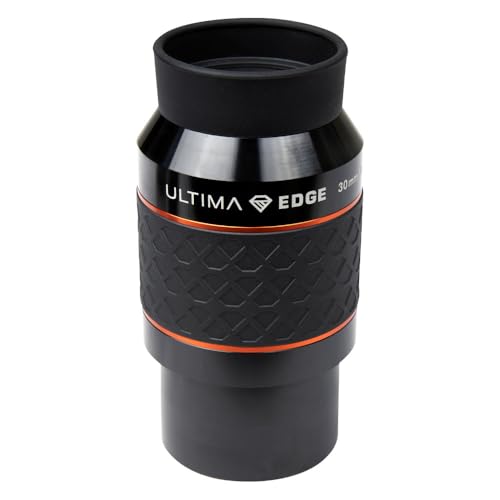
- A 12V power tank — The mount devours AA batteries in 2–3 hours. A rechargeable power pack is essential for sessions longer than a quick peek. The Celestron PowerTank Lithium is a popular choice.
- A 5–6mm eyepiece — Pushes magnification to 108–130x without the Barlow, giving cleaner views for planetary detail. A 6mm "goldline" costs ~$25 and is a dramatic upgrade. See our 10mm vs 25mm eyepiece comparison for context on eyepiece selection.
- A collimation tool — A laser collimator or Cheshire eyepiece makes the regular collimation this scope needs fast and painless.
- A light pollution filter — An OIII or UHC filter significantly improves nebula contrast from suburban skies.
Can You Use the Explorer 130P for Astrophotography?
The Explorer 130P is capable of basic astrophotography — planetary, lunar, and short-exposure deep-sky — but the alt-azimuth mount limits what you can achieve.
Lunar and planetary imaging — Good
The M42 thread on the included Barlow lens accepts a T-ring, letting you attach a DSLR directly. A planetary camera (like the Celestron NexImage or ZWO ASI224MC) plugs into the focuser for video-based lucky imaging. The GoTo tracking keeps the target centered while you capture frames. The 130P's fast f/5 ratio delivers a bright image, and 650mm of focal length gives a reasonable image scale for Jupiter and Saturn.
For tips on technique, see our how to photograph the Moon guide and our astrophotography with telescope overview.
Deep-sky imaging — Limited
The alt-azimuth mount causes field rotation during long exposures — stars at the edge of the frame trail in arcs rather than straight lines. This limits individual exposures to roughly 15–30 seconds depending on where in the sky you're pointing. You can stack many short exposures to build up signal, but you'll never match what an equatorial mount with proper tracking delivers.
EAA (Electronically Assisted Astronomy) — live-stacking with a sensitive camera to build up a real-time image on a screen — works reasonably well with this telescope and mount combination. It's a middle ground between visual observation and full astrophotography.
For serious deep-sky astrophotography, you need an equatorial mount. See our budget DSLR astrophotography setup guide for dedicated imaging configurations.
Explorer 130P vs Celestron 130SLT vs Heritage 130P FlexTube
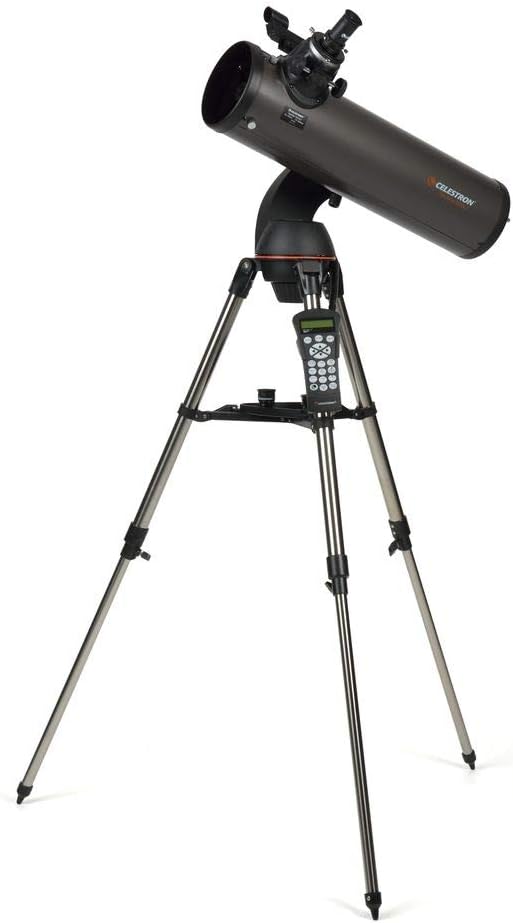
These are the three telescopes most buyers cross-shop. All have 130mm aperture, but they differ significantly in mount type, features, and price.
| Feature | SW Explorer 130P GoTo | Celestron NexStar 130SLT | SW Heritage 130P FlexTube |
|---|---|---|---|
| Optical Design | Parabolic Newtonian | Newtonian (spherical mirror) | Parabolic Newtonian |
| Aperture | 130mm f/5 | 130mm f/5 | 130mm f/5 |
| Focal Length | 650mm | 650mm | 650mm |
| Mirror Type | Parabolic | Spherical (less sharp) | Parabolic |
| Mount | Alt-az GoTo (motorized) | Alt-az GoTo (motorized) | Manual tabletop Dobsonian |
| GoTo Database | 42,900+ objects | 40,000+ objects | None (manual) |
| Control | Handset or WiFi app | NexStar+ handset | Manual push-to |
| Focuser | 2" with 1.25" adapter | 1.25" only | 1.25" only |
| Included Eyepieces | 25mm + 10mm + 2x Barlow | 25mm + 9mm | 25mm + 10mm |
| Tripod | Stainless steel | Aluminum | Tabletop (no tripod) |
| Collapsible Tube | No | No | Yes (FlexTube) |
| Weight (total) | ~15 kg | ~13 kg | ~5.8 kg (OTA only) |
| Approx. Price | £350–400 / $450–550 | ~$400–450 | ~£170 / $200 |
The verdict:
The Explorer 130P GoTo is the best all-round option for buyers who want GoTo convenience with sharp optics. The parabolic mirror is a genuine advantage over the Celestron 130SLT's spherical mirror — at f/5, the difference is visible as crisper star images at the field edges. The 2" focuser and stainless steel tripod are also superior to the 130SLT's spec.
The Celestron 130SLT is the more established name in the US market and has broader accessory compatibility within the Celestron ecosystem, but the spherical mirror is a real optical compromise at f/5.
The Heritage 130P FlexTube is the value champion — half the price, identical optics to the Explorer 130P (parabolic mirror), and ultra-portable. The trade-off is no GoTo, no tracking, and it needs a table or surface to sit on. If you don't need GoTo and want maximum optics per dollar, the Heritage is hard to beat. See our guide on what you can see with a 130mm telescope for aperture-specific expectations.
For broader brand comparisons, see Celestron vs Sky-Watcher.
Pros and Cons of the Sky-Watcher Explorer 130P
What we like
- Parabolic mirror at this price is the standout feature. Most competing 130mm GoTo telescopes use spherical mirrors.
- 2-inch focuser opens up the option for wide-field 2" eyepieces — rare on budget telescopes and excellent for deep-sky.
- Stainless steel tripod is noticeably sturdier than the aluminum tripods on the Celestron 130SLT and similar scopes. Vibrations dampen faster.
- Complete accessory package — two eyepieces, a 2x Barlow, a 6×30 finderscope, and an M42 camera adapter built into the Barlow.
- SynScan app (WiFi version) is smooth, intuitive, and crash-free. The "Tonight's Best" feature is genuinely useful for beginners who don't know what to look for.
- Wide field of view at f/5 — over 2° with the 25mm eyepiece makes sweeping the Milky Way and framing large objects satisfying.
What we don't like
- Collimation is required frequently. As a fast Newtonian, the mirrors shift during transport. You'll need to check and adjust collimation before each session, especially if you drive to a dark site. This is not difficult once learned (5 minutes with a laser collimator), but it adds a maintenance step that GoTo Schmidt-Cassegrains and refractors don't require. See our collimation tools guide.
- Battery consumption is high. The mount drains 8× AA batteries in 2–3 hours. A 12V power tank is effectively a mandatory purchase — budget an extra £30–50 / $30–50.
- No hand controller on the AZ Go-2 WiFi version. You must use a smartphone. If your phone battery dies mid-session or the app crashes, you lose mount control. The older handset version avoids this but lacks WiFi convenience.
- The alt-az mount limits astrophotography. Field rotation prevents exposures beyond ~15–30 seconds for deep-sky. No equatorial wedge option exists for this mount, unlike the Celestron NexStar SE line.
- Open tube design means dust settles on the primary mirror over time, and dew can form on the secondary mirror. A light shroud or dew shield helps.
- Focuser is functional but basic. The rack-and-pinion mechanism works but lacks the smoothness of a Crayford focuser. Fine focusing at high magnification requires patience.
How Much Does the Sky-Watcher Explorer 130P Cost?
The Explorer 130P SynScan AZ GoTo typically sells for approximately £350–400 in the UK and $450–550 in the US, depending on retailer and which mount version (handset vs WiFi) you get. The WiFi AZ Go-2 version tends to be slightly more expensive.
At this price, it competes directly with the Celestron NexStar 130SLT (~$400–450) and sits well below the Celestron NexStar 5SE (~$939) and 6SE (~$1,099). For the money, you get more aperture than the 5SE (130mm vs 125mm), a wider field of view (f/5 vs f/10), and a comparable GoTo system — though the SE series' Schmidt-Cassegrain design is more compact, requires less maintenance, and is better suited to high-magnification planetary work.
For budget options below this price, see our best budget telescopes and best telescopes under $300 roundups. For the full range of Sky-Watcher's lineup, see our brand comparison.
Is the Explorer 130P Worth Buying?
Yes — the Sky-Watcher Explorer 130P SynScan AZ GoTo is one of the best value GoTo telescopes available for under £400 / $550. The combination of a parabolic mirror, a 2-inch focuser, a GoTo mount with WiFi app control, and a complete accessory package is difficult to match at this price.
Buy the Explorer 130P if:
- You want GoTo convenience without spending over $600
- You value wide-field deep-sky views (the f/5 ratio excels here)
- You want sharp optics — the parabolic mirror matters at f/5
- You prefer smartphone-based telescope control (WiFi version)
- You're a beginner who wants a scope to grow into for 2–3 years
Consider alternatives if:
- You want the most compact GoTo telescope — a Schmidt-Cassegrain like the NexStar 5SE is smaller and maintenance-free
- Deep-sky astrophotography is a primary goal — you need an equatorial mount
- You don't care about GoTo — the Heritage 130P FlexTube delivers identical optics for half the price
- Collimation is a dealbreaker — refractors and SCTs rarely need it
For beginners choosing their first telescope, our best telescopes for beginners guide covers all categories. See also our best telescopes with automatic tracking list for GoTo-specific options.
Frequently Asked Questions
Is the Sky-Watcher Explorer 130P good for beginners?
Yes. The SynScan GoTo system eliminates the steepest part of the learning curve — finding objects in the sky. The included eyepieces and Barlow lens cover a useful range of magnifications, and the SynScan app's "Tonight's Best" feature suggests interesting targets based on your location and time. The main learning tasks are collimation (straightforward with a laser collimator) and star alignment (5 minutes once familiar). For context, see our guide on whether computerized telescopes are good for beginners.
How often does the Explorer 130P need collimation?
Check collimation before every session, especially after transporting the telescope. At f/5, even slight mirror misalignment degrades image quality noticeably. The process takes 5 minutes with a laser collimator or Cheshire eyepiece. It is a skill every Newtonian owner learns quickly.
Can I use the Explorer 130P for astrophotography?
Yes, for lunar and planetary imaging. The M42 thread on the included Barlow lens lets you connect a DSLR via a T-ring. A dedicated planetary camera also plugs into the focuser for video-based imaging. Deep-sky astrophotography is limited by the alt-azimuth mount's field rotation — individual exposures beyond 15–30 seconds show star trails.
What is the difference between the SynScan handset and AZ Go-2 WiFi version?
The SynScan handset version uses a wired controller with a physical keypad and LCD. The AZ Go-2 WiFi version replaces the handset with a built-in WiFi module — you control the telescope via the free SynScan Pro app on your smartphone. The WiFi version is more intuitive but depends on your phone; the handset version is self-contained.
How does the Explorer 130P compare to the Celestron NexStar 130SLT?
The Explorer 130P has a parabolic mirror (sharper images) vs. the 130SLT's spherical mirror, a 2-inch focuser vs. 1.25-inch, and stainless steel tripod legs vs. aluminum. The 130SLT offers broader US retail availability and Celestron's accessory ecosystem. Optically, the Explorer 130P is the superior telescope.
What can you see with the Sky-Watcher Explorer 130P?
The Moon in sharp detail (craters, rilles, mountain ranges), Jupiter's cloud bands and moons, Saturn's rings and Cassini Division, Mars' polar caps at opposition, bright nebulae (Orion, Dumbbell, Ring), star clusters (Pleiades, Double Cluster, M13), and nearby galaxies (Andromeda, Bode's). Fainter galaxies appear as fuzzy patches. See our 130mm telescope viewing guide for detailed expectations.
Does the Explorer 130P work with planetarium software?
Yes. Both the handset and WiFi versions are compatible with third-party planetarium software including Stellarium, SkySafari, and Cartes du Ciel. The WiFi version connects via the SynScan app, which can interface with compatible software. The handset version connects via a serial-to-USB adapter.
How long do the batteries last?
Eight AA batteries power the GoTo mount for approximately 2–3 hours of active use. The motors consume significant power during slewing and tracking. A 12V rechargeable power tank or AC adapter is strongly recommended for anything beyond a quick session.
Is the Explorer 130P portable?
Reasonably. The telescope, mount, and tripod weigh approximately 15 kg (33 lbs) total and disassemble into three manageable pieces. It fits in a car easily. It is not backpack-portable like the Heritage 130P FlexTube, but it's lighter than most 6-inch or 8-inch setups. See our best travel telescopes for more portable options.
What is the best upgrade for the Explorer 130P?
A 12V power supply (most impactful for usability) and a 5–6mm wide-angle eyepiece (most impactful for planetary views). After that, a UHC or OIII filter for nebulae, and a laser collimator for faster collimation.
Want to go deeper? Our Stargazing Secrets course covers everything from your first night out to advanced observation techniques — $19 with a 30-day money-back guarantee.
Explore our free course sampler and browse the latest guides on TelescopeGuides.
Related Articles
- Sky-Watcher Explorer 130m Review
- Are GoTo Telescopes Worth It? (Real Experience)
- Sky-Watcher 150P Telescopes Review
- Celestron vs Sky-Watcher Telescopes
- What Can You See with a 130mm Telescope?
- Best Computerized Telescopes
- Best Telescopes with Automatic Tracking
- Best Telescopes for Beginners
- Dobsonian vs Newtonian Telescopes
- Budget DSLR Astrophotography Setup Guide