The Sky-Watcher Explorer 130M is a 130mm parabolic Newtonian reflector on a motorized EQ2 equatorial mount for approximately $300–350. The "M" stands for motorized — a single-axis motor drive tracks objects automatically by compensating for Earth's rotation, keeping targets centered in the eyepiece without manual adjustment. At this price, a motorized equatorial mount with a quality 130mm optic is genuinely uncommon.
The 130mm aperture gathers enough light for detailed views of Jupiter's cloud belts, Saturn's rings, the Moon's craters, and dozens of bright deep-sky objects. The parabolic primary mirror produces sharper images than the spherical mirrors found in cheaper reflectors. And the motor-driven EQ mount adds tracking capability that transforms the observing experience — especially at higher magnifications where untracked objects drift out of the field in seconds.
The tradeoffs: the telescope is bulky (12.6 kg total), the EQ mount has a learning curve, and collimation is required. Here's the complete picture.
Explorer 130M at a Glance
| Specification | Details |
|---|---|
| Optical design | Parabolic Newtonian reflector |
| Aperture | 130mm (5.1 inches) |
| Focal length | 900mm |
| Focal ratio | f/6.9 |
| Mount | EQ2 German equatorial with single-axis motor drive |
| Limiting magnitude | ~12.4 |
| Resolving power | 0.88 arc seconds |
| Max useful magnification | ~260× (practical sweet spot: 100–180×) |
| Included eyepieces | 25mm (36×) and 10mm (90×) Kellner |
| Barlow | 2× included |
| Finder | 6×24 red dot |
| Tube weight | 3.4 kg (7.5 lbs) |
| Total weight | 12.6 kg (27.8 lbs) |
| Secondary obstruction | 46mm |
What Sets the Explorer 130M Apart: The Motor Drive
Most telescopes under $350 come on manual mounts — either alt-azimuth (push up/down, left/right) or basic equatorial without motors. The Explorer 130M includes a single-axis motor drive on the Right Ascension axis that automatically rotates the mount to match Earth's rotation.
Why this matters: Without tracking, objects at high magnification drift out of the eyepiece field in roughly 30 seconds. You constantly nudge the scope to re-center your target. With the motor drive engaged (after a rough polar alignment), objects stay centered indefinitely. This means:
- Extended observation of planetary detail without interruption
- Easier sharing — the object stays in the eyepiece between observers
- Basic astrophotography becomes possible (short exposures of the Moon and planets)
- Less frustration at higher magnifications
The motor runs on a 9V battery (not included) and attaches to the RA slow-motion gear. It's a simple, reliable system. The tracking isn't precision-grade (you won't do deep-sky astrophotography with it), but for visual observing it's a genuine quality-of-life upgrade over a manual mount.
To understand how equatorial mounts differ from alt-azimuth designs and why tracking matters, see our alt-azimuth vs. equatorial mount guide.
What Can You See with the Explorer 130M?
130mm of aperture is the threshold where astronomy starts getting genuinely rewarding. The Explorer 130M gathers 30% more light than 114mm scopes and reaches a limiting magnitude of ~12.4, putting thousands of objects within visual range.
Moon
The Moon is spectacular through the 130M. At 90× (the 10mm eyepiece), crater walls cast sharp shadows, the Apennine mountain range shows individual peaks, and rilles are visible along the terminator. Bump to 180× with the Barlow and you're exploring individual craterlets on the floors of larger impacts. The motor drive keeps the Moon centered while you study it — no re-centering every 30 seconds.
Planets
Jupiter: Two to three cloud belts clearly separated, the Great Red Spot visible on good seeing nights at 150–180×, all four Galilean moons showing as distinct points. The motor tracking is particularly valuable here — Jupiter rewards patient observation, and not having to nudge the scope lets you wait for the brief moments when the atmosphere steadies and detail snaps into focus.
Saturn: Rings clearly separated from the disc, Cassini Division visible during excellent seeing, Titan easily spotted nearby. The shadow of the globe on the rings is a subtle but beautiful detail visible at 150×+.
Mars: During opposition, a small orange disc with dark surface markings and the polar ice cap at 150–180×.
For tips on maximizing planetary views, see our planets through a telescope guide.
Deep-Sky Objects
The 130mm aperture and f/6.9 focal ratio deliver a decent balance between magnification and field of view for deep-sky observing.
What you'll see well: M42 (Orion Nebula) with visible nebulosity, the Trapezium star cluster resolved, and hints of the wings. M31 (Andromeda Galaxy) as a bright, extended glow with the companion galaxy M32 visible nearby. M13 (Hercules Cluster) as a grainy ball beginning to resolve into individual stars at 150×. The Double Cluster as a rich field of stars. Open clusters like M35 and M37 are beautiful. Bright planetary nebulae like M57 (Ring Nebula) are identifiable as a small, distinct ring.
What will be faint or challenging: Fainter galaxies appear as small, indistinct smudges. Extended nebulae like the Veil Nebula need an OIII filter and dark skies. You won't see spiral arms in galaxies at this aperture — that requires 8 inches or more.
For a broader overview of what different apertures reveal, see what you can see through a telescope.
Optics: Parabolic Mirror Advantage
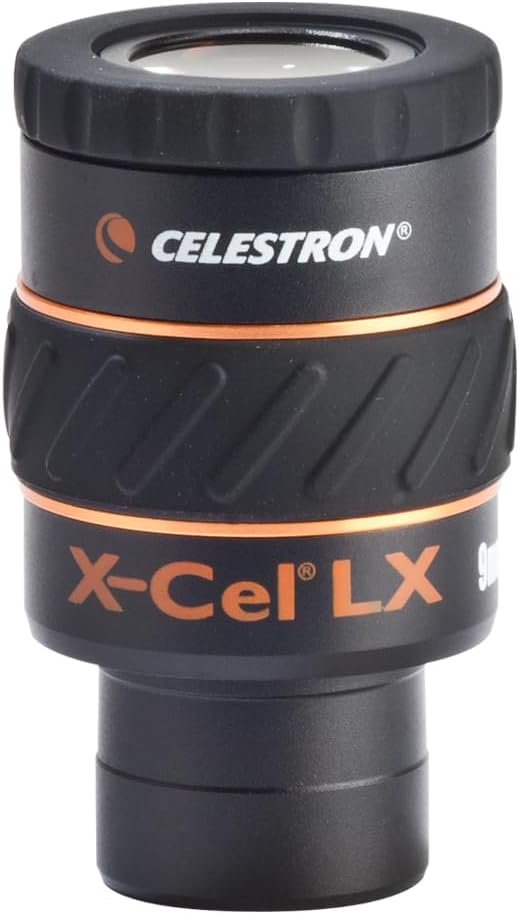
A strong first upgrade over the included 10mm Kellner for sharper, wider high-power views.
Check price on AmazonThe Explorer 130M uses a parabolic primary mirror — not a spherical one. This is an important distinction. Parabolic mirrors focus all incoming light to a single point, producing sharp star images across the field. Spherical mirrors (used in cheaper telescopes like the AstroMaster 114EQ's Bird-Jones design) suffer from spherical aberration that softens the image.
The mirror coatings deliver 94% reflectivity (aluminum + quartz overcoat), the same spec used across Sky-Watcher's higher-end models. The 46mm secondary mirror obstruction is moderate — it slightly reduces contrast on planetary views but is standard for this aperture class.
The telescope ships with a 2× Barlow lens and two Kellner eyepieces (25mm and 10mm), giving four magnification options: 36×, 72×, 90×, and 180×. The eyepieces are functional but not premium — upgrading the 10mm to a wider-angle design (like the Goldline 66° or Celestron X-Cel LX 9mm) makes a noticeable difference. See our eyepiece sizing guide for specific recommendations.
Setup and Collimation
Setup
Assembly takes 20–30 minutes the first time. Extend the tripod, attach the equatorial mount head, install the counterweight bar and counterweight, mount the tube on the dovetail, and attach the finderscope and eyepiece.
The equatorial mount requires polar alignment — point the polar axis roughly at Polaris. For visual observing, a rough alignment (within a few degrees) is sufficient for the motor drive to track accurately. Exact alignment only matters for long-exposure astrophotography, which the EQ2 mount isn't really designed for.
The biggest setup challenge is the weight. At 12.6 kg total and a tube over 900mm long, this isn't a grab-and-go telescope. It's best suited for a backyard or patio setup where you can leave the mount assembled and just drop the tube on when you want to observe. If you need portability, the Heritage 130P tabletop Dobsonian is a lighter alternative.
Collimation
Like all Newtonian reflectors, the Explorer 130M needs periodic collimation (mirror alignment). Check alignment before each session by looking down the focuser tube — if the reflections of the mirrors aren't concentric, adjustment is needed. A collimation cap or laser collimator (~$25–35) makes this a 5–10 minute process. The telescope may arrive well-collimated from the factory, but transport will shift the mirrors. Budget for a collimation tool.
Pros
Motorized Equatorial Mount at Budget Price
This is the Explorer 130M's defining advantage. A motorized EQ mount at ~$300 is extremely rare. The tracking capability transforms observing at 100×+ magnification from a constant chase to a relaxed experience. It also opens the door to basic lunar and planetary photography.
Parabolic Mirror, Not Spherical
The parabolic primary mirror produces sharper, more contrasty images than the spherical mirrors found in cheaper reflectors. This is a genuine optical quality advantage over telescopes like the AstroMaster 114EQ at a similar price.
130mm Aperture at f/6.9
A versatile balance — enough focal length (900mm) for useful planetary magnification, and a fast enough focal ratio for decent wide-field deep-sky views. The 130mm aperture gathers meaningfully more light than 114mm and 100mm alternatives, showing more detail on every target.
Good Value Accessory Package
Two eyepieces, a 2× Barlow (effectively giving four magnification levels), a finder, counterweight, equatorial mount with motor drive, and a sturdy aluminum tripod — all included for ~$300. You can start observing out of the box without purchasing anything extra.
Cons
Size and Weight
At 12.6 kg total with a tube over 900mm long, the Explorer 130M is not portable. Setting up and tearing down for each session gets tiring. This is a backyard telescope, not a travel telescope. If you need to transport a scope to dark-sky sites regularly, consider the Heritage 130P (same aperture, tabletop form factor, no EQ mount) or the Explorer 130P SynScan (GoTo alt-az mount, more portable).
EQ Mount Learning Curve
Equatorial mounts are more complex than alt-azimuth mounts. The counterweight system, polar alignment, and slow-motion cables take time to learn. Beginners may spend their first few sessions figuring out the mount rather than observing. This is a real consideration if the telescope is for a younger user — an alt-azimuth mounted scope is more intuitive.
EQ2 Mount Is Light-Duty
The EQ2 is adequate for visual use with the 130mm tube, but it's at its payload limit. Adding heavy accessories (a DSLR camera, a large eyepiece) can cause the mount to flex or drift. In wind, the tube shakes and takes 3–5 seconds to settle. The mount handles casual observation well but won't support serious astrophotography beyond short-exposure planetary imaging.
Red Dot Finder Is Basic
The included 6×24 finder is functional but underwhelming. It doesn't show stars fainter than naked-eye visibility, making it harder to locate deep-sky objects. Upgrading to a proper 6×30 or 9×50 optical finderscope ($25–40) is one of the best improvements you can make.
Collimation Required
Standard for all Newtonian reflectors — the mirrors need periodic alignment, especially after transport. Not difficult once you've learned it, but it adds a step that sealed refractors and Maksutov-Cassegrains don't require.
Explorer 130M vs. Alternatives
Explorer 130M vs. Celestron AstroMaster 130EQ
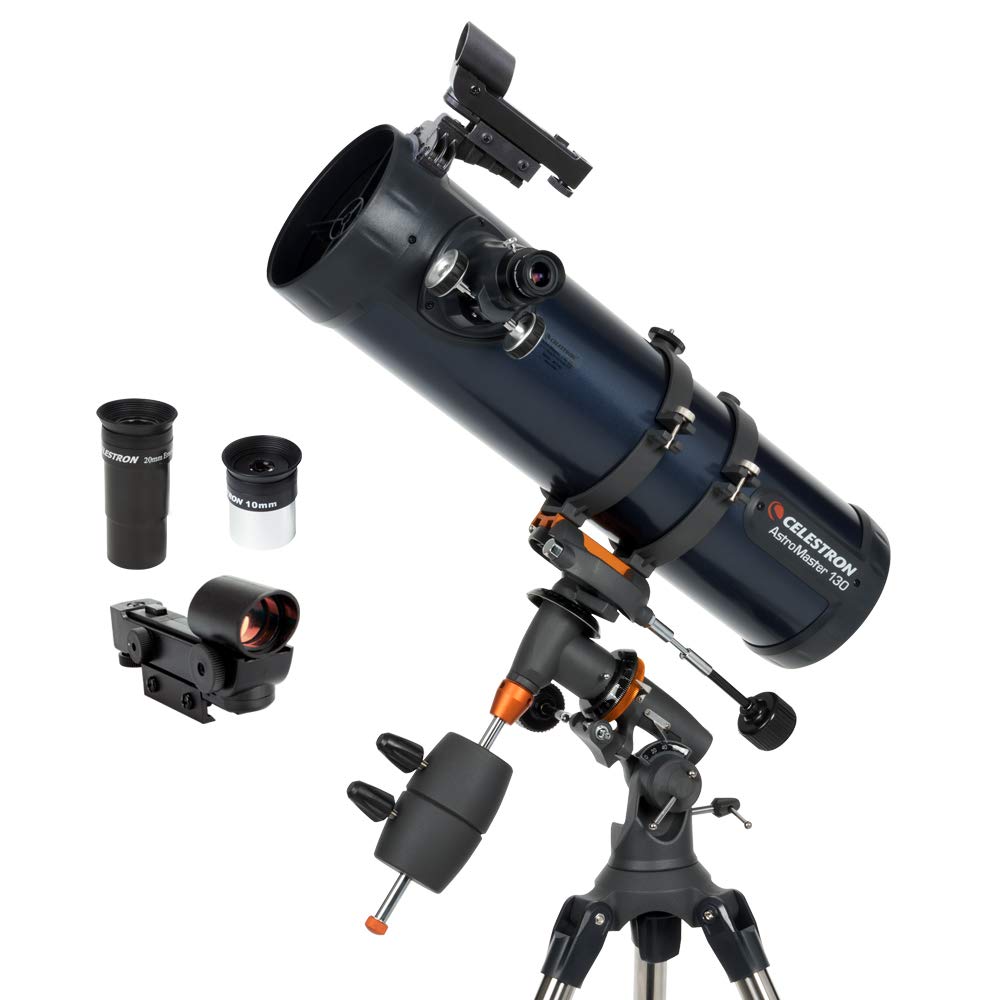
Similar 130mm Newtonian concept on a manual equatorial mount; choose it only if you do not need motorized tracking.
Check price on AmazonThe AstroMaster 130EQ is the closest competitor — same 130mm parabolic aperture on a similar equatorial mount, at a similar price. The key difference: the Explorer 130M includes a motor drive; the AstroMaster 130EQ is manual. Choose the Explorer 130M if motorized tracking matters to you. Choose the AstroMaster 130EQ if you don't need tracking and prefer Celestron's ecosystem (StarSense app compatibility, wider accessory selection).
Explorer 130M vs. Sky-Watcher Heritage 130P
The Heritage 130P has the same 130mm parabolic aperture in a compact tabletop Dobsonian package — collapsible tube, no counterweights, no EQ learning curve. It weighs about half as much and costs $50–100 less. But it has no tracking at all. Choose the Explorer 130M if you value the motorized EQ mount and don't mind the weight. Choose the Heritage 130P if portability and simplicity matter more than tracking.
Explorer 130M vs. Explorer 130P SynScan AZ GoTo
The Explorer 130P SynScan is the same 130mm optics on a fully computerized GoTo alt-azimuth mount. It costs $100–200 more but finds and tracks objects automatically from a 40,000+ database. It's also more portable than the EQ2-mounted 130M. Choose the 130M if you want an equatorial mount on a strict budget. Choose the 130P SynScan if GoTo automation and a smaller form factor justify the extra cost.
Explorer 130M vs. Sky-Watcher 6-Inch Dobsonian
The 6-inch Dobsonian has a 150mm aperture — 33% more light-gathering area — on a simple manual Dobsonian mount. It costs roughly the same as the Explorer 130M. The bigger aperture shows more detail on every target. But there's no tracking, no equatorial capability, and it's even heavier. Choose the 130M if you specifically want motorized EQ tracking. Choose the 6-inch Dob if you want the most aperture per dollar for visual observing.
For the full Sky-Watcher lineup, see our complete Sky-Watcher telescope breakdown.
Frequently Asked Questions
Is the Sky-Watcher Explorer 130M good for beginners?
Yes, with the caveat that the equatorial mount has a learning curve. The motor drive actually makes it more beginner-friendly than a manual EQ mount — once aligned, tracking is automatic. If the EQ mount seems daunting, the Heritage 130P offers the same optics on a simpler Dobsonian mount. For a full beginner comparison, see our best telescopes for beginners ranking.
Can I do astrophotography with the Explorer 130M?
Basic lunar and planetary photography works well — the motor drive tracks objects during short exposures, and you can attach a phone or planetary camera to the eyepiece. Deep-sky astrophotography (galaxies, nebulae) is not practical — the EQ2 mount doesn't have the precision, payload capacity, or autoguider port needed for multi-minute exposures. For a beginner astrophotography path, see our DSLR astrophotography guide.
Does the Explorer 130M need collimation?
Yes, periodically. The parabolic mirror needs alignment, especially after transport. A collimation cap or laser collimator (~$25–35) makes this a quick process. Check before each session — it takes 30 seconds to verify and 5–10 minutes to adjust if needed.
What's the difference between the Explorer 130M and the Explorer 130P?
The 130M has a 900mm focal length on an EQ2 motorized equatorial mount. The Explorer 130P SynScan has a 650mm focal length (shorter tube, wider field) on a computerized GoTo alt-azimuth mount. The 130P is more portable and has automated object finding. The 130M has a longer focal length (better for planetary magnification) and an equatorial mount (better for tracking accuracy). Different tools for different priorities.
What eyepieces should I upgrade to?
The included Kellner eyepieces are functional but narrow-field. A quality 10mm wide-angle eyepiece (Goldline 66° or Celestron X-Cel LX 9mm, $25–50) is the most impactful single upgrade. A 32mm Plössl ($30) gives you a wider low-power field for deep-sky sweeping. See our eyepiece guide for full recommendations.
How does the motor drive work?
The motor attaches to the Right Ascension axis and rotates the mount at sidereal rate (one revolution per 23 hours 56 minutes) to compensate for Earth's rotation. It runs on a 9V battery (not included). After rough polar alignment (point the mount at Polaris), engage the motor and objects stay centered in the eyepiece. No hand controller, no computer, no alignment procedure — just a switch.
Is the Explorer 130M worth it at ~$300?
Yes, if you value motorized tracking and an equatorial mount at this price. No other 130mm telescope under $350 includes a motor drive. The parabolic optics, included Barlow, and accessory bundle add genuine value. The main compromise is bulk — if you need portability, the Heritage 130P or Explorer 130P SynScan are better fits.
Verdict: Should You Buy the Explorer 130M?
The Sky-Watcher Explorer 130M is the best value motorized equatorial telescope under $350. No competitor matches its combination of 130mm parabolic optics, a motor-driven EQ mount, and a complete accessory bundle at this price. The motorized tracking transforms the observing experience at higher magnifications and opens the door to basic astrophotography.
Buy the Explorer 130M if you:
- Want motorized tracking without spending $500+ on a GoTo system
- Plan to observe from a fixed location (backyard, patio, balcony)
- Want a telescope that handles both planetary and deep-sky observation
- Are comfortable learning an equatorial mount (or willing to invest the time)
Consider something else if you:
- Need portability → Heritage 130P (same optics, tabletop Dobsonian, half the weight)
- Want automated GoTo object finding → Explorer 130P SynScan ($100–200 more)
- Want the most aperture per dollar → Sky-Watcher 6-inch Dobsonian (bigger mirror, same price, no tracking)
- Find the EQ mount intimidating → any alt-azimuth mounted telescope will be more intuitive
The Explorer 130M does something genuinely unusual for its price: it gives you a real equatorial mount with real motor tracking, paired with optics good enough to make that tracking worthwhile. For the budget-conscious observer who wants tracking but not GoTo complexity, it's the sweet spot.
Explore more Sky-Watcher reviews:
- Sky-Watcher Telescopes: Complete Model Breakdown
- Sky-Watcher Explorer 130P SynScan Review
- Sky-Watcher Heritage 130P Review
- Sky-Watcher 200P Dobsonian Review
- Sky-Watcher Skymax 127 Review
- Sky-Watcher 6-Inch Dobsonian Review
New to stargazing? Our Stargazing 101 guide covers everything from your first night out to building an observation log.